C.F. Martin Guitars Made for Charles Ditson
& Co.
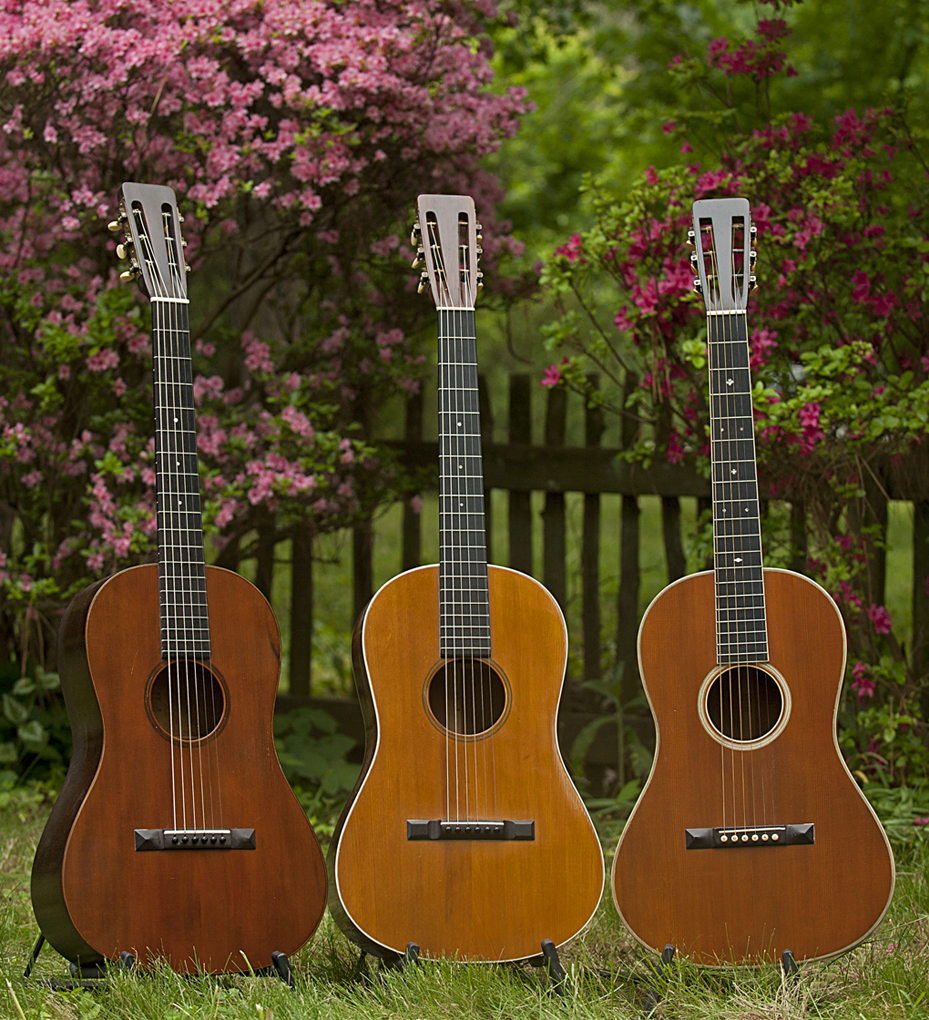
Martins made Ditson 1921 Style 11 #565, 1916 Style 22 #160, and 1920 Style 33 #557.
Oliver Ditson (b. October 20, 1811), a major music publisher, born in Boston, Massachusetts to Scottish parents, entered the musical instrument business in 1867, when he acquired a stock of musical instruments from Firth, Son & Company (seller of Ashborn guitars) a few years after the death of John Firth, and opened a new store to sell the instruments. This offshoot of the Boston Oliver Ditson Company was called the John C. Haynes Co., as it was managed by John Haynes (1829-1907), who Ditson had already taken on as a junior partner. Soon Haynes started producing Tilton guitars under license in the shop of Swedish luthier Pehr A. Anderberg. Haynes eventually bought out Anderberg's shop, and then grew into a major builder of guitars, including Bay State and many other brands, with a factory of 25 men.
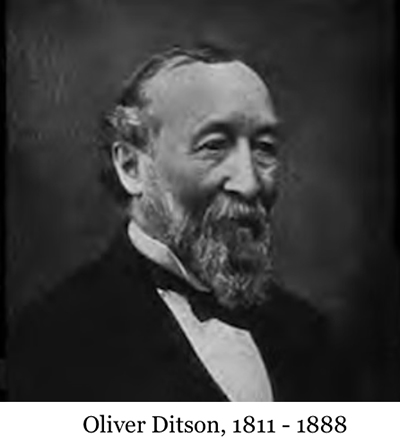
Upon the death of Oliver Ditson on December 21, 1888, John Haynes became the President of the Oliver Ditson Company until he retired in 1903 and Oliver's son Charles Healy Ditson became President. In 1907, Bay State was sold to the Vega Banjo Company.
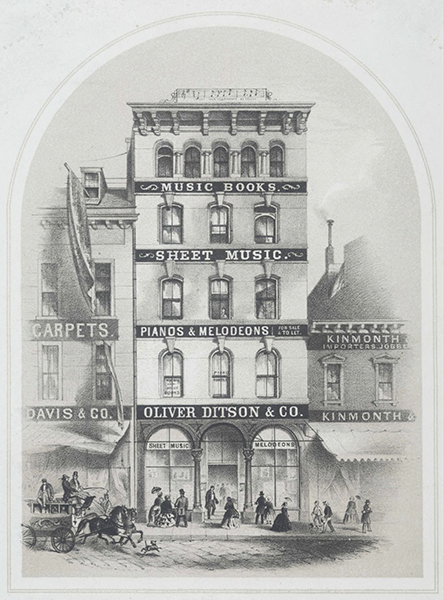
More importantly, Oliver's son Charles Healy Ditson (b. August 11, 1845) opened a store in New York in 1867. Martin guitars and mandolins were not just "shipped" to the Charles Ditson Store. While Oliver Ditson in Boston was both a retailer and a jobber, who sold Martin guitars to many other stores, the uniquely styled Ditson instruments were ordered by the New York store, and the Boston store buyer had little interest or even knowledge of these instruments. They were happy to sell standard Martin instruments. It was Small Goods Manager Harry Lawrence Hunt who was responsible for ordering these unique instruments from the Martin Company,. Martin built guitars and mandolins for the Charles Ditson Store until a few years after Charles Healy Ditson's death on May 14, 1929, when the store was closed. Shortly before the store's closing, Harry Hunt left to open the Lyon and Healy Harp Salon in Steinway Hall. It should be noted that Lyon and Healy gained it's foothold as Oliver Ditson gave financial backing to George Washburn Lyon and Patrick J. Healy to open a small store in Chicago as an outlet for Oliver Ditson's sheet music. Lyon and Healy grew to be a large company as representatives of Steinway Pianos.
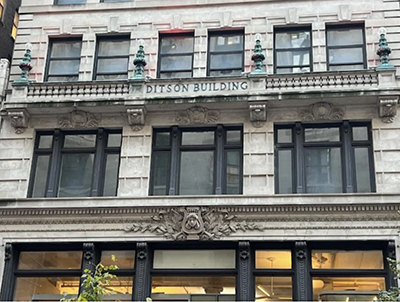
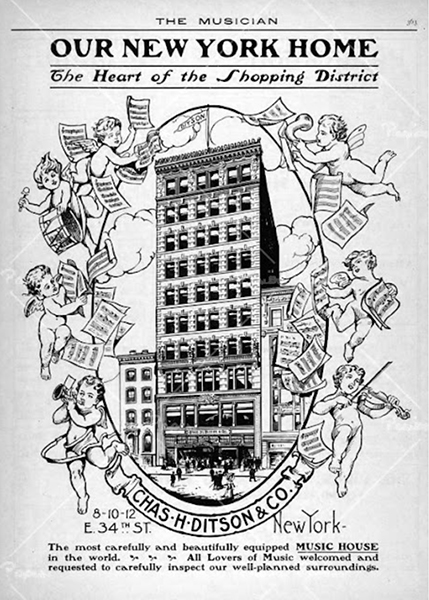
Charles Ditson built this 10 story building on E. 34th Street between 5th Avenue and Madison in 1907 to replace his space in a building on 867 Broadway at 18th Street which had caught fire.
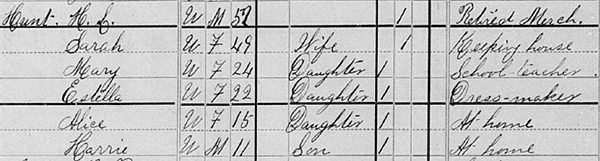
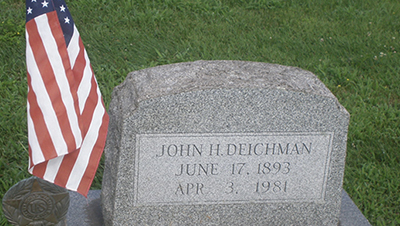
Harry L. Hunt was one of the most influential individuals in the history of the Martin Guitar. The Martin Dreadanught guitar was essentially a collaboration between Harry L. Hunt, who conceived of the guitars, and John Deichmann (June 17, 1893 - April 3, 1981), the Martin guitars Factory Foreman who created the actual guitars.
Harry was born in Cottonwood Falls, Kansas on November 22, 1872, and died in New York on September 15, 1956 at age 88.
Harry L. Hunt worked at the Ditson Company from 1895 to 1930, and in addition to being Musical Instrument Manager, he was also Secretary of the company and wrote their advertising copy.
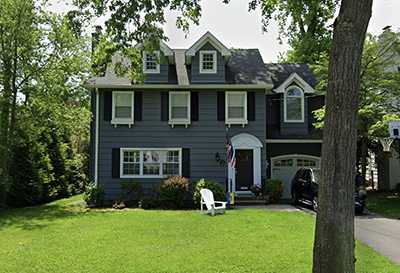
While working for Ditson, Harry lived in an apartment in Newark, New Jersey, first as a boarder, and then renting an apartment three doors down with his wife Louise Hall Reynolds Hunt.
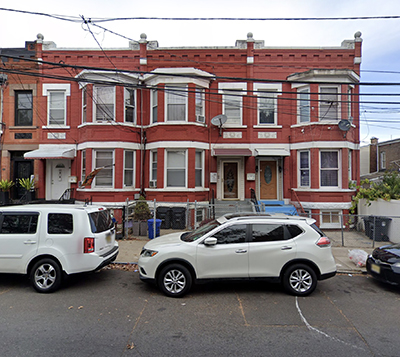
...while Charles Ditson had built a five story Manhattan townhouse on 37th Street off Madison Avenue in 1905, and then built the new 10 story store a three block walk away.
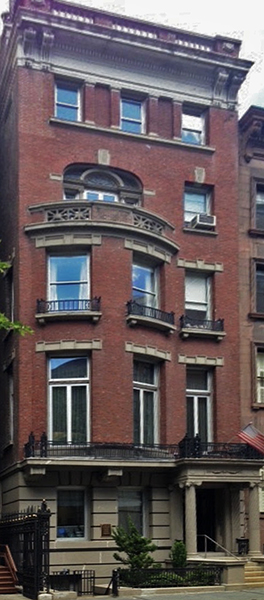
When working for Lyon and Healy, the Hunts lived in a nice 4 bedroom house in Short Hills, Morris County, New Jersey.
...and Harry Hunt had a sense of humor and flair. Most of the correspondence of the time was extremely proper and formal. When Ditson received a surprisingly small number of pamphlets to give to customers, Harry thanked Martin for the "homeopathic dose" of pamphlets.
Harry Hunt at age 11.
John Deichman
Martin's "Ditson Model" guitars, with their wide waisted body shapes reminiscent of early European guitars, were made expressly for the Ditson Stores and came in three sizes, Standard, Concert, and Extra Large.
The Standard Model has a width at the lower bout of 11 1/8"
The Concert Model has a width at the lower bout of 12 3/4"
The Extra Large Model has a width at the lower bout of 15 5/8"
The Extra Large model, requested by Harry Hunt of the Ditson Company, and designed with the help of Martin shop foreman John Deichmann, became known as "the Dreadnaught", and was the first Dreadnaught guitar ever made.
The Ditson Models had their own model designations, and unlike other Martins, their trim level was designated as 1, 2, or 3, but their size was designated by the number of digits, i.e. 1, 11 or 111.
All of these regular Ditson Models were made with a spruce top and mahogany back and sides.
Some Ditson Model guitars have either lighter orange tinted tops or dark stained tops. In some years the stained top was an option.
While fan bracing is generally associated with lighter guitars made for gut or nylon strings, the Ditson models have the same style of fan bracing as seen on the koa wood guitars made for the Southern California Music Company, which were originally made to be played with heavier steel strings in the Hawaiian style.
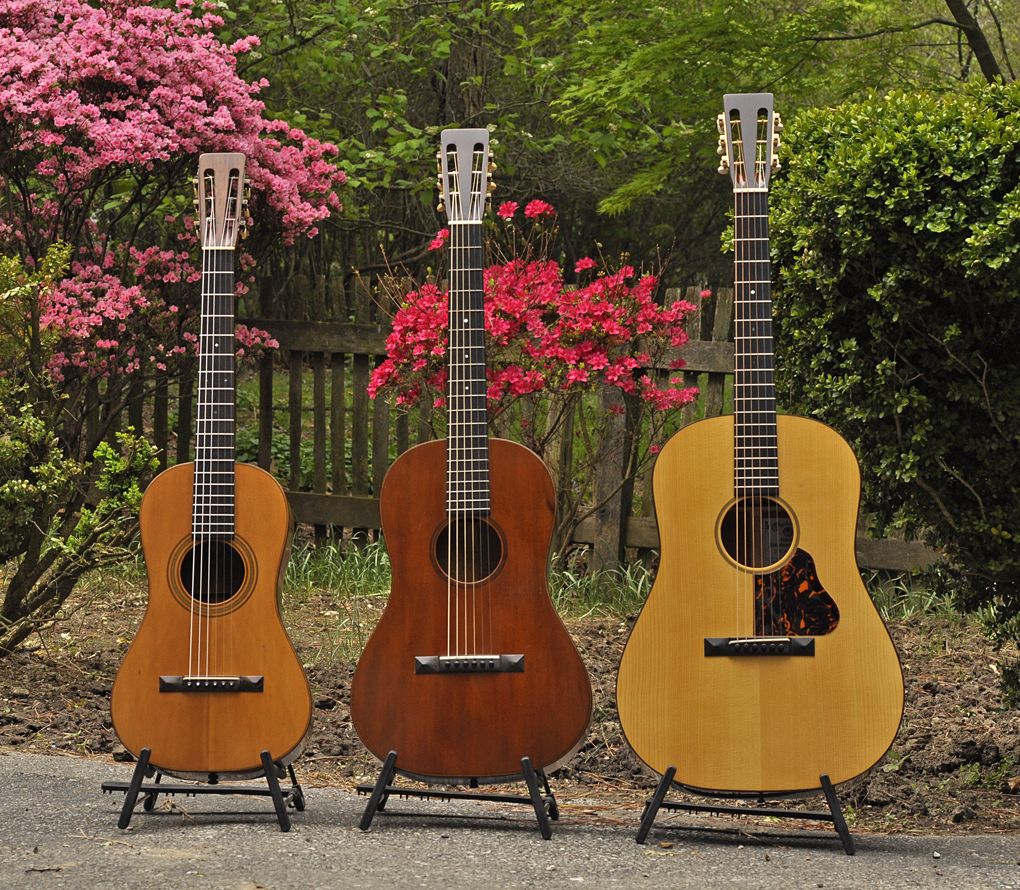
The "Standard" size Ditson Model 1-21, "Concert" size Ditson Model 11, and "Extra Large" (Dreadnaught) size Ditson Model 111.
The Models 1, 11 and 111 have dark binding on front, none on the back.
The Models 2, 22 and 222 have white binding front and back.
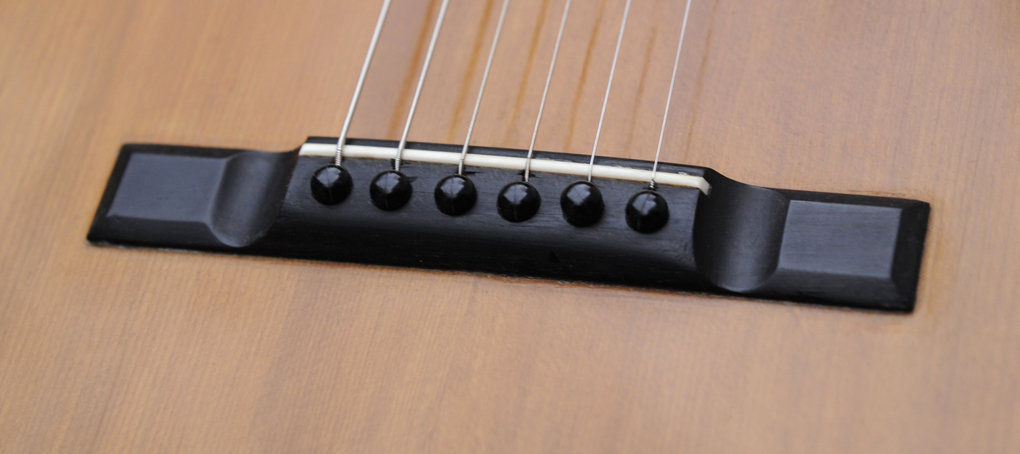
The earlier Ditson models had bridges supplied by Lyon & Healy of Chicago with raised flat topped squares on the wings rather than the pyramids typical of many of the better vintage Martins.
The 3 and 33 were fancier models which changed a bit through the years. These had pearl inlaid bridges supplied by Lyon & Healy, and the earliest examples had fancy fingerboard inlays. The extra large 333 was cataloged, but none seem to have been made.
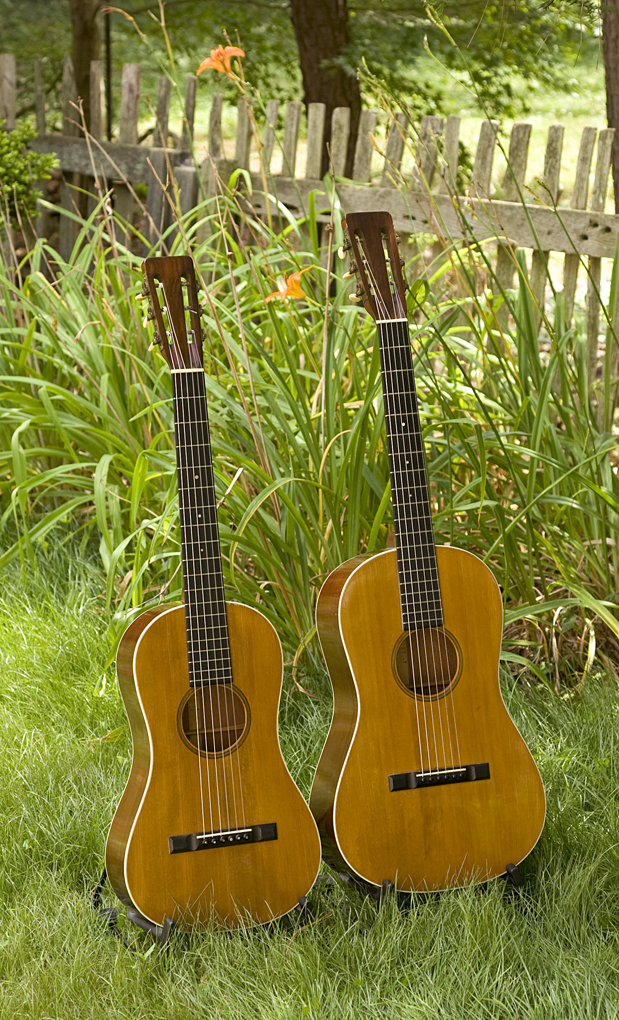
Early Ditson Model 2 #144 and Model 22 #160, both from December, 1916
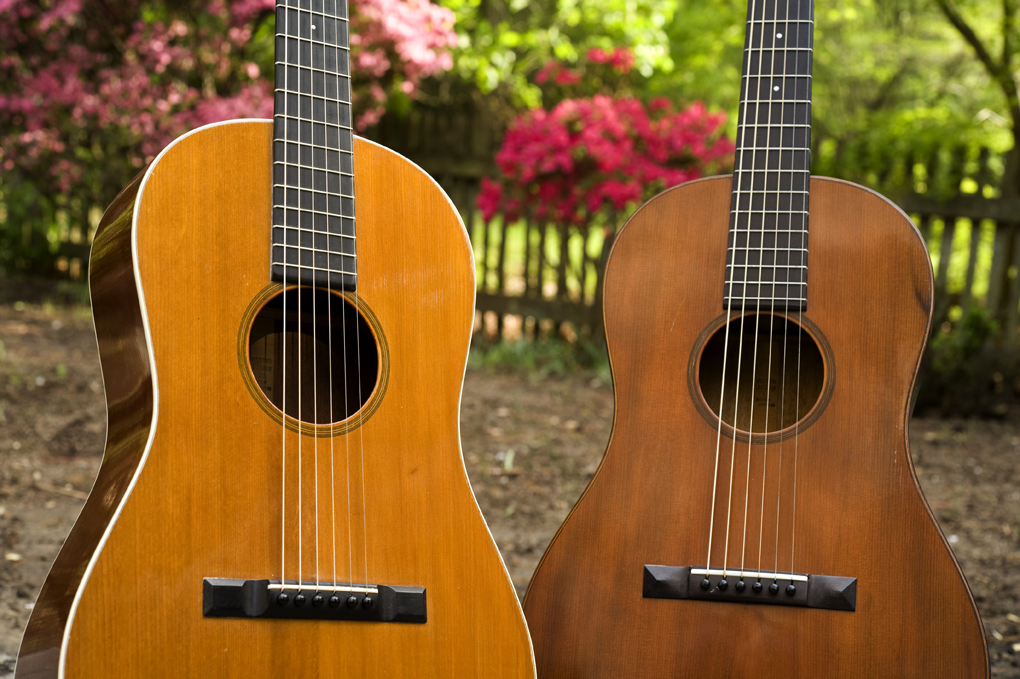
Early Ditson Model 22 #160 from December, 1916 with white binding, standard tinted top and Chicago style bridge, and one from the very last batch of small Martin "Ditson Model" guitars, a Model 11, #565 from January, 1921 with dark binding on top only, optional dark tinted top and standard Martin pyramid bridge. The Model 111 was revived in 1923, and 19 more were made between then and 1930, with standard Martin X bracing replacing the earlier fan bracing.
Ditson also sold guitars which combined the trim levels of regular Martin Styles with the same small, narrow body shape of the Ditson "Standard" size, an example of which is the Style 1-21 shown here. The 1-21 has standard Martin Style 21 trim, including herringbone design marquetry in the rosette around the soundhole and in the center strip on the back. Besides the 1-21, this Ditson size was also available as Ditson Models 1-18, 1-28, 1-30, 1-42, and 1-45.
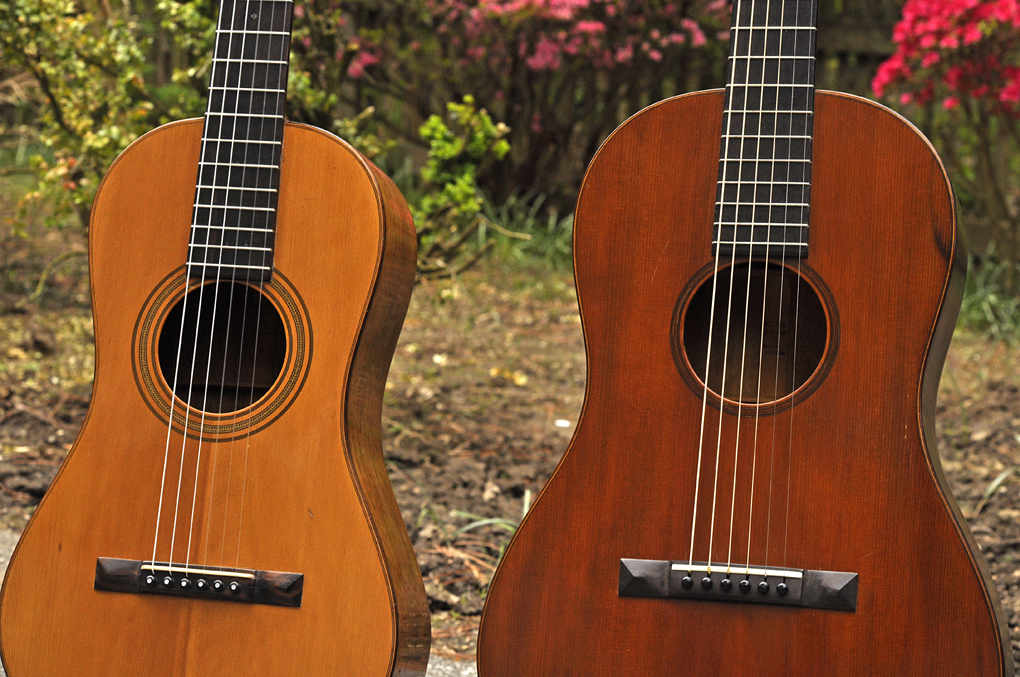
Ditson Model 1-21 #433 from July, 1919 and Model 11 #565 from January, 1921
Ditson was a large music retailer with stores in New York and Boston (and earlier in Philadelphia), and was one of Martin's largest customers, selling guitars and other instruments, including many mandolins. Besides the "Ditson Model" Martins, a large number of regular Martin models, stamped with the C. F. Martin name only, were sold by Ditson. A number of the regular Martin models were also sold by Ditson with the Ditson stamp on the back of the headstock and/or on the inside center strip. And many other models, such as the Empire, were made by other manufacturers for Ditson. So finding an instrument with the Ditson stamp does not necessarily mean you've found a "Ditson Model" Martin, or even an instrument that was made by Martin at all.
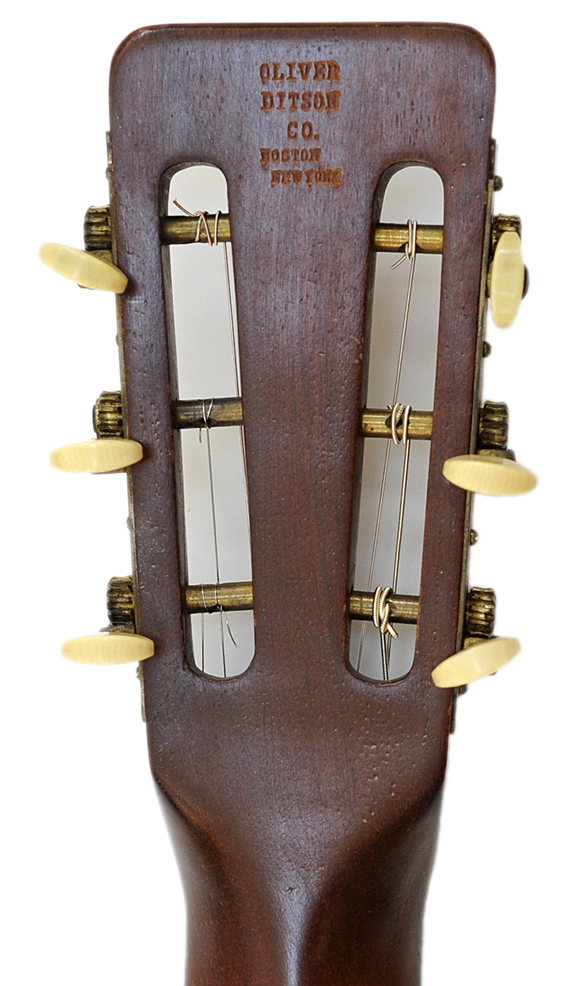
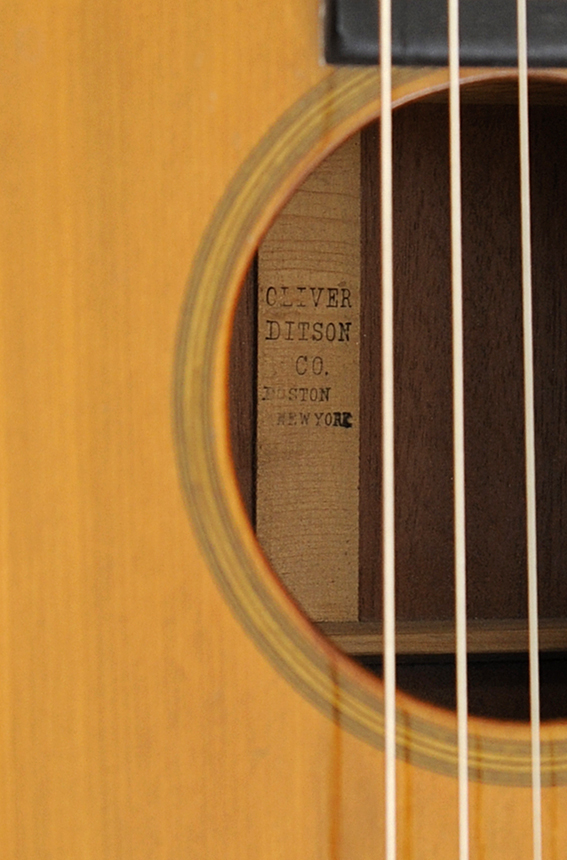
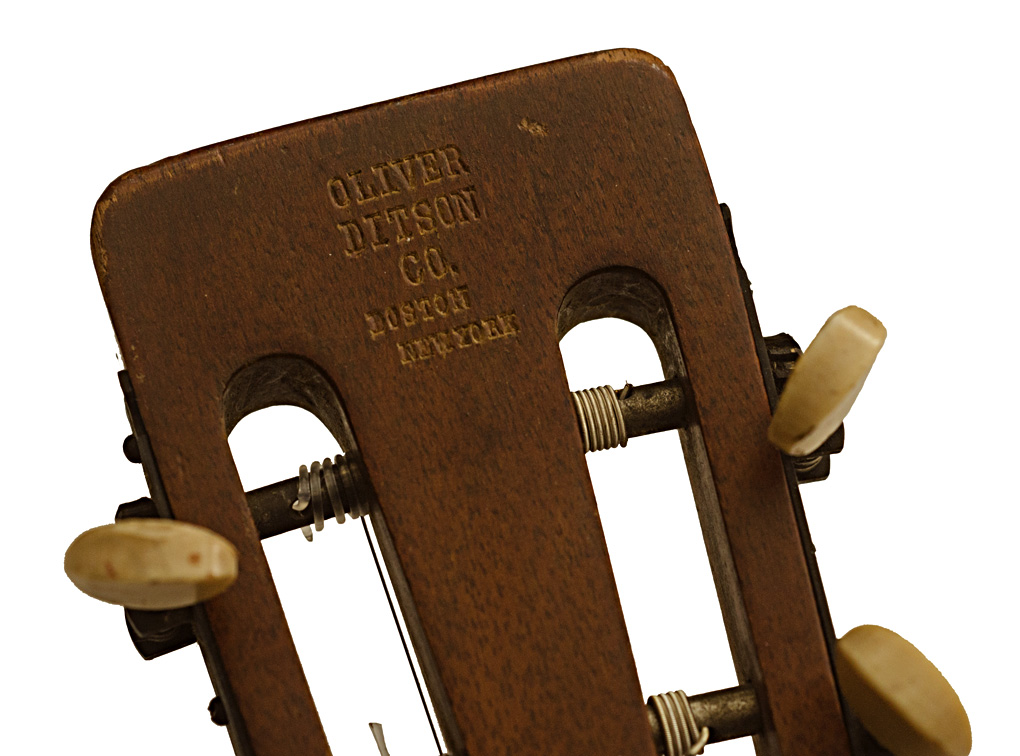
1916 Ditson Model 22 with Oliver Ditson stamps.
During the boom years of the Hawaiian craze, as Martin was struggling to keep up with demand, Martin purchased "Chicago Style" bridges supplied by Lyon & Healy, which were used on the Ditson models.
Ditson Standard Model Dimensions:
Width at the upper bout, 8 7/16"
Width at waist, 7 1/8"
Width at the lower bout, 11 1/8"
End to bridge, 4 9/16"
Bridge depth, 15/16"
Bridge to soundhole, 4 1/8"
Soundhole, 3 9/16"
Soundhole to 12th fret, 4 1/2"
Ditson Concert Model Dimensions:
Width at the upper bout, 9 7/8"
Width at waist, 8 1/2"
Width at the lower bout - 12 3/4"
End to bridge, 5 13/16"
Bridge depth, 15/16"
Bridge to soundhole, 4"
Soundhole, 3 9/16"
Soundhole to 12th fret, 4 9/16"
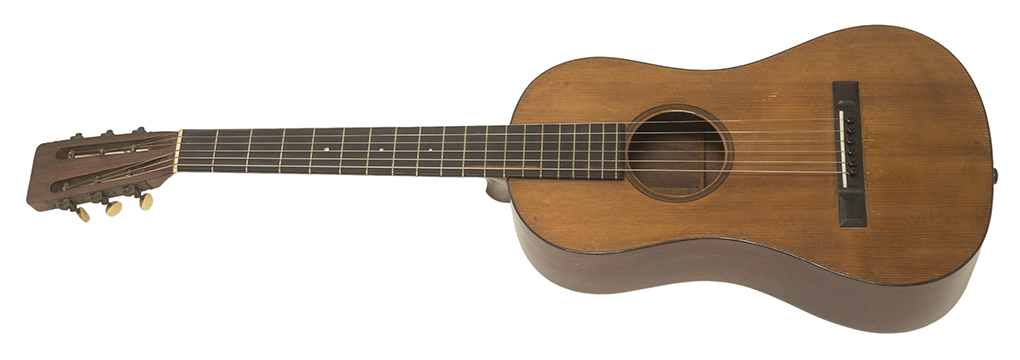
C.F. Martin 1916 Ditson Standard Model 1
Listed as "New Style 1".
Serial Number 118
Shipped 10/24/16
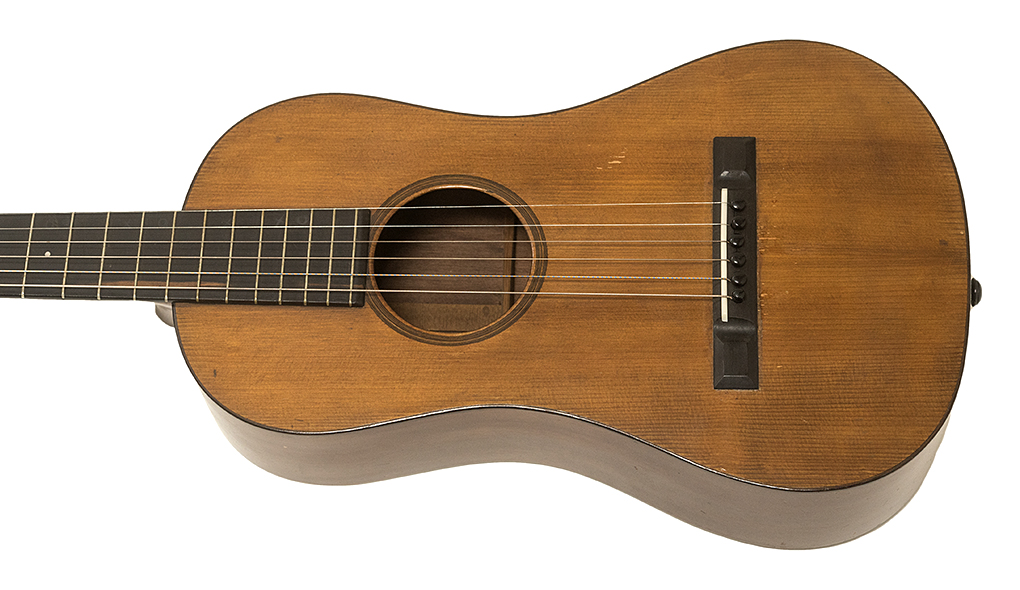
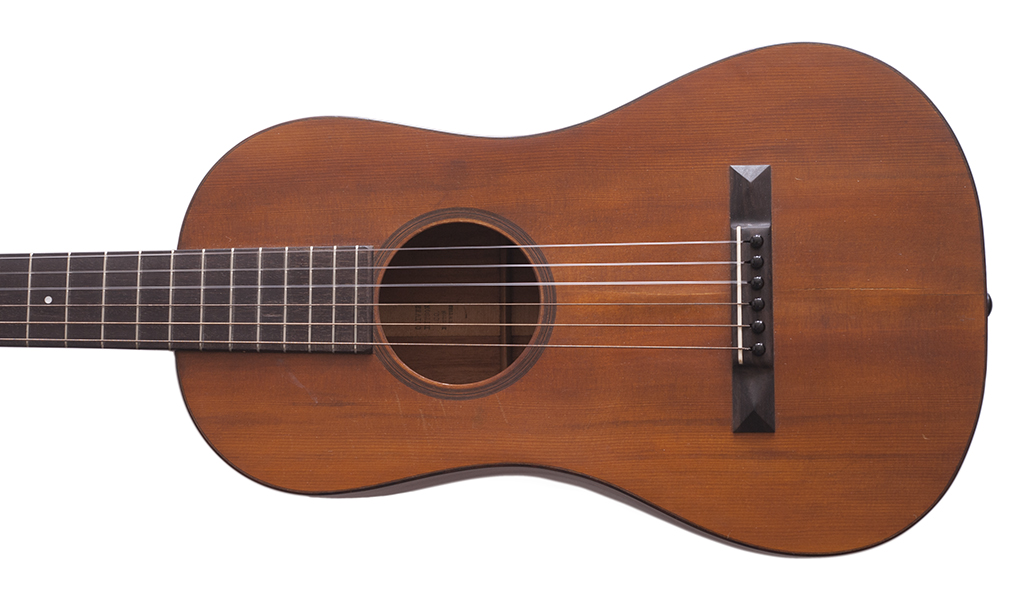
From the last batch of Ditson Style 1 guitars.
Serial Number 542
Shipped 6/8/20
C.F. Martin 1916 Ditson Standard Model 2
From the first batch of Ditson "Dreadnaught" guitars.
This is the earliest Martin/Ditson and the earliest "Dreadnaught" shaped guitar that we know of existing today.
This first batch of Ditsons, listed as Ditson "Standard" guitars, was specified to be "like style 2 uke".
While the second batch of Ditsons, built a month later, were listed as "Standard Style 2 guitars", this first batch was not assigned with a Style number.
Serial Number 6
Shipped 3/28/16
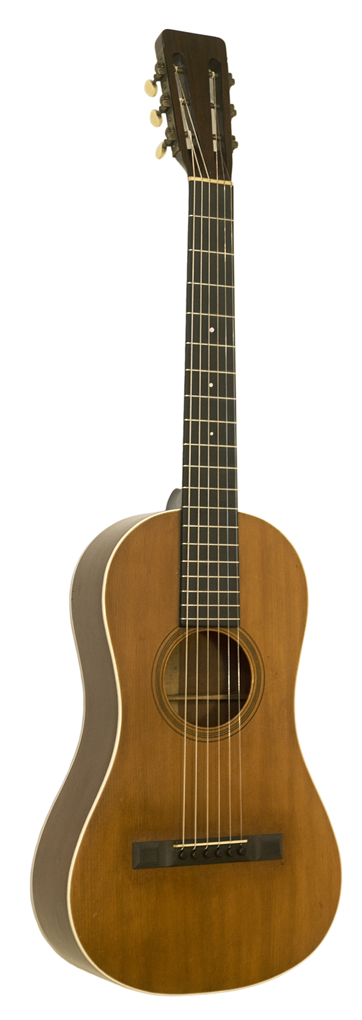
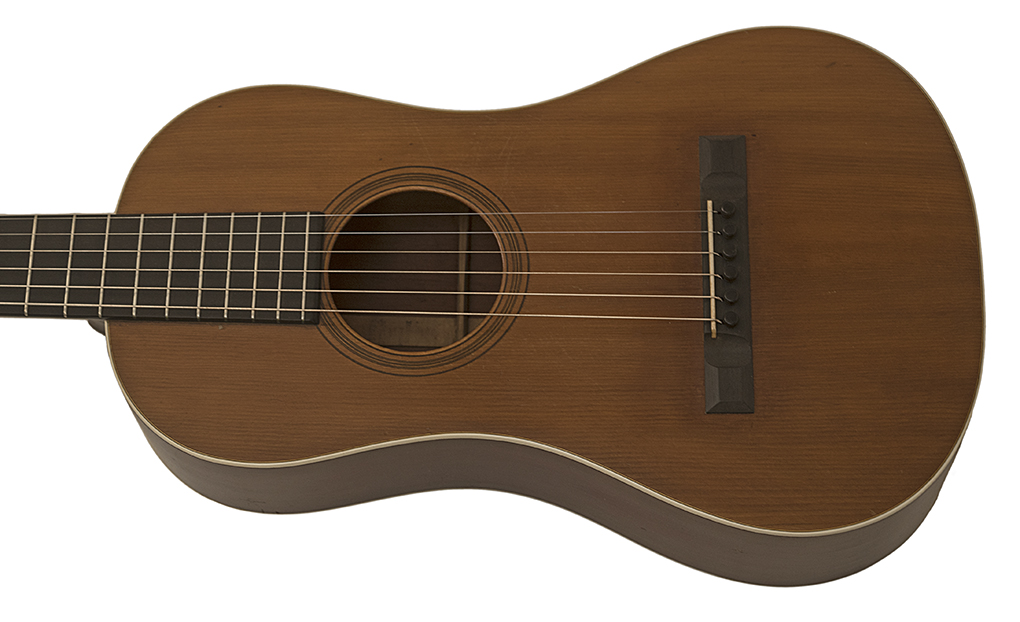
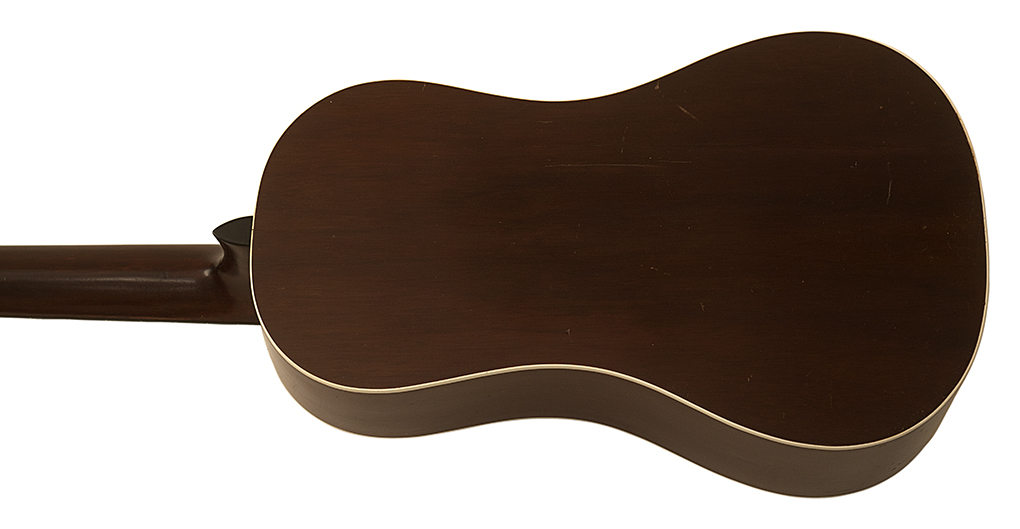
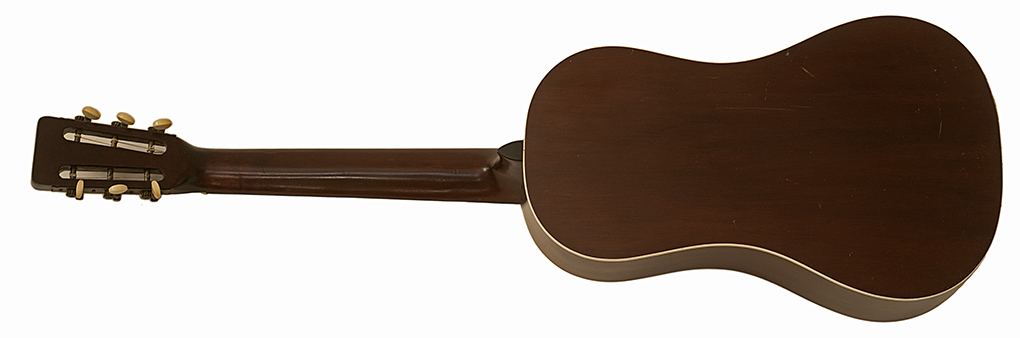
C.F. Martin 1920 Ditson Concert Model 11
The "Concert 1" was the last of the Ditson Concert models to be built.
This guitar is from the second batch, one of only 30 Style 22 built.
Serial Number 565
Shipped 1/5/21
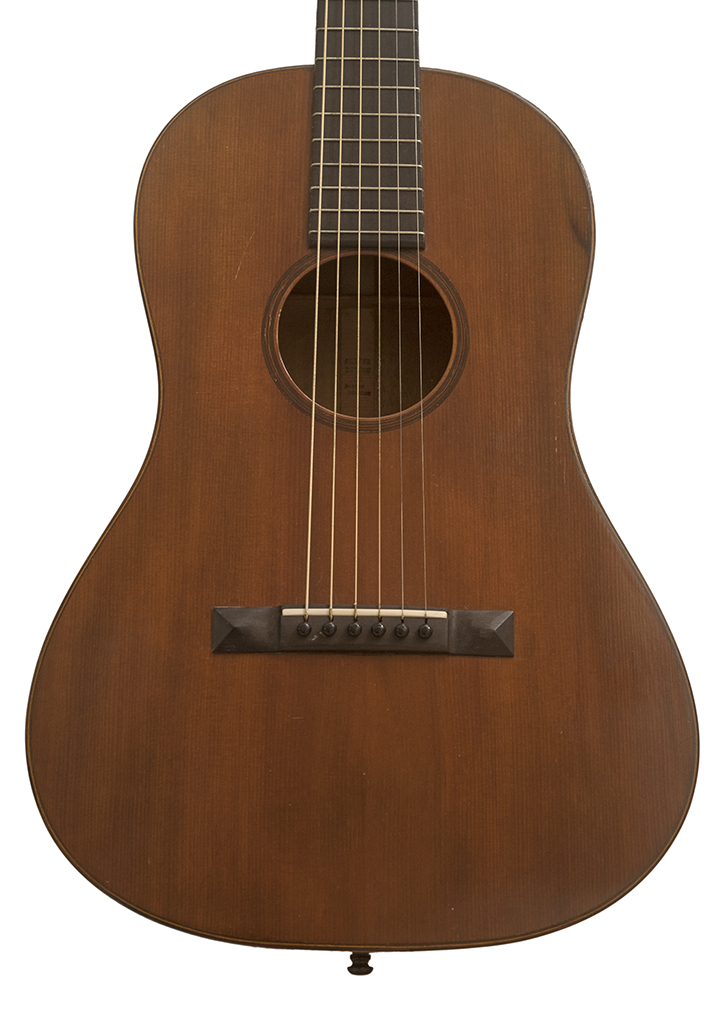
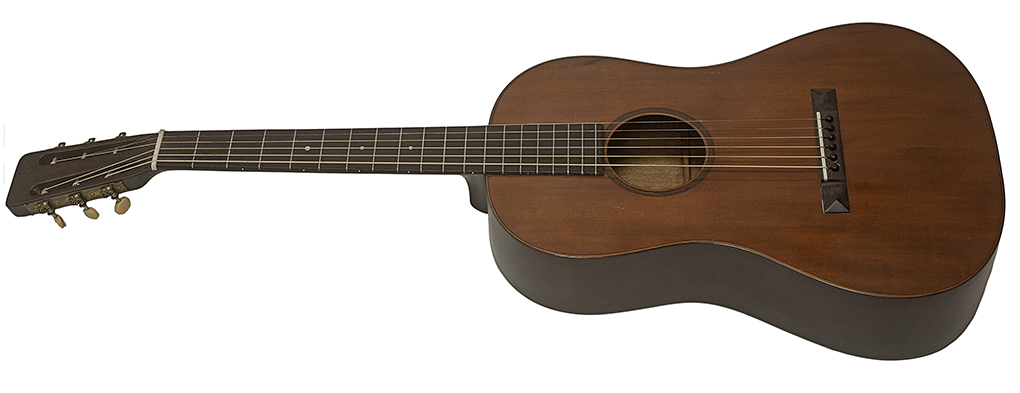
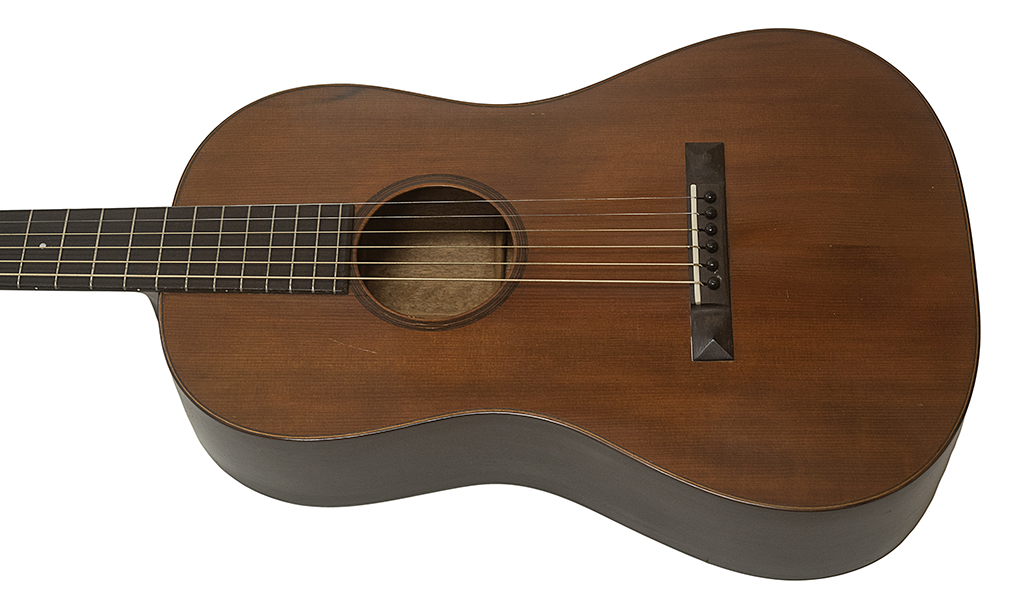
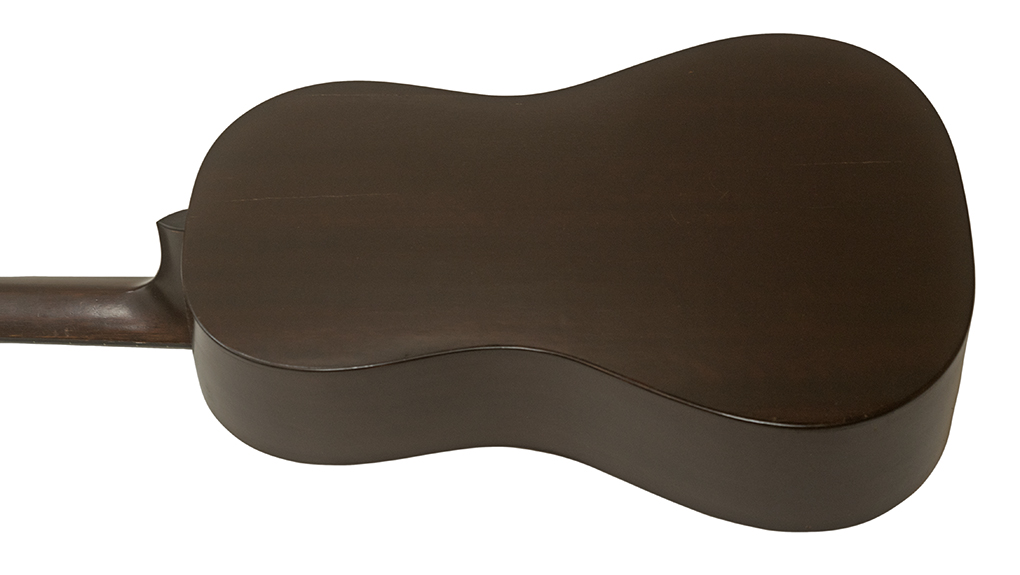
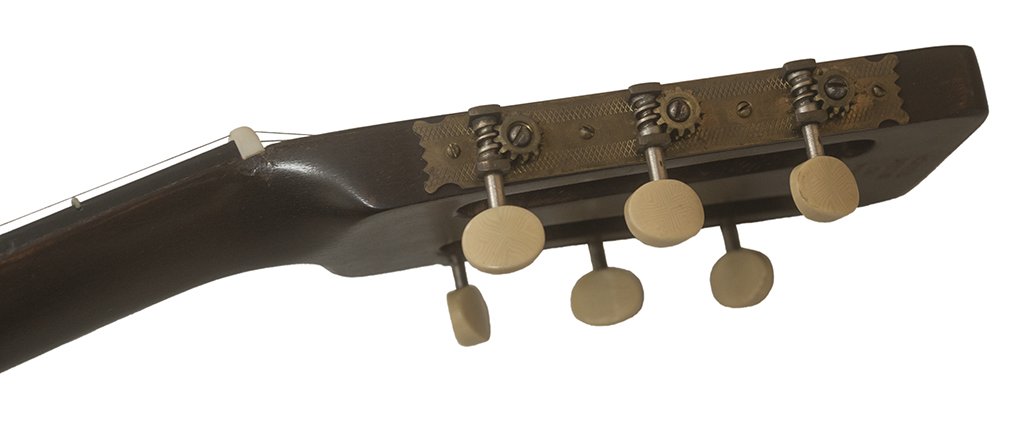
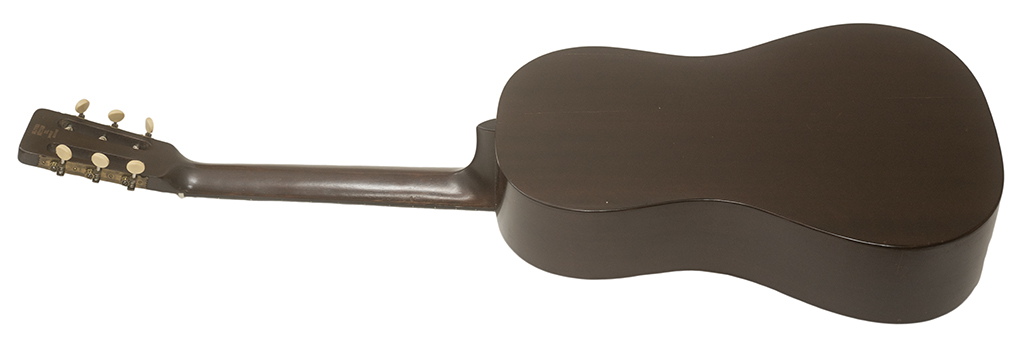
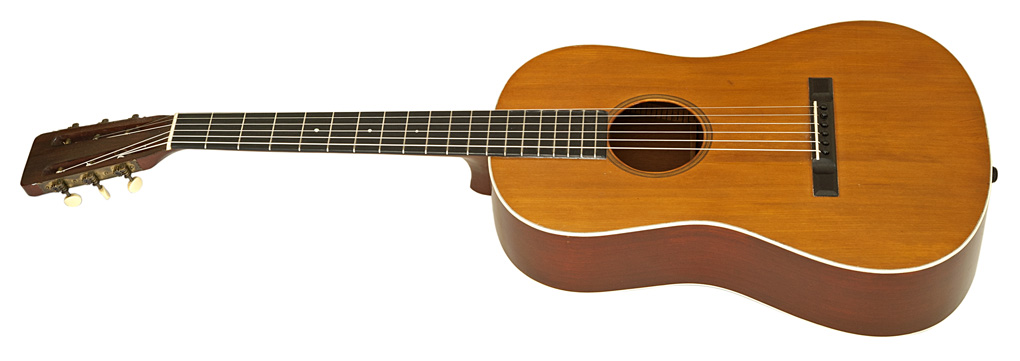
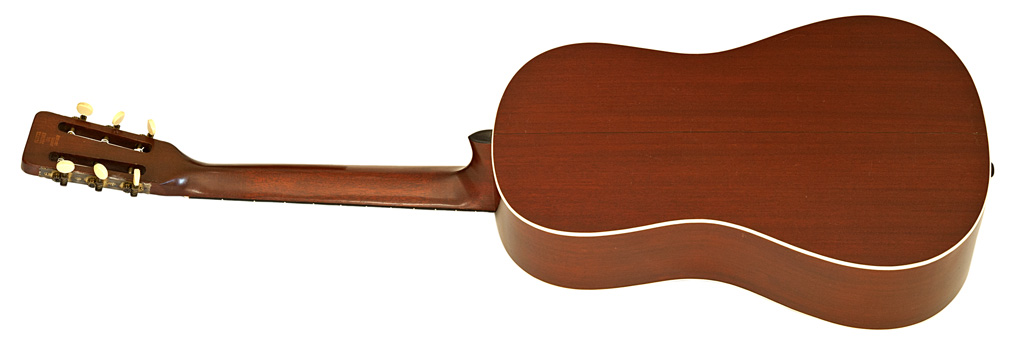
C.F. Martin 1916 Ditson Concert Model 22
The "Concert 2" was the last of the Standard or Concert models to be built.
This guitar is from the second batch, one of only 30 Style 22 built.
Serial Number 160
Shipped 12/30/16
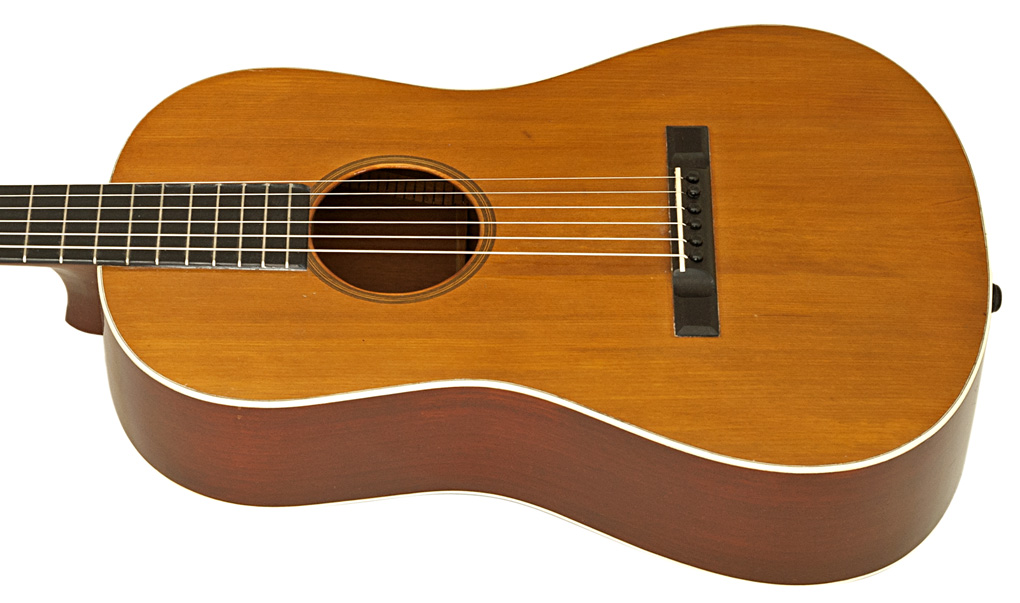
C.F. Martin 1920 Ditson Concert Model 33
From the fourth and final batch, one of 28 built.
Serial Number 557
Shipped 7/31/20
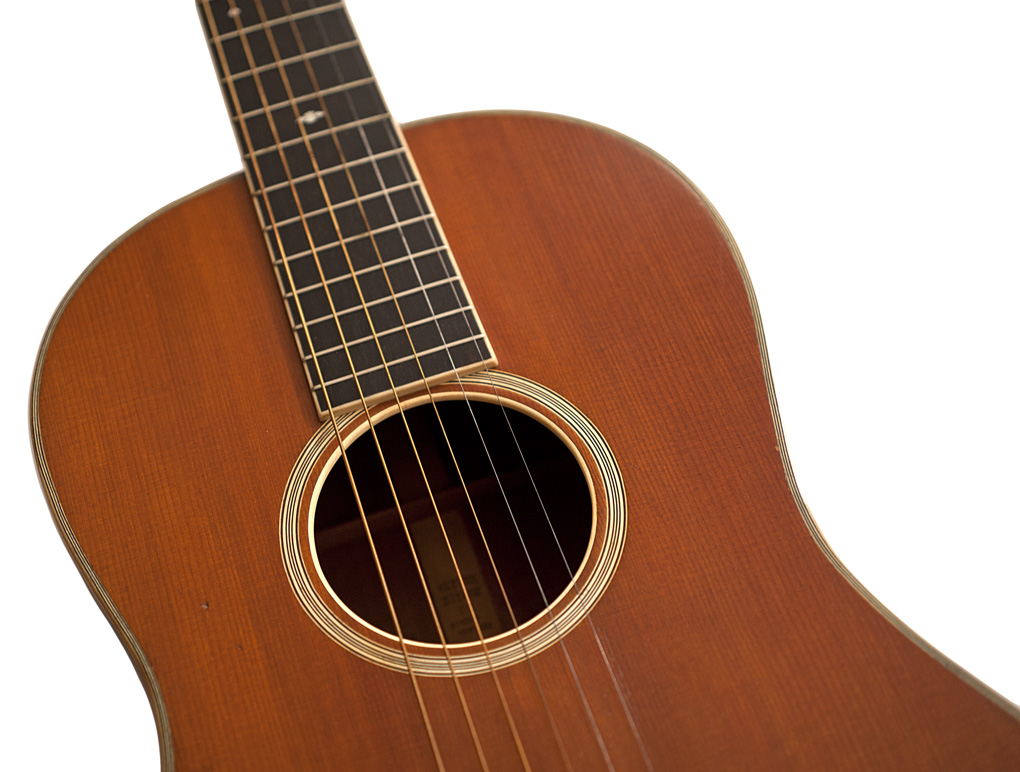
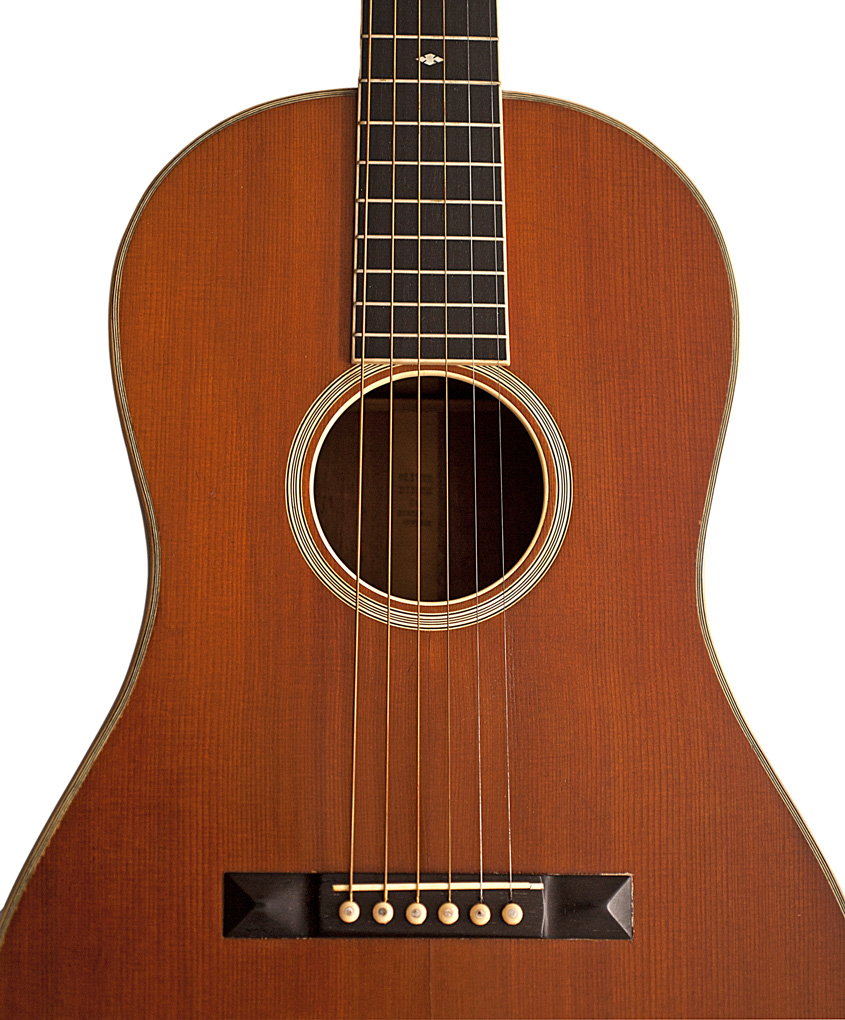
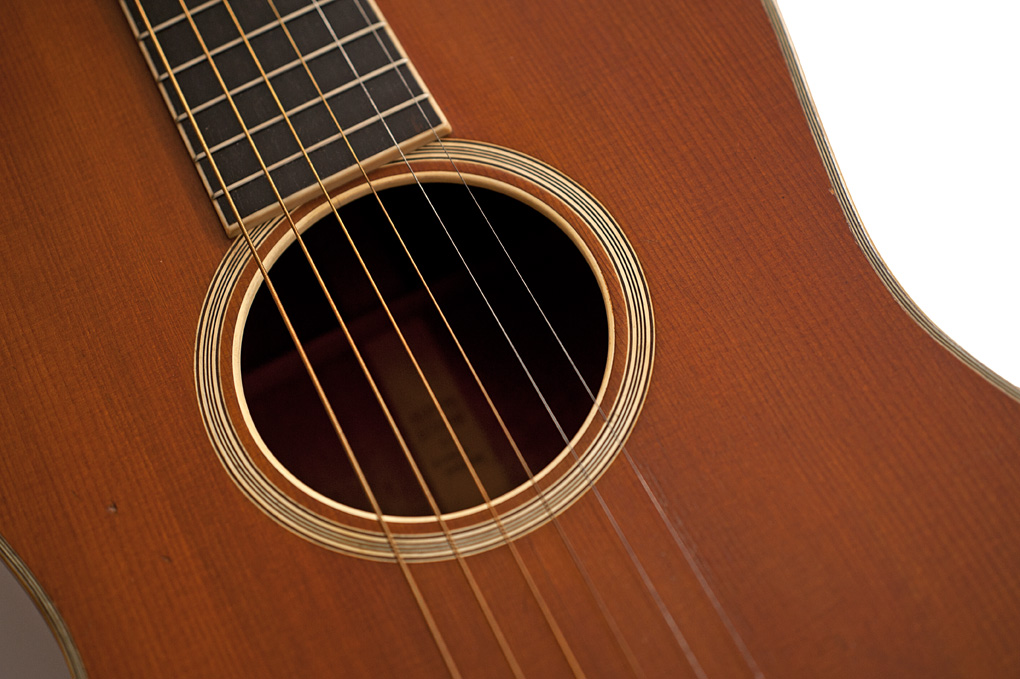
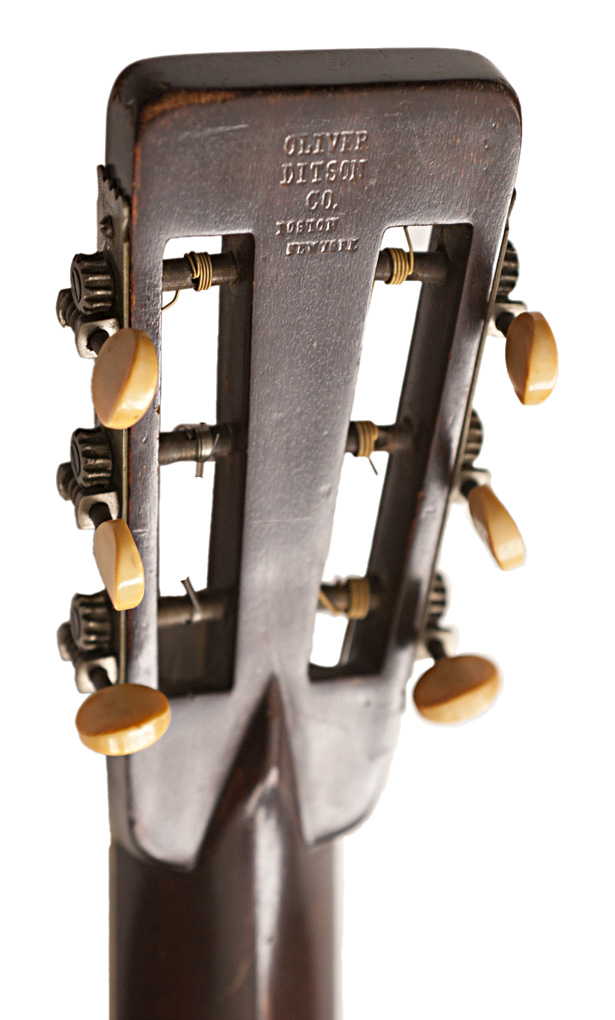
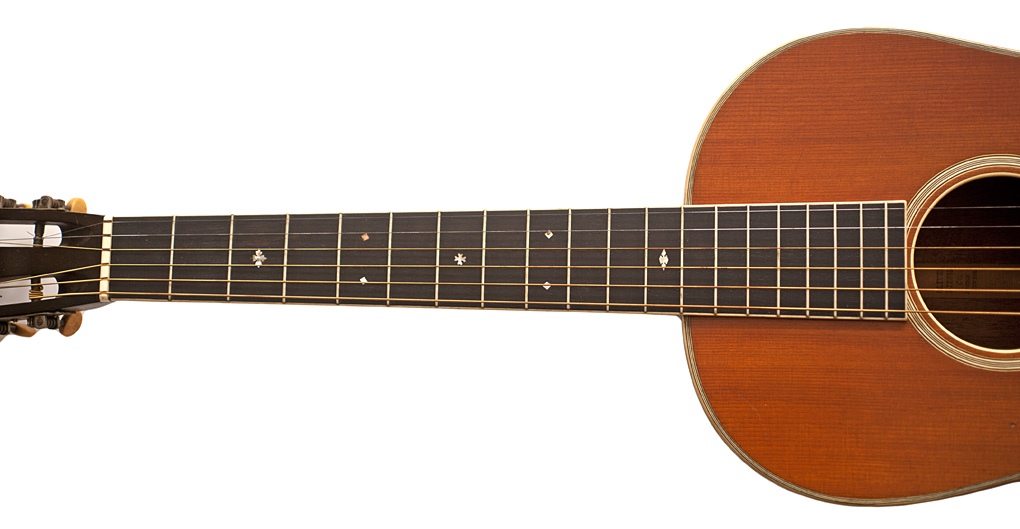
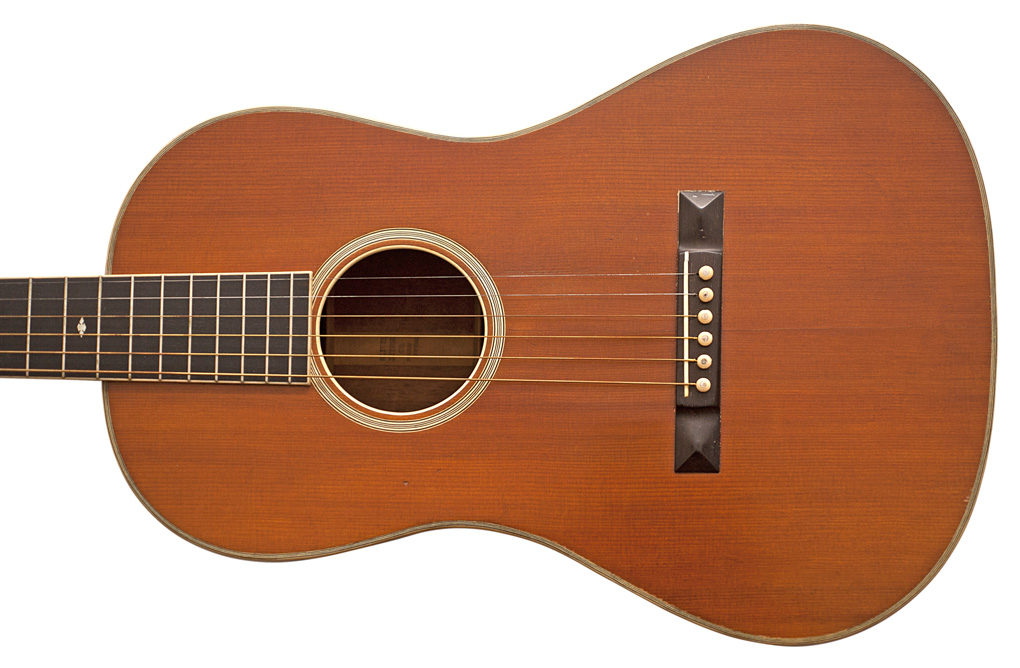
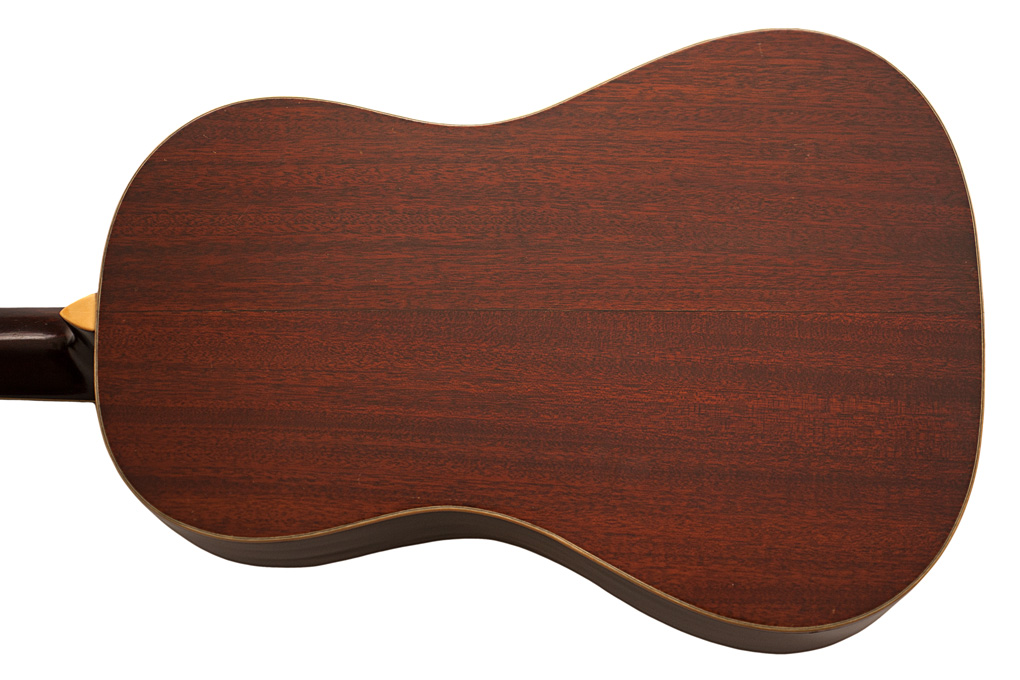
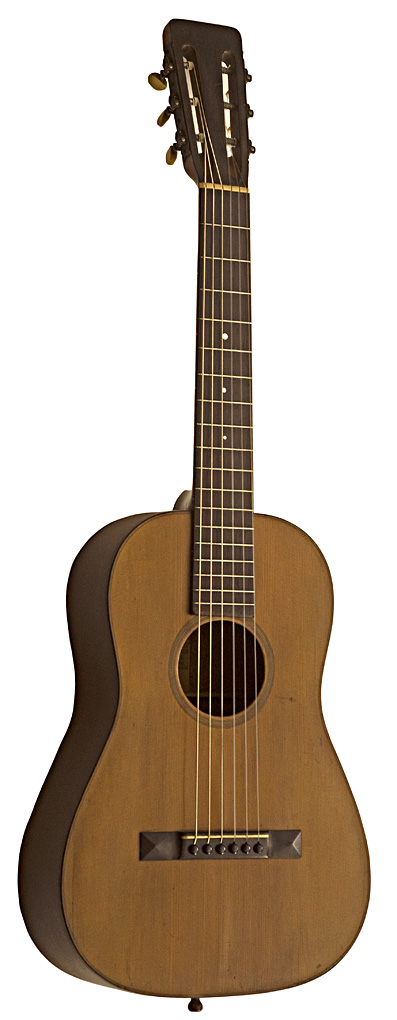
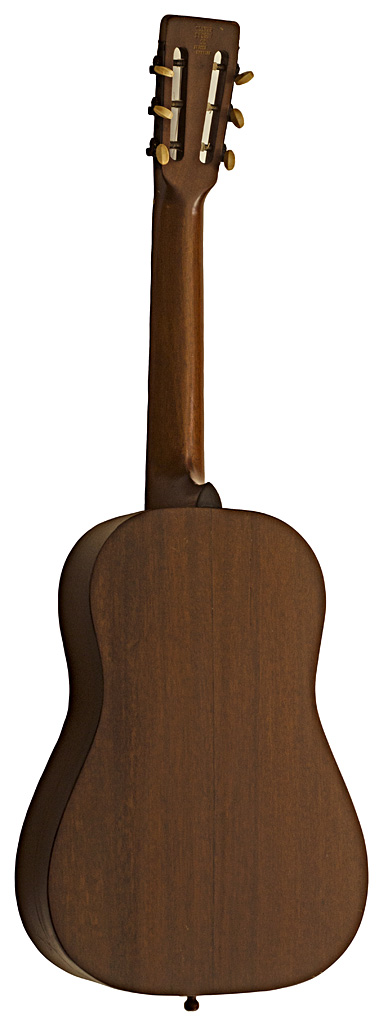
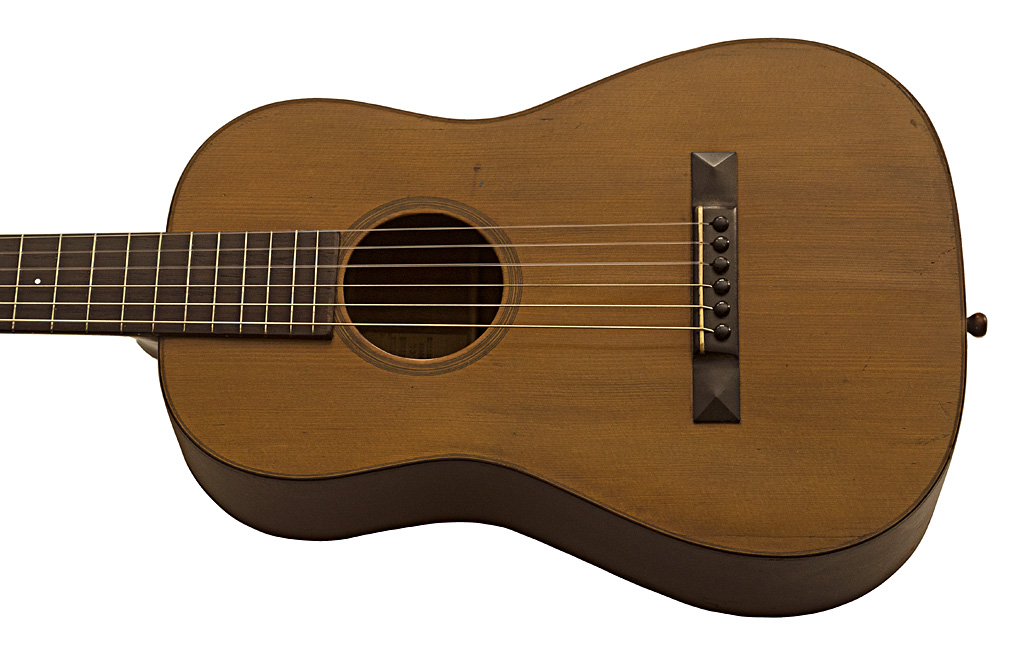
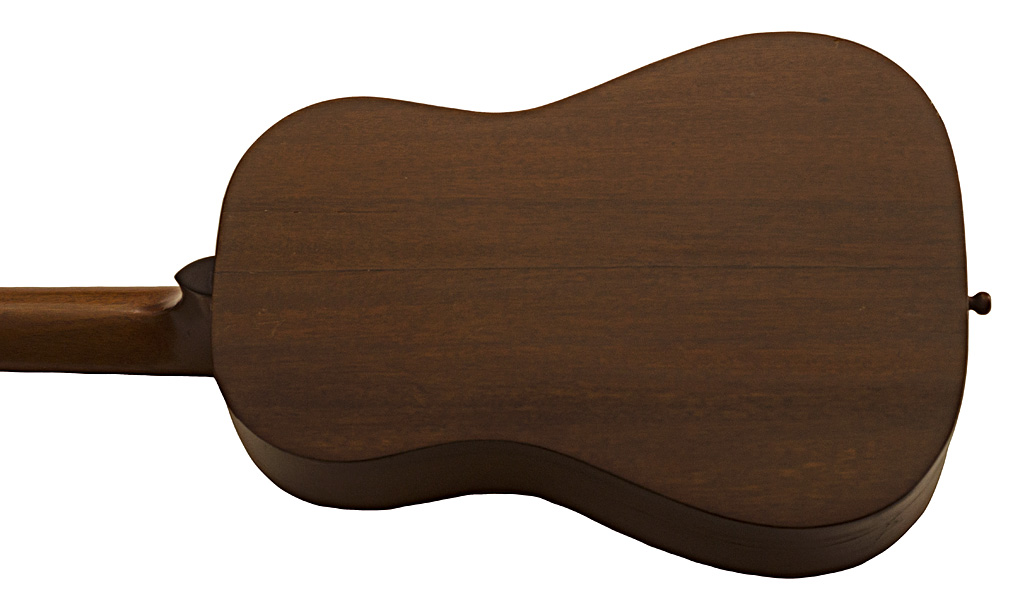
1919 Martin Ditson 3/4 Size Hawaiian Model 1 "Dreadnaught" Guitar
In early 1919, the Ditson Stores ordered six Hawaiian Dreadnaught shape guitars in a 3/4 size, with a short "terz" scale, a scale length used by C.F. Martin Sr. on some of his earliest guitars.
The proportions of the 3/4 size Hawaiian is closer to the "Extra Large" full size Dreadnaught.
Scale - 21 1/4"
Serial Number 13520
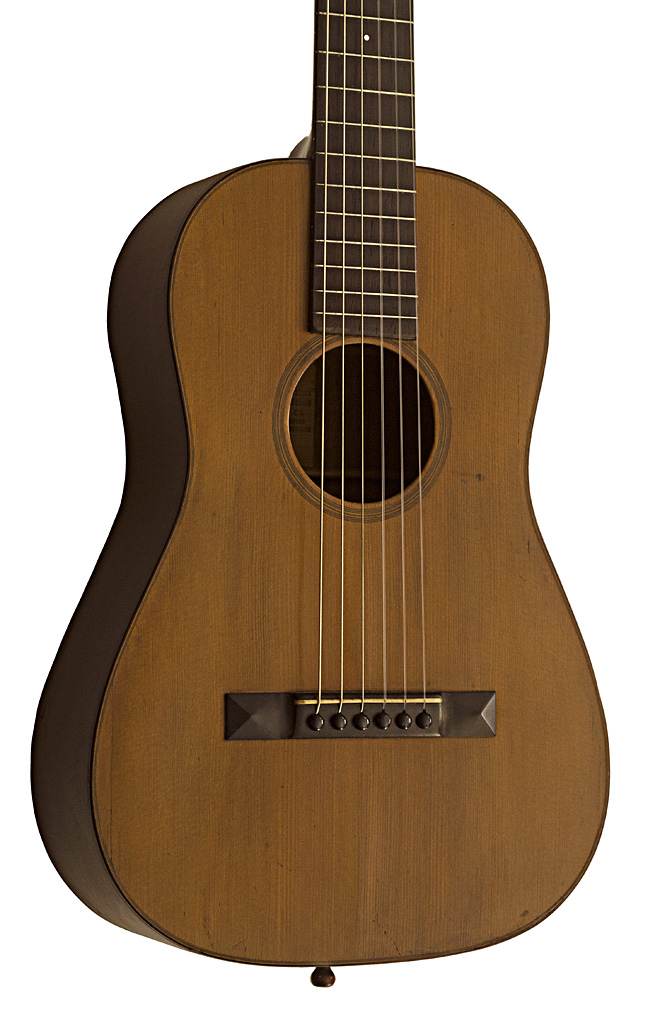
Ditson 3/4 Size
Width at the upper bout, 8 1/4"
Width at waist, 7 3/8"
Width at the lower bout, 11"
End to bridge, 4 7/16"
Bridge depth, 7/8"
Bridge to soundhole, 3 11/16"
Soundhole, 3 1/8"
Soundhole to 12th fret, 3 11/16"
Total length, 15 3/4"
2 lbs, 0.4 oz.
Ditson "Standard" Model 1
Width at the upper bout, 8 7/16"
Width at waist, 7 1/8"
Width at the lower bout, 11 1/8"
End to bridge, 4 9/16"
Bridge depth, 15/16"
Bridge to soundhole, 4 1/8"
Soundhole, 3 9/16"
Soundhole to 12th fret, 4 1/2"
Total length, 17 11/16"

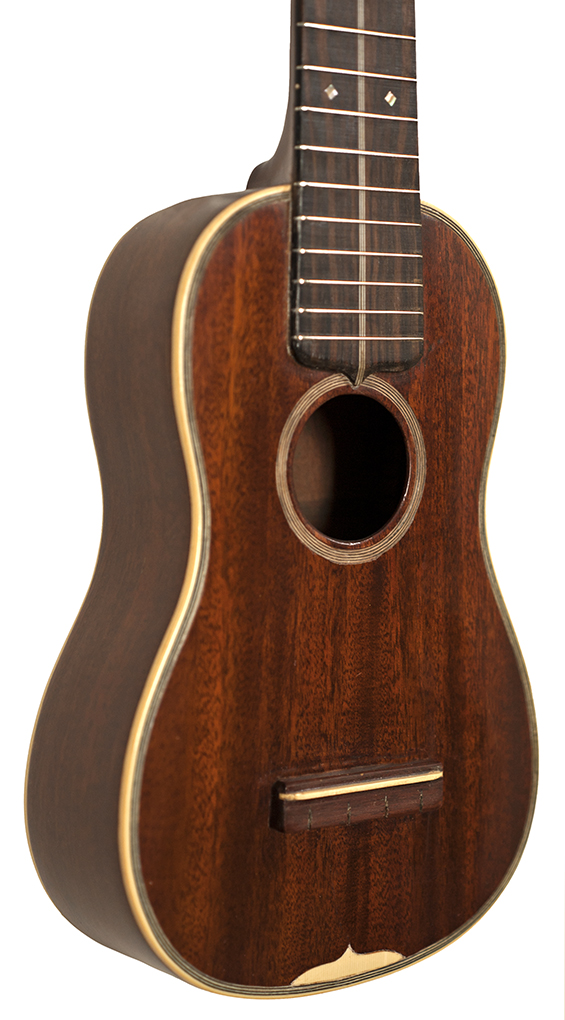
1916 Martin Ditson Model 3 Mahogany Dreadnaught Ukulele
In 1916, the Ditson Stores, one of Martin's largest customers, ordered the first Dreadnaught shaped guitars.
In the same year, Ditson also ordered ukuleles in all the various models Martin offered, with a Dreadnaught shape as well.
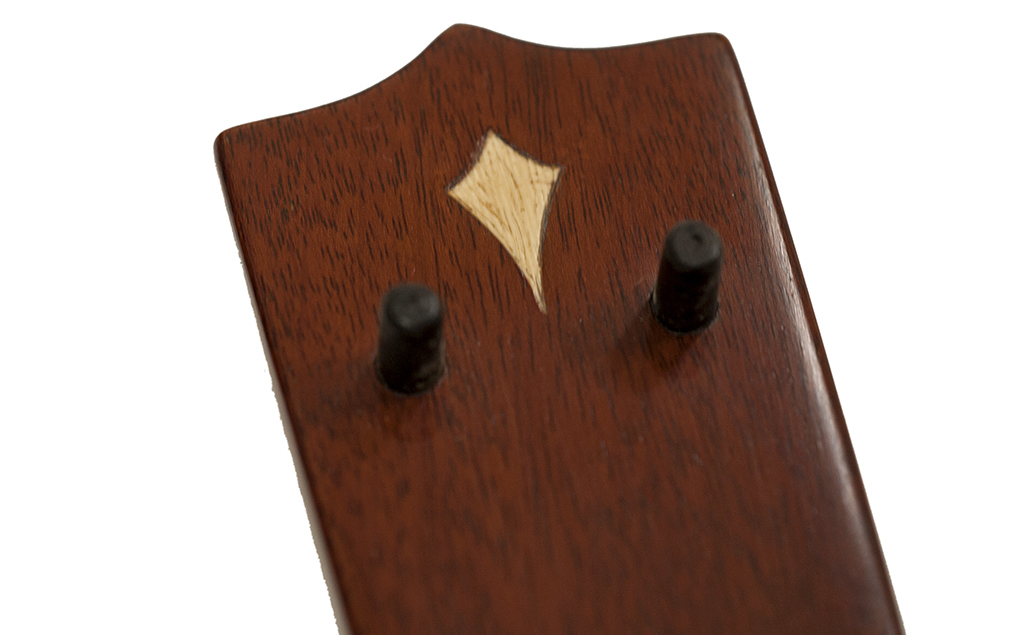
The Model 3 is one of Martin's most beautiful model ukes, with inlays and multiple stripes on the fretboard, and a design in Ivoroid on the lower face. The earliest ukuleles had simple ebony tuning pegs and an Ivoroid design on the headstock.
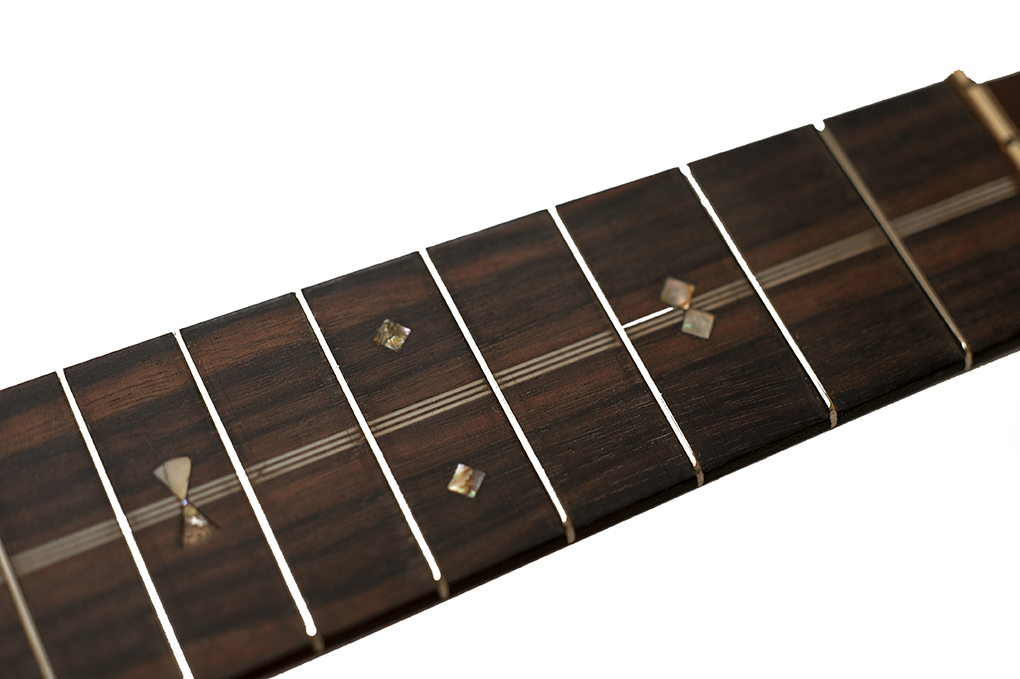
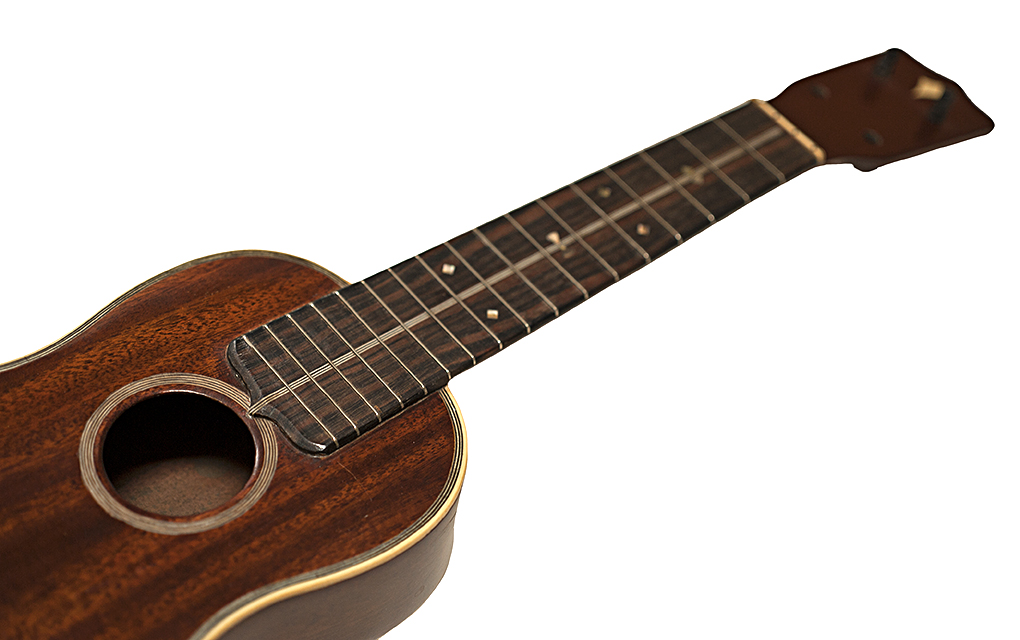
C.F. Martin 1918 000-42
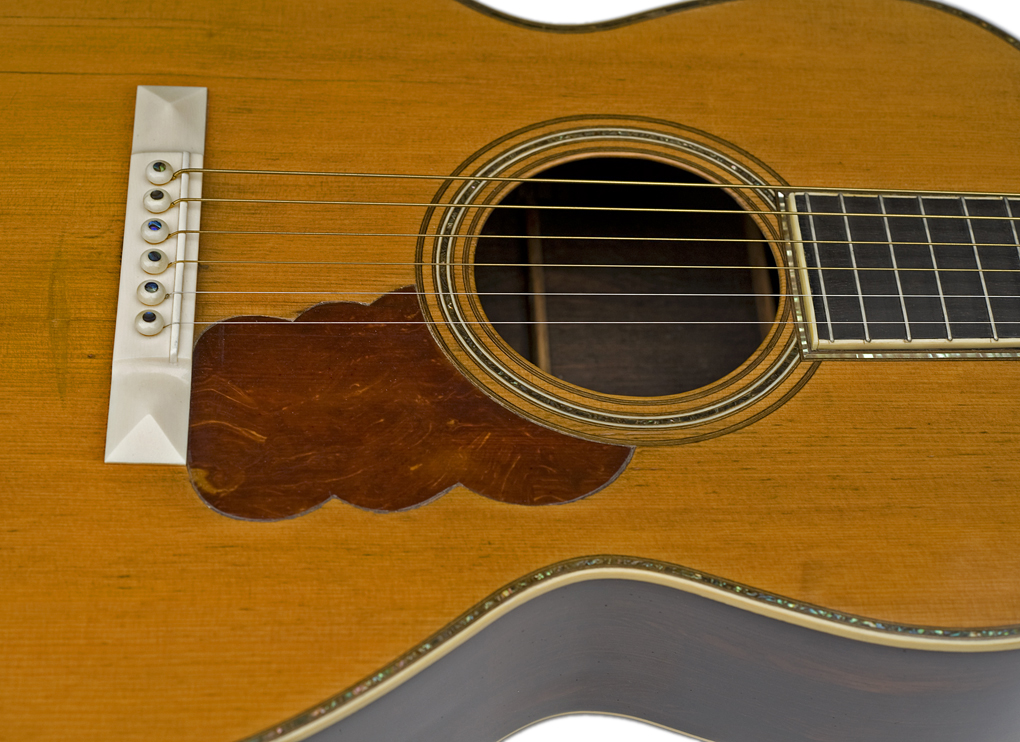
In 1918, Martin made their first two Style 42 guitars in the relatively new and larger 000 size. While one of the two was a rather conventional Style 42 in the 000 size, this 000-42 was special ordered by the Ditson Company in 1918 in the style of Ditson's new Dreadnaught guitars, which were built for Hawaiian style playing with steel strings. That makes this guitar a rare example of an extremely early 000 size Martin built for steel strings, as well as a rare example of a Martin built for steel strings with an ivory pyramid style bridge. As was true of the early Martin Dreadnaught, and all of Martin's early Hawaiian steel string guitars built for both the Ditson Company and The Southern California Music Company, this guitar was built with fan braces. This guitar was also special ordered with a cloud shaped pickguard inlaid into the top.
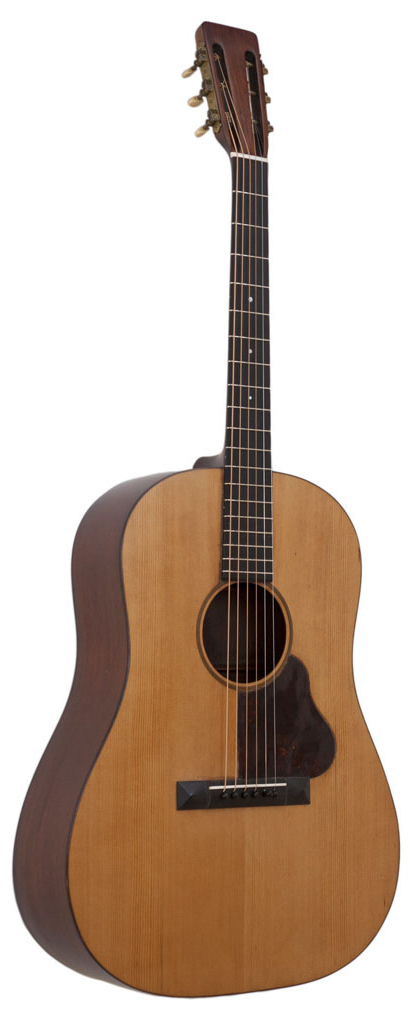
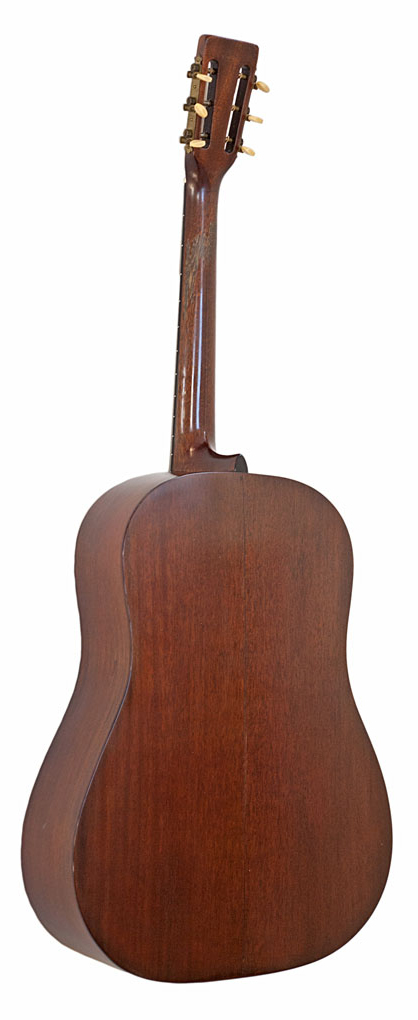
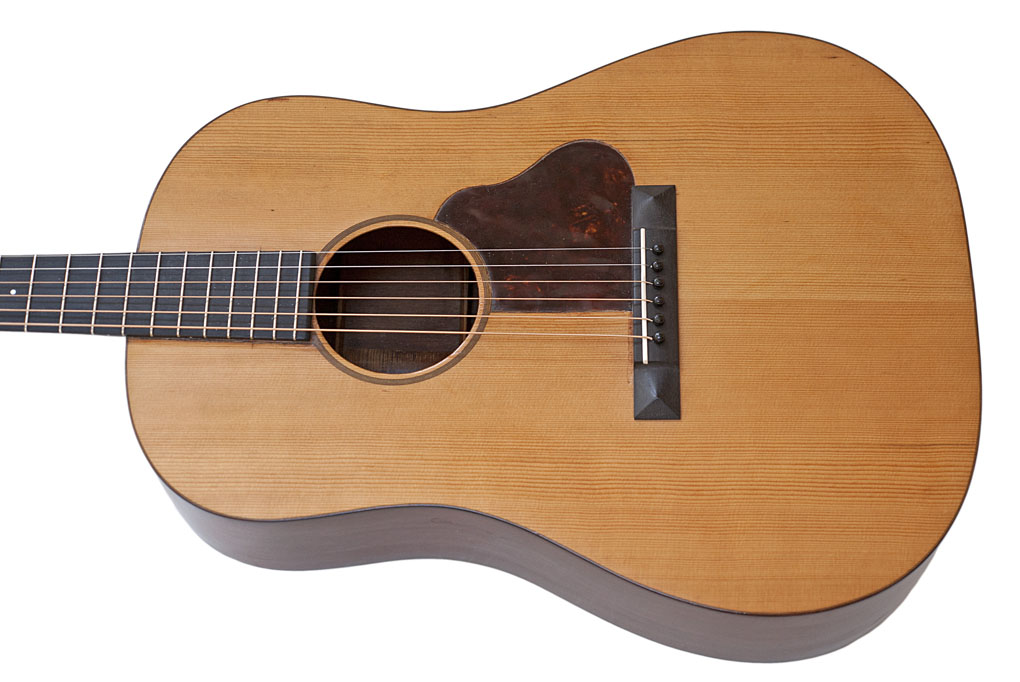
C.F. Martin 1924 Ditson "Extra Large" 111
The largest of the three sizes of guitars mad by Martin for the Ditson Stores was first known as the "Extra Large"
This style was later took on the name "Dreadnaught" after the Extra Large class of battleships, the spelling later becoming "Dreadnought" with an "O".
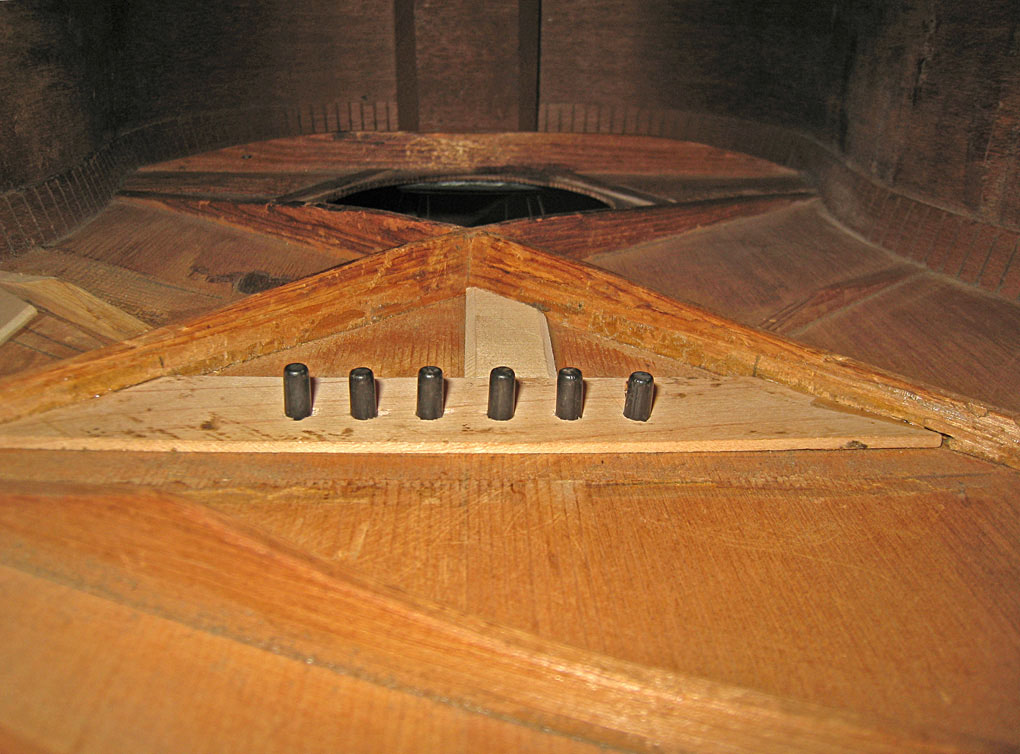
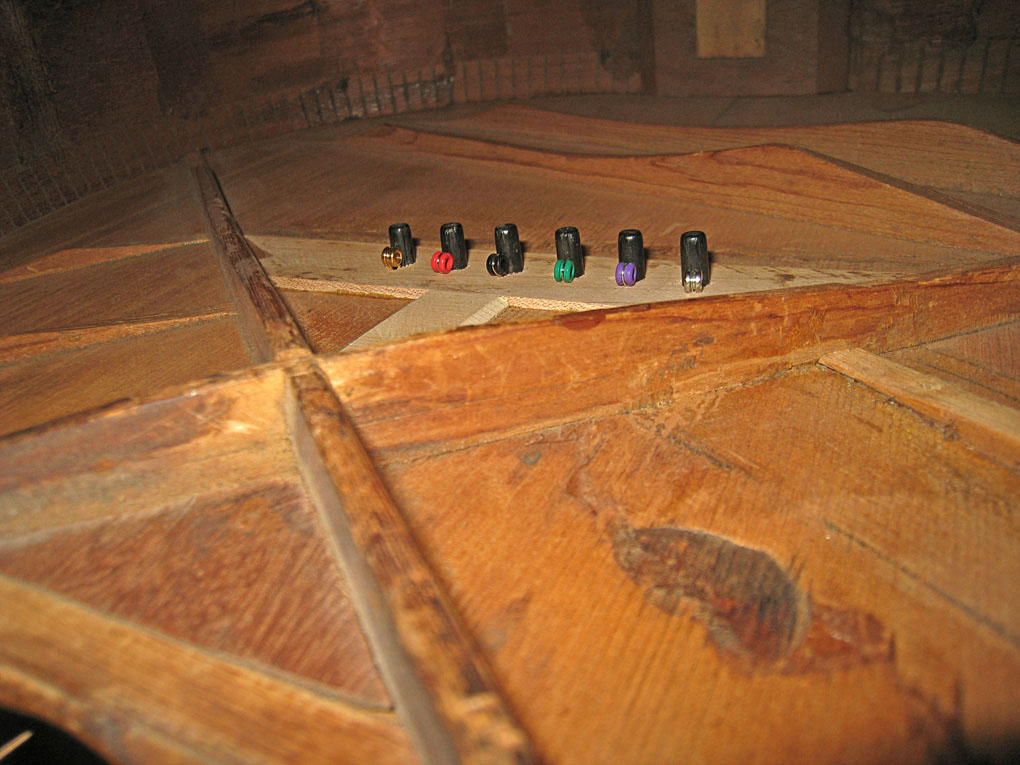
Early Ditson 111 were fan braced. This Ditson 111 was the first to be X-braced.
C.F. Martin/Ditson 1926 2-17
The Ditson Stores also sold many standard Martin models, but with the Ditson stamp replacing the Martin stamp on the headstock and interior center strip, such as on this model 2-17:
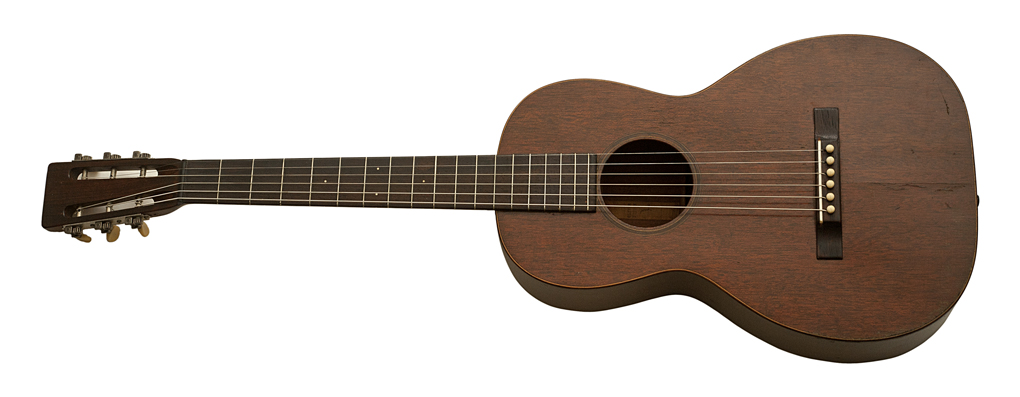
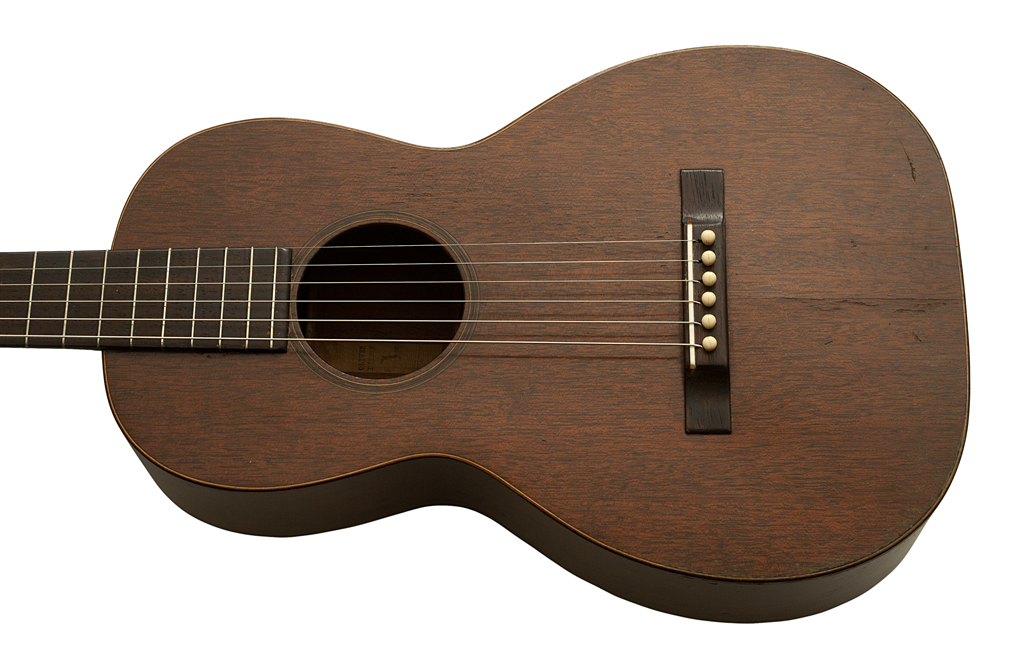
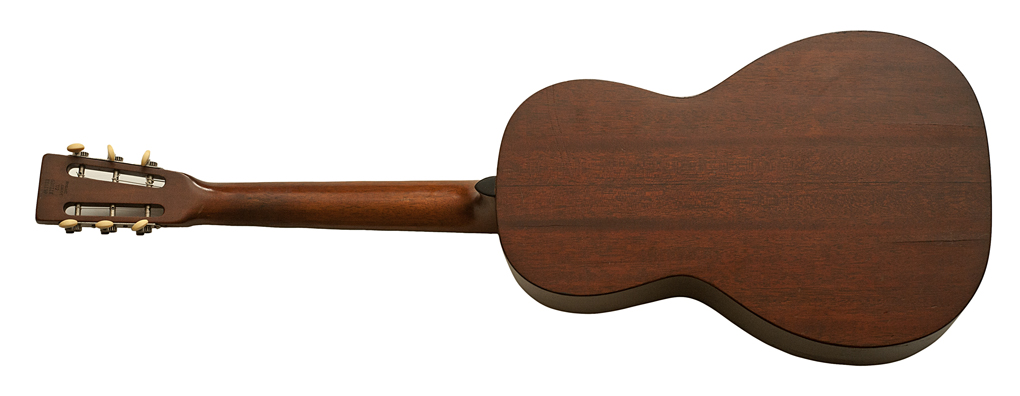
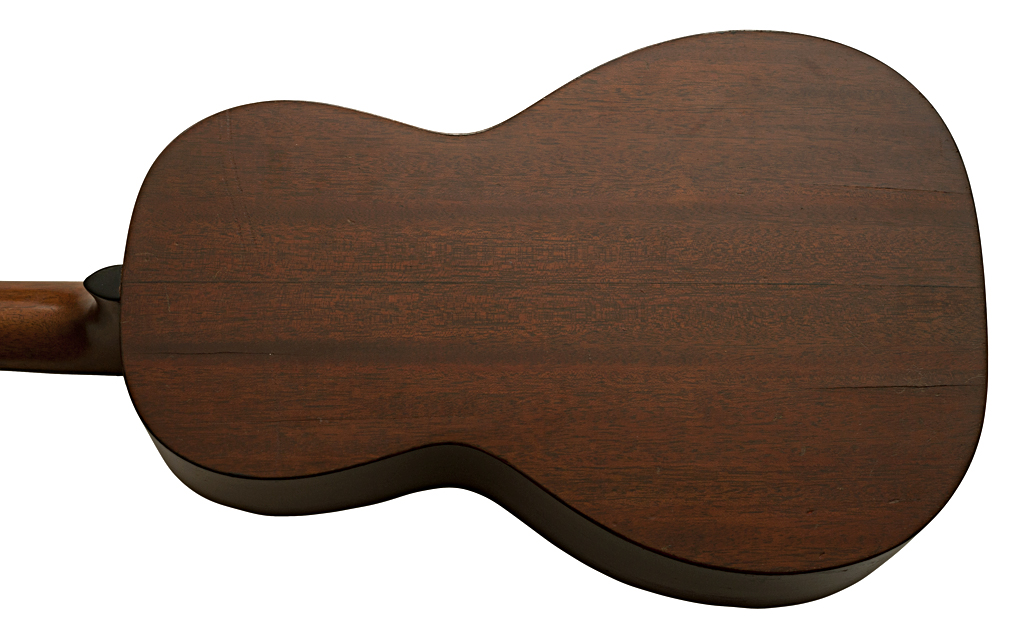
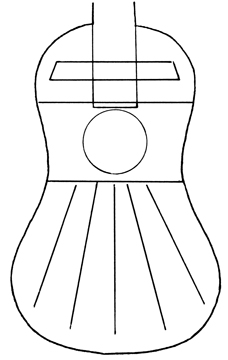
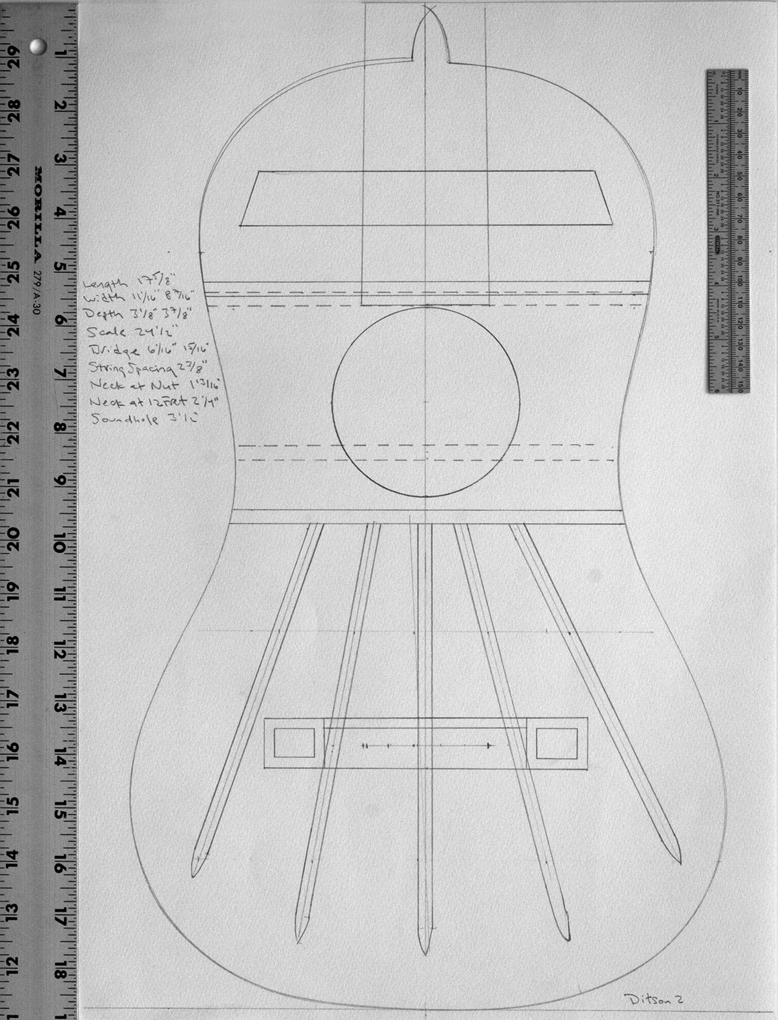
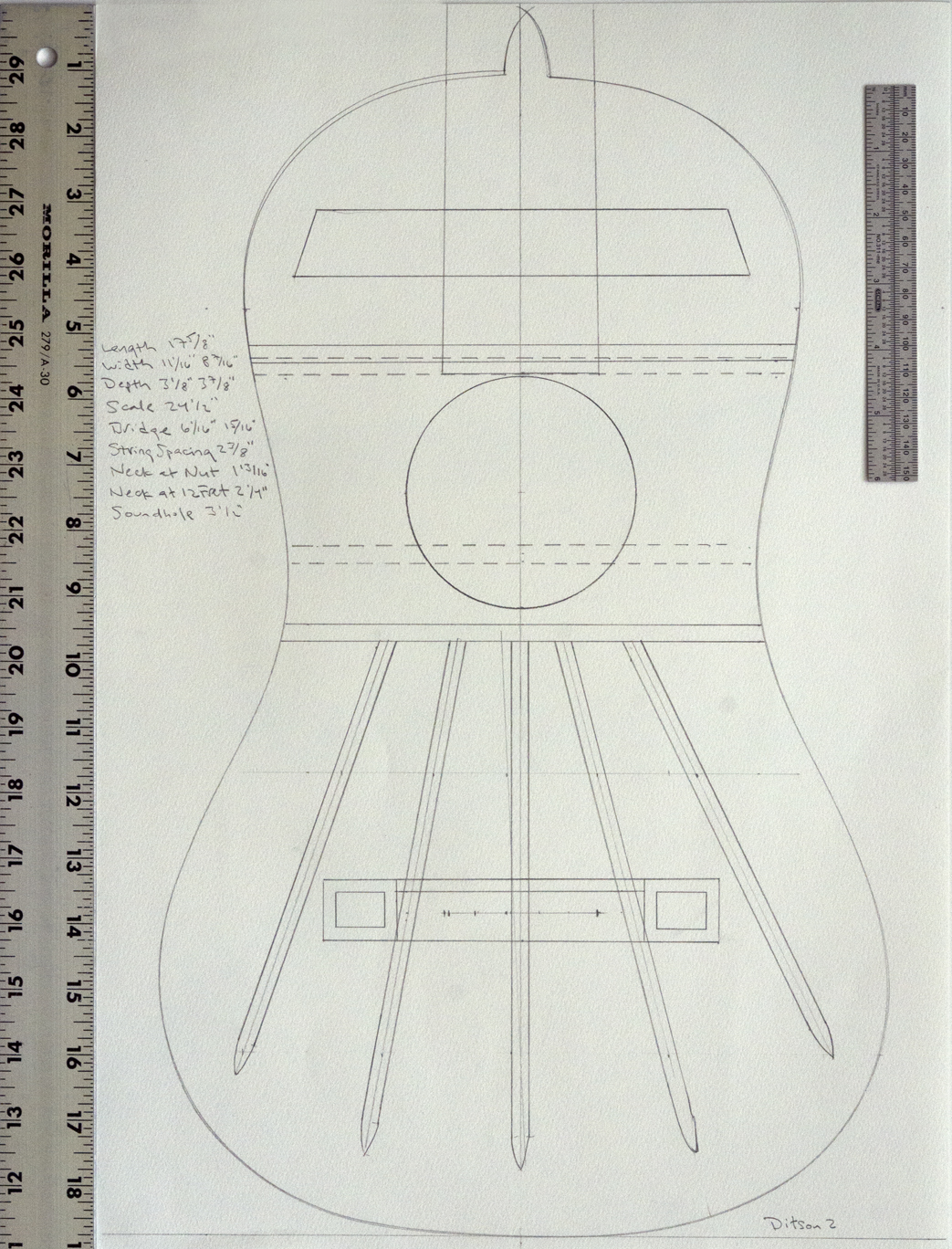
Click on this image to download a full size 1:1 diagram of my 1916 Ditson 2 #144.
Martins made Ditson 1921 Style 11 #565, 1916 Style 22 #160, and 1920 Style 33 #557.
Oliver Ditson (b. October 20, 1811), a major music publisher, born in Boston, Massachusetts to Scottish parents, entered the musical instrument business in 1867, when he acquired a stock of musical instruments from Firth, Son & Company (seller of Ashborn guitars) a few years after the death of John Firth, and opened a new store to sell the instruments. This offshoot of the Boston Oliver Ditson Company was called the John C. Haynes Co., as it was managed by John Haynes (1829-1907), who Ditson had already taken on as a junior partner. Soon Haynes started producing Tilton guitars under license in the shop of Swedish luthier Pehr A. Anderberg. Haynes eventually bought out Anderberg's shop, and then grew into a major builder of guitars, including Bay State and many other brands, with a factory of 25 men.
Upon the death of Oliver Ditson on December 21, 1888, John Haynes became the President of the Oliver Ditson Company until he retired in 1903 and Oliver's son Charles Healy Ditson became President. In 1907, Bay State was sold to the Vega Banjo Company.
More importantly, Oliver's son Charles Healy Ditson (b. August 11, 1845) opened a store in New York in 1867. Martin guitars and mandolins were not just "shipped" to the Charles Ditson Store. While Oliver Ditson in Boston was both a retailer and a jobber, who sold Martin guitars to many other stores, the uniquely styled Ditson instruments were ordered by the New York store, and the Boston store buyer had little interest or even knowledge of these instruments. They were happy to sell standard Martin instruments. It was Small Goods Manager Harry Lawrence Hunt who was responsible for ordering these unique instruments from the Martin Company,. Martin built guitars and mandolins for the Charles Ditson Store until a few years after Charles Healy Ditson's death on May 14, 1929, when the store was closed. Shortly before the store's closing, Harry Hunt left to open the Lyon and Healy Harp Salon in Steinway Hall. It should be noted that Lyon and Healy gained it's foothold as Oliver Ditson gave financial backing to George Washburn Lyon and Patrick J. Healy to open a small store in Chicago as an outlet for Oliver Ditson's sheet music. Lyon and Healy grew to be a large company as representatives of Steinway Pianos.
Charles Ditson built this 10 story building on E. 34th Street between 5th Avenue and Madison in 1907 to replace his space in a building on 867 Broadway at 18th Street which had caught fire.
Harry L. Hunt was one of the most influential individuals in the history of the Martin Guitar. The Martin Dreadanught guitar was essentially a collaboration between Harry L. Hunt, who conceived of the guitars, and John Deichmann (June 17, 1893 - April 3, 1981), the Martin guitars Factory Foreman who created the actual guitars.
Harry was born in Cottonwood Falls, Kansas on November 22, 1872, and died in New York on September 15, 1956 at age 88.
Harry L. Hunt worked at the Ditson Company from 1895 to 1930, and in addition to being Musical Instrument Manager, he was also Secretary of the company and wrote their advertising copy.
While working for Ditson, Harry lived in an apartment in Newark, New Jersey, first as a boarder, and then renting an apartment three doors down with his wife Louise Hall Reynolds Hunt.
...while Charles Ditson had built a five story Manhattan townhouse on 37th Street off Madison Avenue in 1905, and then built the new 10 story store a three block walk away.
When working for Lyon and Healy, the Hunts lived in a nice 4 bedroom house in Short Hills, Morris County, New Jersey.
...and Harry Hunt had a sense of humor and flair. Most of the correspondence of the time was extremely proper and formal. When Ditson received a surprisingly small number of pamphlets to give to customers, Harry thanked Martin for the "homeopathic dose" of pamphlets.
Harry Hunt at age 11.
John Deichman
Martin's "Ditson Model" guitars, with their wide waisted body shapes reminiscent of early European guitars, were made expressly for the Ditson Stores and came in three sizes, Standard, Concert, and Extra Large.
The Standard Model has a width at the lower bout of 11 1/8"
The Concert Model has a width at the lower bout of 12 3/4"
The Extra Large Model has a width at the lower bout of 15 5/8"
The Extra Large model, requested by Harry Hunt of the Ditson Company, and designed with the help of Martin shop foreman John Deichmann, became known as "the Dreadnaught", and was the first Dreadnaught guitar ever made.
The Ditson Models had their own model designations, and unlike other Martins, their trim level was designated as 1, 2, or 3, but their size was designated by the number of digits, i.e. 1, 11 or 111.
All of these regular Ditson Models were made with a spruce top and mahogany back and sides.
Some Ditson Model guitars have either lighter orange tinted tops or dark stained tops. In some years the stained top was an option.
While fan bracing is generally associated with lighter guitars made for gut or nylon strings, the Ditson models have the same style of fan bracing as seen on the koa wood guitars made for the Southern California Music Company, which were originally made to be played with heavier steel strings in the Hawaiian style.
The "Standard" size Ditson Model 1-21, "Concert" size Ditson Model 11, and "Extra Large" (Dreadnaught) size Ditson Model 111.
The Models 1, 11 and 111 have dark binding on front, none on the back.
The Models 2, 22 and 222 have white binding front and back.
The earlier Ditson models had bridges supplied by Lyon & Healy of Chicago with raised flat topped squares on the wings rather than the pyramids typical of many of the better vintage Martins.
The 3 and 33 were fancier models which changed a bit through the years. These had pearl inlaid bridges supplied by Lyon & Healy, and the earliest examples had fancy fingerboard inlays. The extra large 333 was cataloged, but none seem to have been made.
Early Ditson Model 2 #144 and Model 22 #160, both from December, 1916
Early Ditson Model 22 #160 from December, 1916 with white binding, standard tinted top and Chicago style bridge, and one from the very last batch of small Martin "Ditson Model" guitars, a Model 11, #565 from January, 1921 with dark binding on top only, optional dark tinted top and standard Martin pyramid bridge. The Model 111 was revived in 1923, and 19 more were made between then and 1930, with standard Martin X bracing replacing the earlier fan bracing.
Ditson also sold guitars which combined the trim levels of regular Martin Styles with the same small, narrow body shape of the Ditson "Standard" size, an example of which is the Style 1-21 shown here. The 1-21 has standard Martin Style 21 trim, including herringbone design marquetry in the rosette around the soundhole and in the center strip on the back. Besides the 1-21, this Ditson size was also available as Ditson Models 1-18, 1-28, 1-30, 1-42, and 1-45.
Ditson Model 1-21 #433 from July, 1919 and Model 11 #565 from January, 1921
Ditson was a large music retailer with stores in New York and Boston (and earlier in Philadelphia), and was one of Martin's largest customers, selling guitars and other instruments, including many mandolins. Besides the "Ditson Model" Martins, a large number of regular Martin models, stamped with the C. F. Martin name only, were sold by Ditson. A number of the regular Martin models were also sold by Ditson with the Ditson stamp on the back of the headstock and/or on the inside center strip. And many other models, such as the Empire, were made by other manufacturers for Ditson. So finding an instrument with the Ditson stamp does not necessarily mean you've found a "Ditson Model" Martin, or even an instrument that was made by Martin at all.
1916 Ditson Model 22 with Oliver Ditson stamps.
During the boom years of the Hawaiian craze, as Martin was struggling to keep up with demand, Martin purchased "Chicago Style" bridges supplied by Lyon & Healy, which were used on the Ditson models.
Ditson Standard Model Dimensions:
Width at the upper bout, 8 7/16"
Width at waist, 7 1/8"
Width at the lower bout, 11 1/8"
End to bridge, 4 9/16"
Bridge depth, 15/16"
Bridge to soundhole, 4 1/8"
Soundhole, 3 9/16"
Soundhole to 12th fret, 4 1/2"
Ditson Concert Model Dimensions:
Width at the upper bout, 9 7/8"
Width at waist, 8 1/2"
Width at the lower bout - 12 3/4"
End to bridge, 5 13/16"
Bridge depth, 15/16"
Bridge to soundhole, 4"
Soundhole, 3 9/16"
Soundhole to 12th fret, 4 9/16"
C.F. Martin 1916 Ditson Standard Model 1
Listed as "New Style 1".
Serial Number 118
Shipped 10/24/16
From the last batch of Ditson Style 1 guitars.
Serial Number 542
Shipped 6/8/20
C.F. Martin 1916 Ditson Standard Model 2
From the first batch of Ditson "Dreadnaught" guitars.
This is the earliest Martin/Ditson and the earliest "Dreadnaught" shaped guitar that we know of existing today.
This first batch of Ditsons, listed as Ditson "Standard" guitars, was specified to be "like style 2 uke".
While the second batch of Ditsons, built a month later, were listed as "Standard Style 2 guitars", this first batch was not assigned with a Style number.
Serial Number 6
Shipped 3/28/16
C.F. Martin 1920 Ditson Concert Model 11
The "Concert 1" was the last of the Ditson Concert models to be built.
This guitar is from the second batch, one of only 30 Style 22 built.
Serial Number 565
Shipped 1/5/21
C.F. Martin 1916 Ditson Concert Model 22
The "Concert 2" was the last of the Standard or Concert models to be built.
This guitar is from the second batch, one of only 30 Style 22 built.
Serial Number 160
Shipped 12/30/16
C.F. Martin 1920 Ditson Concert Model 33
From the fourth and final batch, one of 28 built.
Serial Number 557
Shipped 7/31/20
1919 Martin Ditson 3/4 Size Hawaiian Model 1 "Dreadnaught" Guitar
In early 1919, the Ditson Stores ordered six Hawaiian Dreadnaught shape guitars in a 3/4 size, with a short "terz" scale, a scale length used by C.F. Martin Sr. on some of his earliest guitars.
The proportions of the 3/4 size Hawaiian is closer to the "Extra Large" full size Dreadnaught.
Scale - 21 1/4"
Serial Number 13520
Ditson 3/4 Size
Width at the upper bout, 8 1/4"
Width at waist, 7 3/8"
Width at the lower bout, 11"
End to bridge, 4 7/16"
Bridge depth, 7/8"
Bridge to soundhole, 3 11/16"
Soundhole, 3 1/8"
Soundhole to 12th fret, 3 11/16"
Total length, 15 3/4"
2 lbs, 0.4 oz.
Ditson "Standard" Model 1
Width at the upper bout, 8 7/16"
Width at waist, 7 1/8"
Width at the lower bout, 11 1/8"
End to bridge, 4 9/16"
Bridge depth, 15/16"
Bridge to soundhole, 4 1/8"
Soundhole, 3 9/16"
Soundhole to 12th fret, 4 1/2"
Total length, 17 11/16"
1916 Martin Ditson Model 3 Mahogany Dreadnaught Ukulele
In 1916, the Ditson Stores, one of Martin's largest customers, ordered the first Dreadnaught shaped guitars.
In the same year, Ditson also ordered ukuleles in all the various models Martin offered, with a Dreadnaught shape as well.
The Model 3 is one of Martin's most beautiful model ukes, with inlays and multiple stripes on the fretboard, and a design in Ivoroid on the lower face. The earliest ukuleles had simple ebony tuning pegs and an Ivoroid design on the headstock.
C.F. Martin 1918 000-42
In 1918, Martin made their first two Style 42 guitars in the relatively new and larger 000 size. While one of the two was a rather conventional Style 42 in the 000 size, this 000-42 was special ordered by the Ditson Company in 1918 in the style of Ditson's new Dreadnaught guitars, which were built for Hawaiian style playing with steel strings. That makes this guitar a rare example of an extremely early 000 size Martin built for steel strings, as well as a rare example of a Martin built for steel strings with an ivory pyramid style bridge. As was true of the early Martin Dreadnaught, and all of Martin's early Hawaiian steel string guitars built for both the Ditson Company and The Southern California Music Company, this guitar was built with fan braces. This guitar was also special ordered with a cloud shaped pickguard inlaid into the top.
C.F. Martin 1924 Ditson "Extra Large" 111
The largest of the three sizes of guitars mad by Martin for the Ditson Stores was first known as the "Extra Large"
This style was later took on the name "Dreadnaught" after the Extra Large class of battleships, the spelling later becoming "Dreadnought" with an "O".
Early Ditson 111 were fan braced. This Ditson 111 was the first to be X-braced.
C.F. Martin/Ditson 1926 2-17
The Ditson Stores also sold many standard Martin models, but with the Ditson stamp replacing the Martin stamp on the headstock and interior center strip, such as on this model 2-17:
Click on this image to download a full size 1:1 diagram of my 1916 Ditson 2 #144.
earlymartin.com
To See Robert Corwin's Classic Photography of Folk and Roots Musicians, visit:
For Information on Photography for
Exhibition, Publication, CD's, Promotion, Web Pages, Tour Books,
to Purchase Photographic Prints, or
If You Have Questions About An Early Martin Guitar:
e-mail: Robert Corwinentire site copyright �1998 through 2017 Robert Corwin/Photo-Arts. All rights reserved.