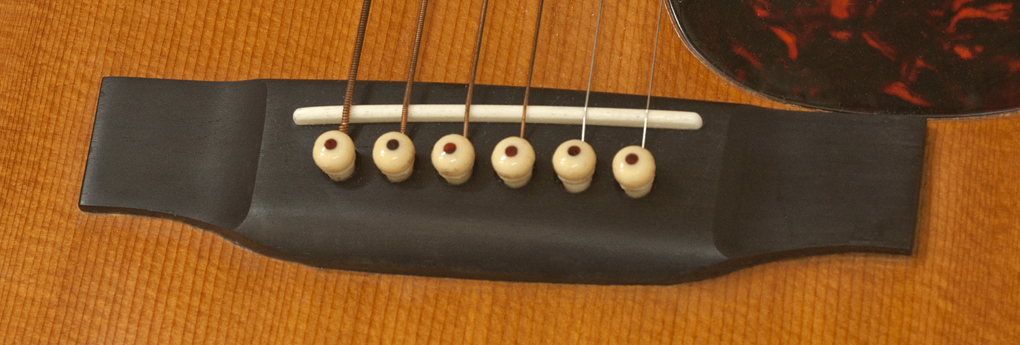
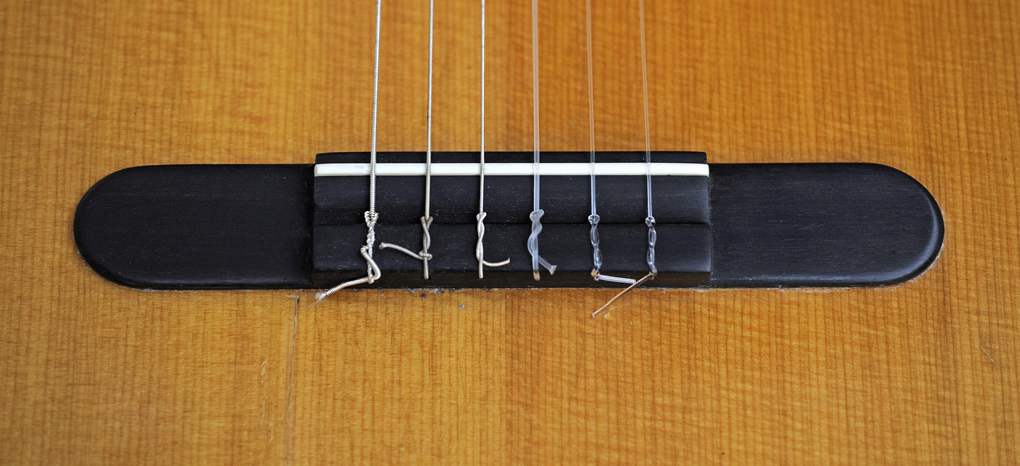
THE BRIDGE TO SOMEWHERE
The Evolution of Bridges on Martin Guitars
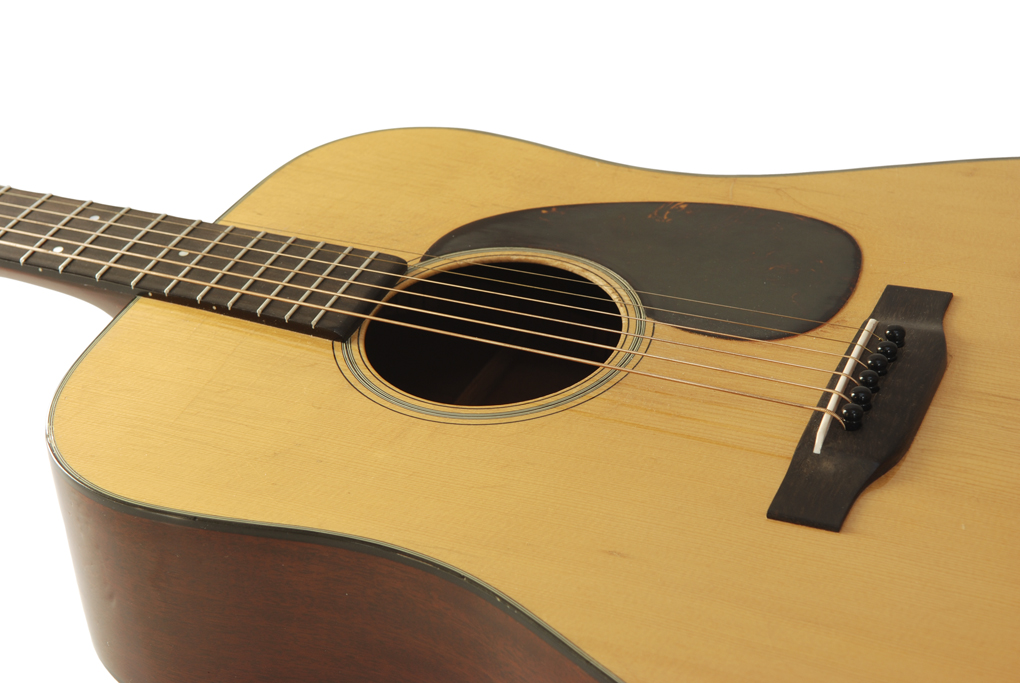
C.F. Martin used many bridge designs on his guitars. Here we trace the evolution of bridges used by Martin and his descendants through the years.
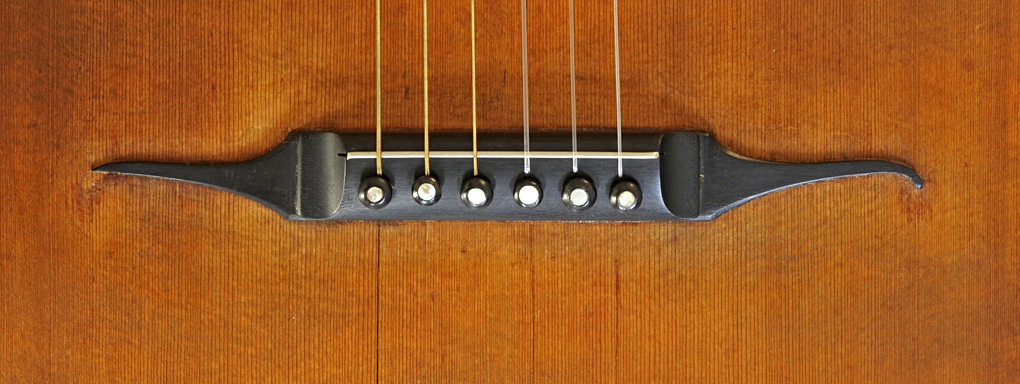
The "moustache" bridge, with a fretwire saddle, appears on early Stauffer and Martin "Stauffer Style" guitars.
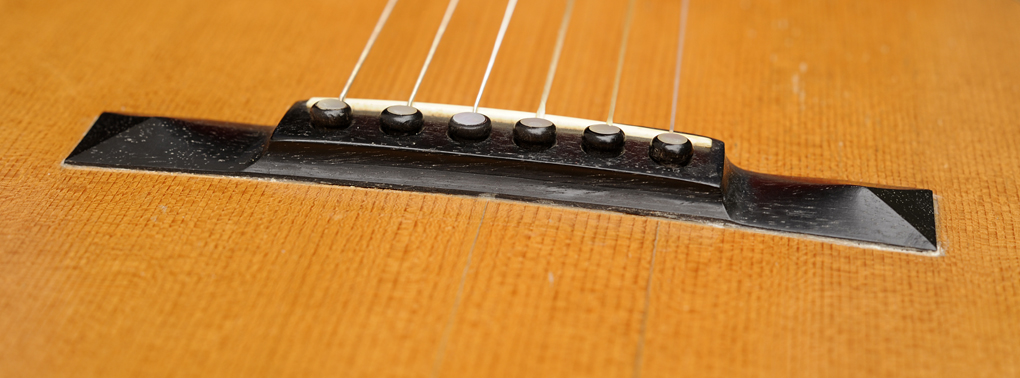
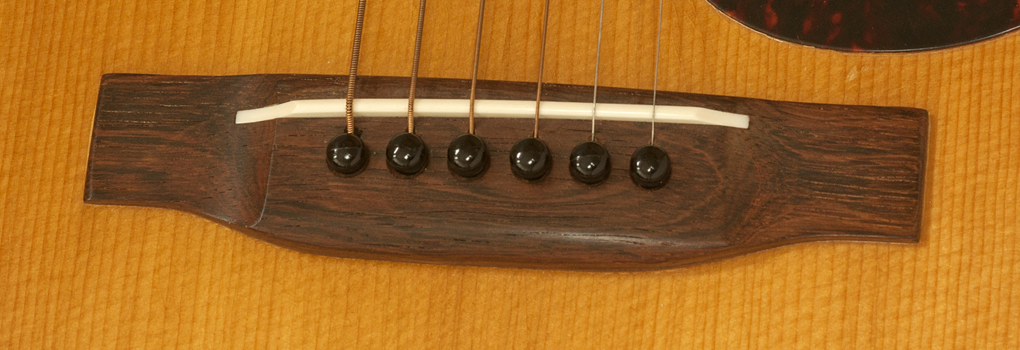
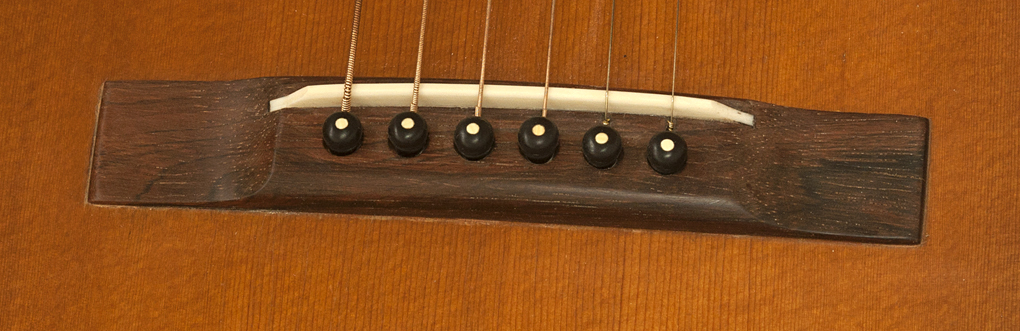
While the pin style bridge is generally associated with steel string guitars, you can see that Martin used pin style bridges with gut strings close to 100 years before introducing steet string guitars.
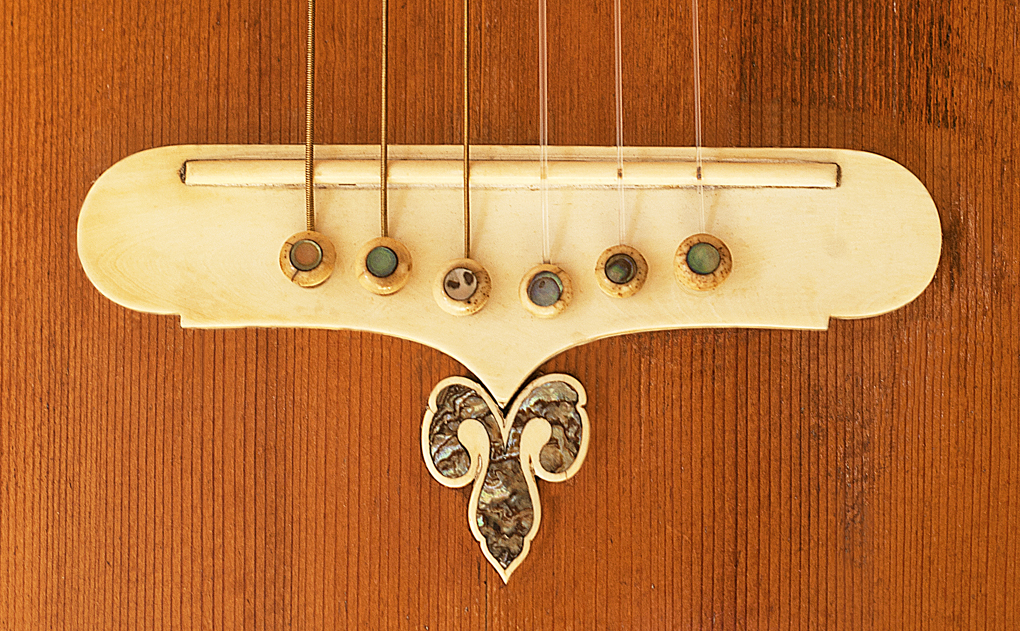
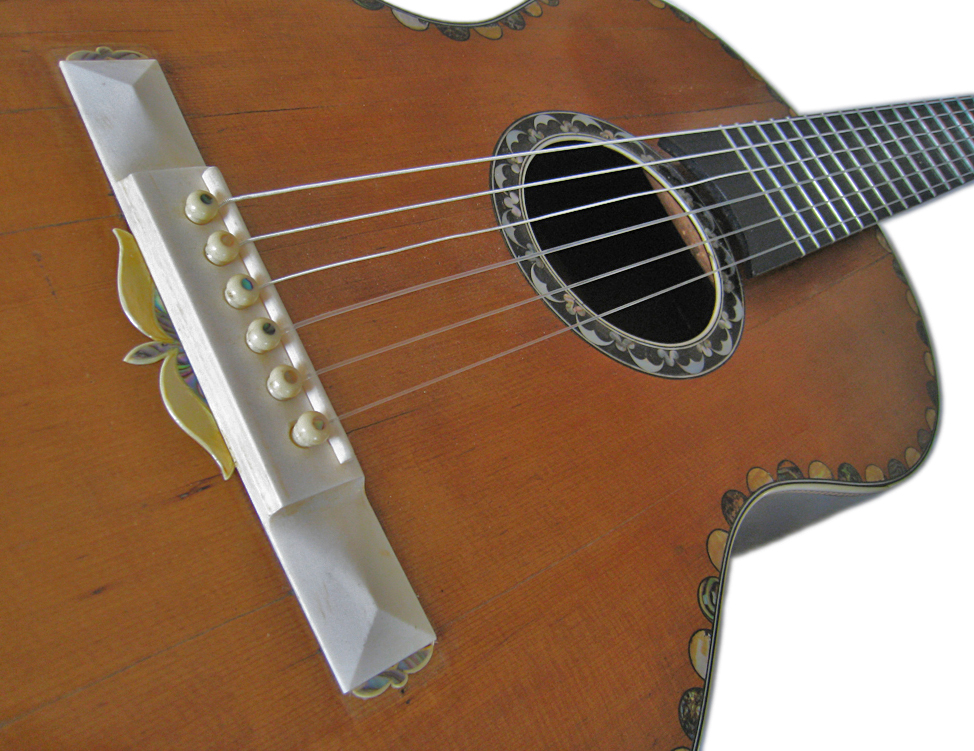
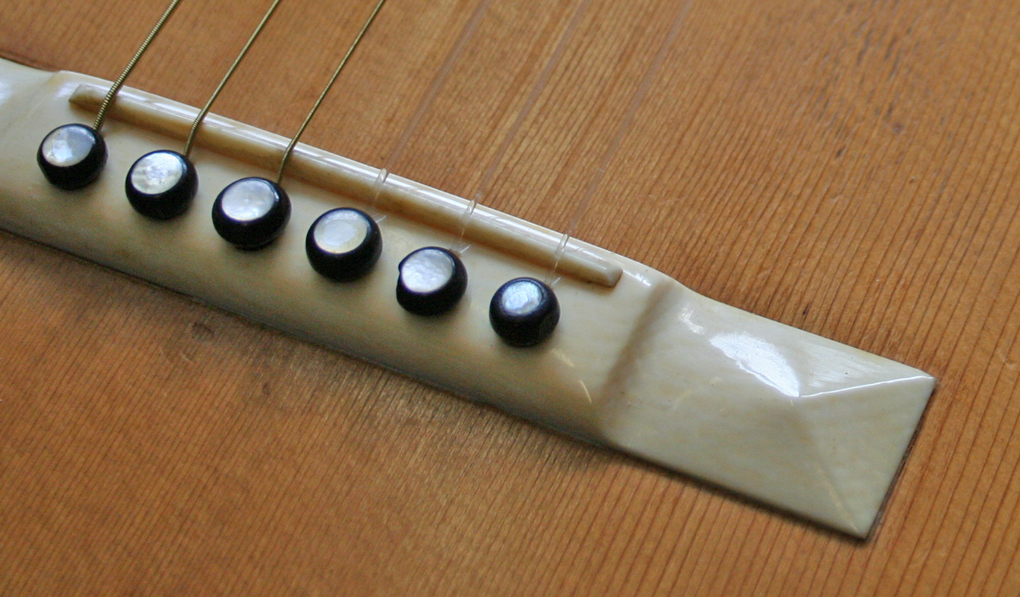
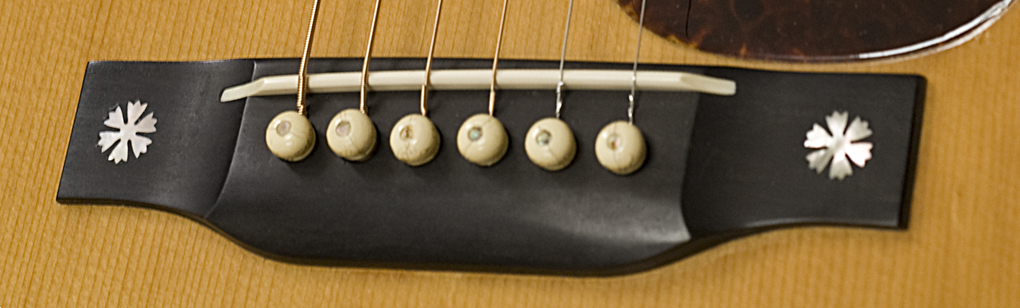
A number of early Martin, Martin & Coupa, and Martin & Schatz guitars, such as this one, have the "badge" or "shield" style bridge, in either ebony or ivory, here seen with an added "flower" or pendant. Some ivory versions have a fretwire saddle similar to those on the Stauffer "moustache" bridges. Some have a simple "drop in" ivory saddle such as this.
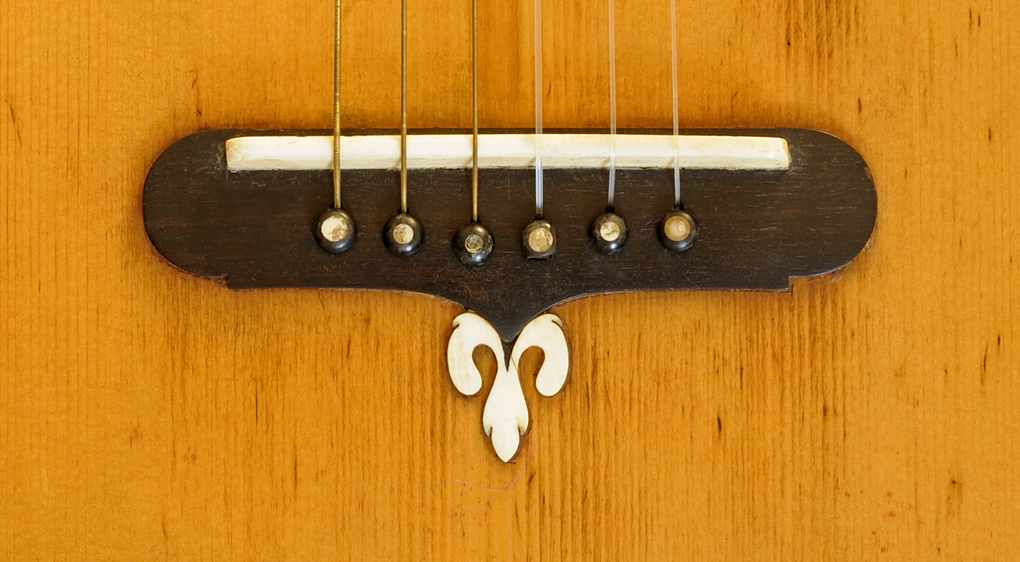
This Martin & Coupa has an ebony version with an ivory pendant.
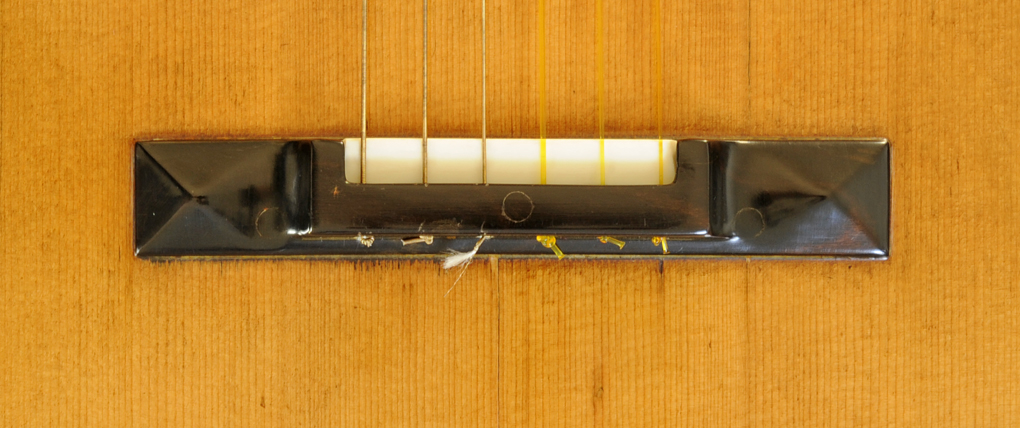
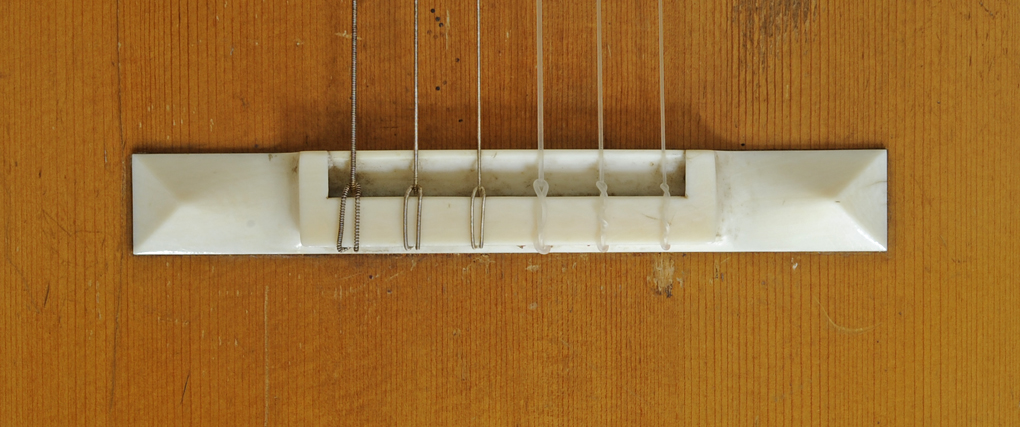
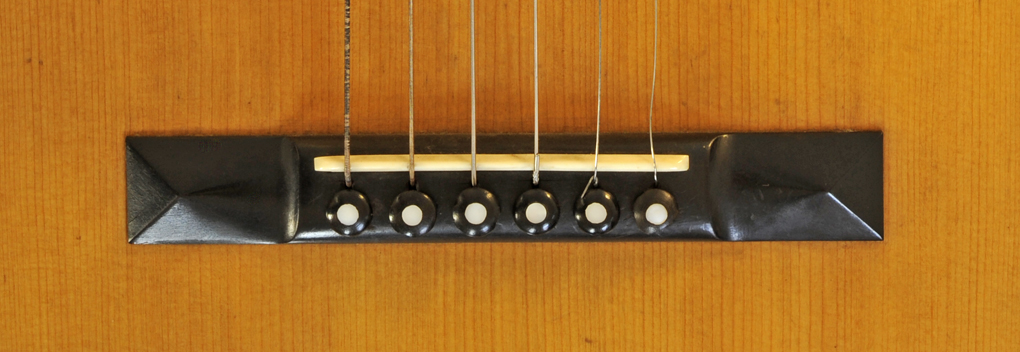
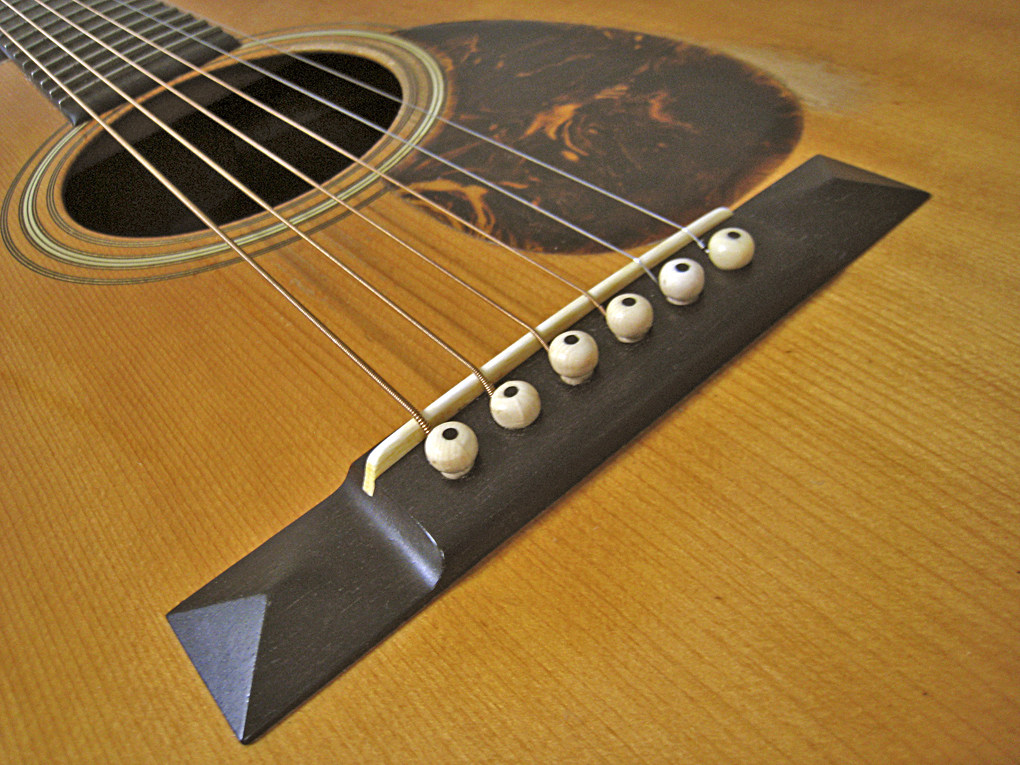
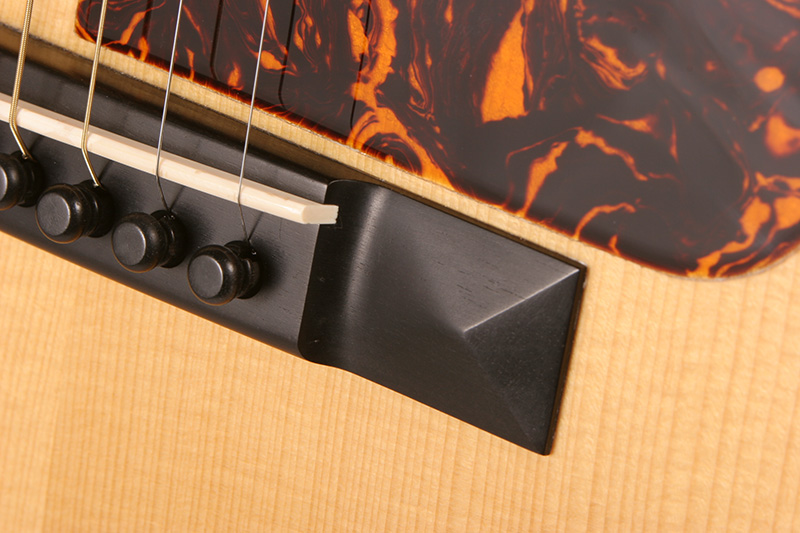
Many early Martin and Martin & Coupa guitars have a pyramid "tie" style bridge, such as those seen on early guitars from Spain.
Early versions, such as on this Martin & Coupa, are ebony with a wide ivory saddle which curves up to form a clean edge:
This Spanish style Martin, probably slightly later, has an ivory version of the tie style pyramid bridge, still with a wide curved ivory saddle.
The ivory tie style pyramid bridge is 25/32" x 5 29/32". The ebony tie style pyramid bridge above is a quite differently proportioned 29/32" x 1 27/32"
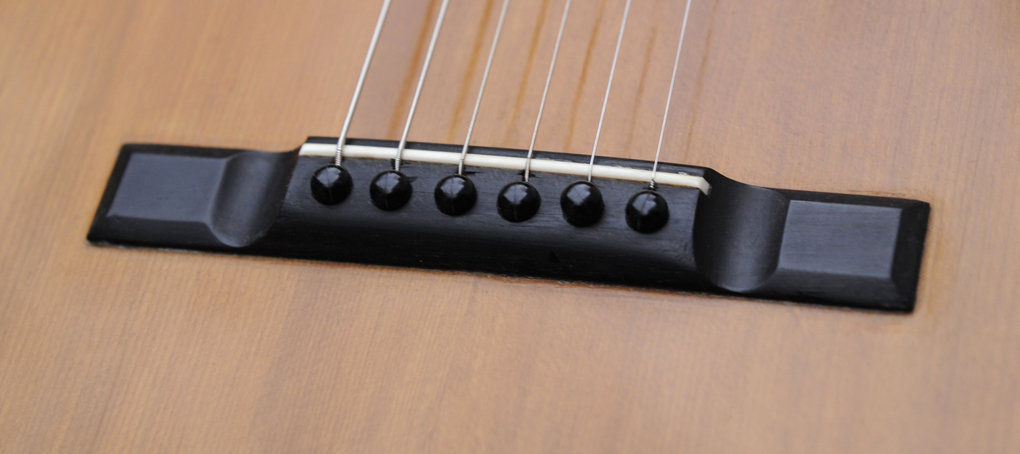
The earliest pin style pyramid bridge is only a slight step away from the "tie style" pyramid, with a similar "lipped" or scooped back, and the first notched "drop in" saddles.
As you can see from this example, the early pyramid bridges were paper thin.
This scooped back ivory pin bridge on this very early Hudson Street Martin is likely a replacement, but the decorative ivory and pearl pendants are most likely original from c. 1837. It's entirely possible, however, that this guitar did originally have a pyramid bridge.
The vestigal "lipped" or "scooped back", however, was only produced for a very short time.
I have an early spruce lined style 27 with the round back pyramid bridge. My early style 28 with checkerboard binding and early hybrid X-bracing has a pyramid bridge which is even longer than the style 34 mentioned above, but appears to be original, certainly very early, which has a round back as well. And the shark tooth rosette style 23 has a round back pyramid bridge as well.
I see that the lipped bridges I have are 27/32" x 5 27/32". Most of the early round back pyramids are 7/8" x 5 7/8".
My "sharks tooth" 23, with a 7/8" x 5 27/32" pyramid, might have been transitional.
I have style 24 Martins with both fan and X-bracing with the lipped or scooped back bridges.
I wonder if it might have only been used on certain style guitars.
While the measurements, such as the body width, of somewhat later Martins can vary considerably from one example to the next, the measurements of early Martins are extremely precise.
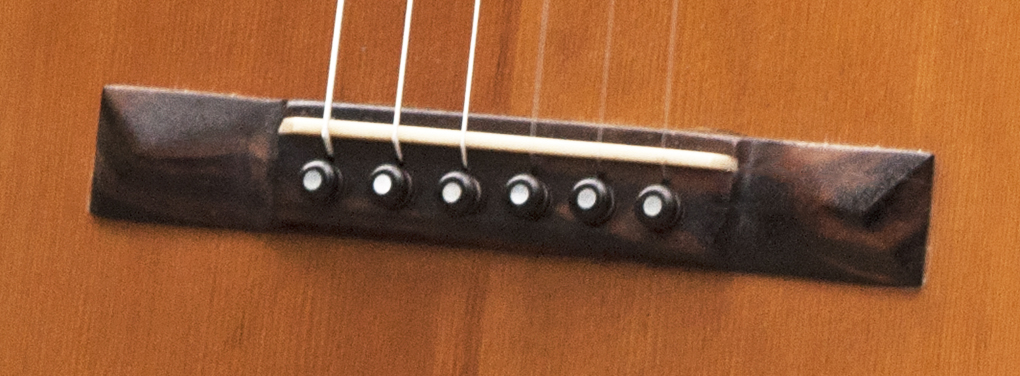
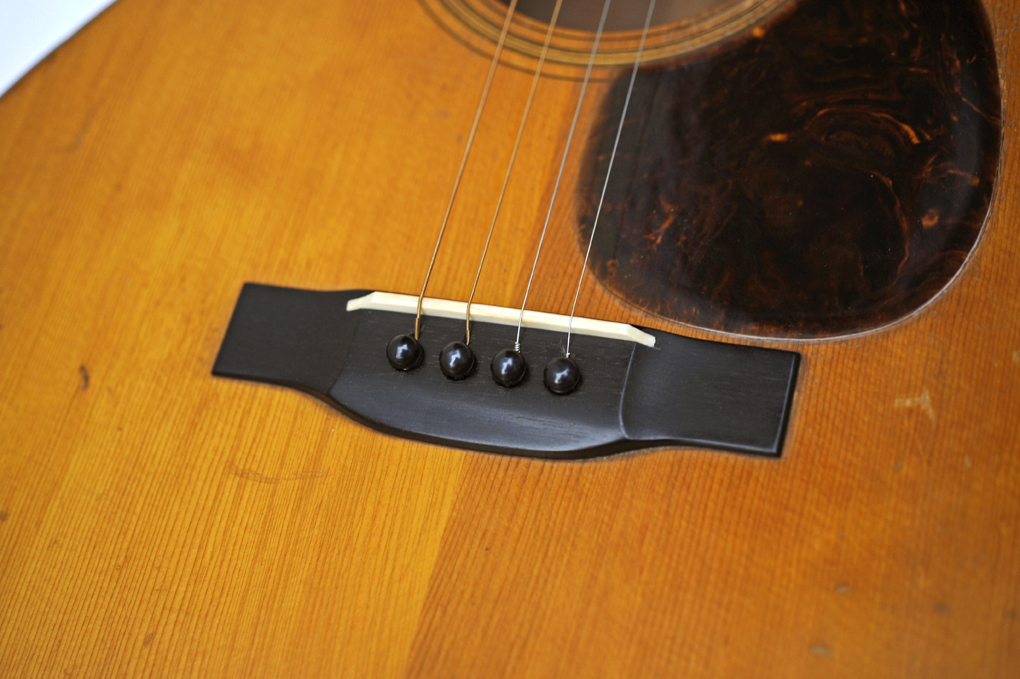
These are later round back pyramid bridges in ivory, which appear until about 1919 with a notched drop in saddle:
If you look carefully, in this photo you can see the center portion of the drop in saddle which fits into the bridge, while the a short portion of the saddle at either end fits over the bridge.
It is also clear from these photos that the saddle is parallel to the front edge of the bridge, with no compensation. The saddles are generally 1/8" from the front of the bridge.
This 2 1/2 - 17 is from 1889:
As you can see, many pyramid bridges made until just after the turn of the century were finished, and not bare wood.
Since Martin switched from a long saddle to a short saddle in 1965, most people assume that the long "through-cut" saddle pre-dated the short drop-in saddle. But as you can see, even earlier Martin bridges had short saddles before the long saddle appeared.
If you look carefully at the photograph of the ivory saddle above, you can see that the saddle is notched, with the exposed part of the saddle extending further than the shorter "drop-in" portion.
The new edition of Longworth, page 38, states that the notched saddles are "typical of pre-1910 Martins" while also saying "by the 1920's the saddle slot was open on both ends".
From what I've observed, by 1916 you start to see some saddles with a long visible top portion that extends to the ends, but that are still notched. The long through-cut saddles appear soon after.
The first of the through-cut saddles may have been on bridges purchased by Martin from Chicago in 1916.
Martin switched back to the short saddle in 1965.
During the boom years of the Hawaiian craze, as Martin was struggling to keep up with demand, the company purchased "Chicago Style" bridges supplied by Lyon & Healy, with flat, raised wings, and a long, through-cut saddle.
In 1920 Martin used some streaked ebony for bridges, which I assume is Macassar ebony.
1920 Martin/Ditson 1-21
At first I thought these bridges might have been added by Ditson, as Martin did ship some guitars "in the white", and some Ditsons do have
Chicago Style bridges which could have been added by Ditson.
...until I found this standard Martin 0-18 from the same year with the same color ebony:
1920 Martin 0-18
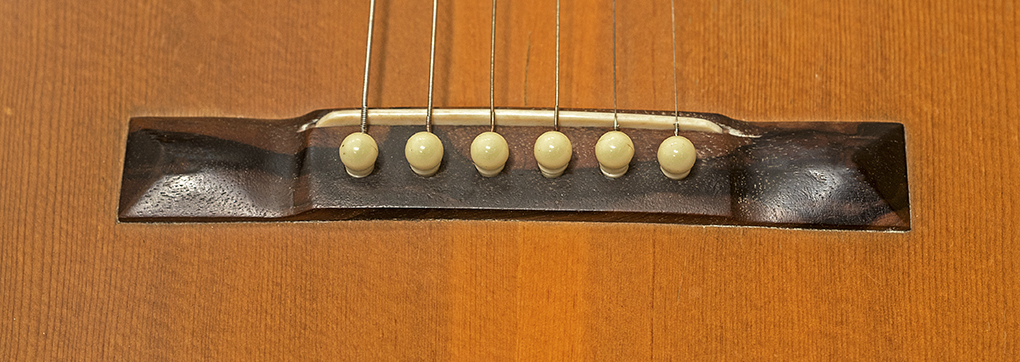
The ebony pyramid bridge was used until 1930, though it has been revived for models such as the new version of the Ditson 111.
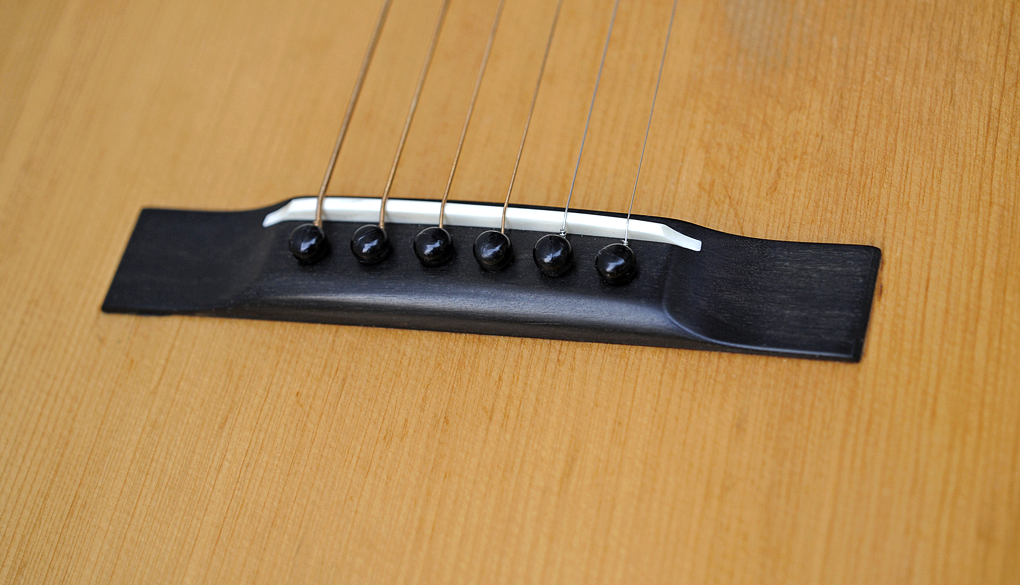
This pyramid bridge is on an early 1930 OM-28.
Here is an excellent reproduction pyramid bridge on the revived Martin Ditson Style111:
Less expensive Martins had a rectangular bridge in the 1920's with plain wings rather than the more expensive pyramids.
1926 00-18
On the Style 18 the plain wing rectangular bridge replaced the pyramid in 1926.
On the Stye 21 the plain wing rectangular bridge replaced the pyramid in 1929.
The pyramid bridge from the mid 1920's to early 1930 has a perfectly straight saddle exactly 1/8" from the front of the bridge. The center of the pin holes are 3/8" from the back of the saddle. The footprint of the bridge is exactly 6"x1". The center portion is 3 1/4" wide. The tops of the pyramids are 9/32" tall and 1/2" in from the ends of the bridge. The center of the bridge is exactly 1/4" tall at the front edge. The thinnest part of the bridge, at the dip between the pyramid and the center is exactly 1/16" tall, the same as the height of the "base" of the pyramids. The string spacing is 2 3/8".
The height of the bridges can vary from one example to the next.
My 1926 0-18 has a height of 9/32" at the bass end of the central portion, 9/32" in the center, an 5/32" at the treble end.
My '29 000-28 is 10/32", 10/32", 9/32". Both have straight saddles 1/8" back from the front edge.
My early 1930 OM-28 bridge is 9/32" high in the center, 1/32" lower on the bass end, and 1/16" lower on the treble end.
In 1930, Martin developed the "belly" bridge, with a larger footprint of exactly 6"x1"and more mass towards the back of the bridge, which extends to 1 3/8", to withstand greater tension from heavier steel strings.
The belly bridges built from 1931 to 1933 have a compensated saddle placed 1/8" from the font on the treble side, and 3/16" on the bass side.
Sometime in the mid 1930's, Martin moved the bass end of the saddle back again to 1/4" from the front of the bridge on belly bridge guitars.
The straight rectangular bridges remained at about 3/16" however.
While all Martin guitars built in 1929 were made with rectangular or pyramid bridges, a number of Martins from before 1930 can be seen with original looking belly bridges, which is the cause of some confusion.
Due to slow sales from the depression era economy, Martin still had a number of unsold instruments with serial numbers stamped in 1929 remaining in their factory for another two or three years, many of which were still unfinished,
without bridge attached, or "in the white". Martin fitted these with belly bridges before they left the factory, and additionally asked dealers to return unsold guitars which they retrofitted with belly bridges to ensure that they were
strong enough to hold steel strings.
Among the first of the Martins to have the belly bridge were the 18 style tenor guitars.
1931 0-18T Tenor guitar.
The belly bridges served Martin well as players moved toward the larger Dreadnaught guitars with heavier strings.
1944 Martin D-18
Martin Style 28 and higher models have always had ebony fingerboards and bridges, while lower models began with ebony bridges.
The Style 18 Dreadnaughts kept their ebony fingerboards and bridges until switching to rosewood in 1947.
On the smaller models, most Style 18 Martins switched to rosewood fingerboards and bridges in 1935, but for that year only. After 1935, most Style 18 fingerboards and bridges were made of ebony once again until the switch to rosewood in 1940.
1962 Martin 000-18
The OM-45 DeLuxe was the only catalogued Martin ever offered with an inlaid bridge, though these were common on many Chicago guitars.
1930 Martin OM-45 DeLuxe
While the Style 21 had moved to the belly bridge in 1930, Martin revived the old style plain wing rectangular bridge for the "New York" Style 21 models of the 1960's.
Martin continued to use genuine ivory for it's saddles through the 1960's.
1964 Martin 00-21NY
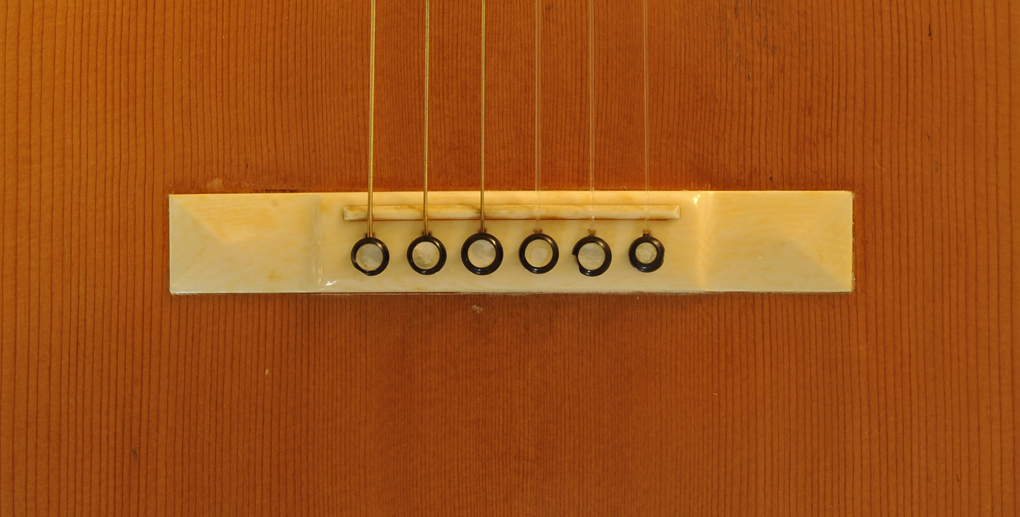
In 1965, Martin moved back to belly bridges with short drop in saddles. Most people, growing up with Martins of the 1960's, think of this as another new, and perhaps less desirable change, not realizing that Martin used drop in saddles for most of their existance, only using through saddles for roughly 50 of their 175 years.
While the "through" saddles were glued in, the "drop in" saddles are not, allowing one to swap out saddles easily. I know one highly regarded luthier who prefers replacing vintage through saddles with drop in saddles to allow player/owners to change to different height saddles to compensate for the changes in geometry that come with seasonal changes in hunidity. The drop in saddle slots are prepared in a way that allows one to extend them later with a router, if one wishes, to convert the bridge to accept a through saddle.
Note the original tortoise dot bridge pins, often referred to as "red dot" pins, which appeared in about 1945 and were in use until 1966.
1965 Martin D-35
Martin revived the tie style bridge for it's later classical guitars such as the 000-28C of the 1960's, once again with an ivory saddle with no compensation.
1962 000-28C
Notes:
a) Pyramid bridges should have a curved slope on the inside portion of the pyramid. Bad copies have four straight edges. The saddles were not slanted until ( ), and they were also drop in for 80 years until 1919. The through saddle didn't start until 1919 (1920?) and lasted until about 1968 when they went back to the drop-in style. I have seen a 1920 0-28 with a drop in saddle.
b) Size:
1. Size 1 and larger from all years have bridges 6" long
2. Size 2 and 2 1/2 Martins have bridges 5 7/8" to 5 3/4" long. At least until the 1890s.
I see that the lipped bridges I have are 27/32" x 5 27/32". Most of the early round back pyramids are 7/8" x 5 7/8".
PYRAMID BRIDGE LENGTH
The earliest pyramid bridges, at least going back to the 1850's, are 5 7/8" long.
From the mid 1890's through the 1930 OM, they are 6" long.
The pyramid bridge from the mid 1920's to early 1930 has a center portion that is 3 1/4" wide. The tops of the pyramids are 9/32" tall and 9/32" in from the ends of the bridge.
Some from the 1870's to the 1890's are 5 3/4" long.
PYRAMID BRIDGE WIDTH
Most before 1900 are roughly 7/8" wide. Some from the 1840s or 1850s are 13/16" wide.
Most after 1900 are 1" wide.
I have one from 1926 that is 15/16" wide.
PYRAMID BRIDGE WINGS
The average length of the wings on most pyramid bridges is roughly 1 3/8"
During the 1880's and 1890's, however, there is more variation, as much as from 1 1/4" to 1 1/2"
On the earlier 7/8" wide bridges, the wings have a very long, narrow, elegant appearance, with a gentle curve to the inside angles of the pyramids, that looks nothing at all like the harsh angles found on many of the bad copies.
I found no difference between the dimensions of ivory and ebony bridges from the same period.
It's interesting that the earlier years have more consistency in length than the middle years. Some time ago I did a survey of the body dimensions of my early guitars, and I found the earliest years to be precise, while the middle years had much more variation.
This 1885 0-34 bridge is the longest and narrowest of the lot, 6" long, 7/8" wide, with 1 1/2" long wings:
PYRAMID BRIDGE HEIGHT
From the mid 1920's, the center of the bridge is usually 1/4" tall at the front edge. The thinnest part of the bridge, at the dip between the pyramid and the center is exactly 1/4" tall.
The height of the bridges can vary from one example to the next.
My 1926 0-18 has a height of 9/32" at the bass end of the central portion, 9/32" in the center, an 5/32" at the treble end.
My '29 000-28 is 10/32", 10/32", 9/32". Both have straight saddles 1/8" back from the front edge.
My early 1930 OM-28 bridge is 9/32" high in the center, 1/32" lower on the bass end, and 1/16" lower on the treble end.
STRING SPACING
The string spacing on 20th century Martins is generally 2 3/8".
On early Martins, it appears that Martin was moving to 2 5/16" spacing on size 2 guitars, and 2 3/8" spacing on size 1.
(all listed are pre-1867 unless otherwise noted)
Original Stauffer - moustache bridge. 2 5/16"
Hudson Street - replacement ivory pin bridge. 2 5/16"
Early fancy Spanish size 3 - ivory tie bridge. 2 7/16"
Ivory fingerboard Stauffer headstock - replacement ebony pin bridge. (I've wondered if the original was ivory pin or tie). New bridge plate. 2 1/4"
Early Spanish Martin & Coupa - ebony tie bridge with ivory inset 2 9/32"
Koa Martin & Coupa - shield shape bridge, pins in arc. 2 5/16"
LIGHT DIAMOND BACKSTRIPS/ Spanish foot
Hybrid X 1-28 2 3/8"
LIGHT DIAMOND BACKSTRIPS/ split neck blocks, old marquetry end
2-23 2 1/4"
2-24 2 5/16"
2-24 2 5/16"
2-20 2 5/16
DARK DIAMOND BACKSTRIPS
2-23 2 5/16" (solid block)
2- 21 2 5/16" (split block)
2-20 with herringbone backstrip, old marquetry end 2 5/16
1-26 with zig zag marquetry border 2 3/8"
1-21 with zig zag marquetry rosette 2 5/16"
Early 1-28 with pearl rosette 2 7/16"
Early 2-27 2 5/16"
post '67 2-27 2 5/16"
1890's 2-42 2 5/16"
COMPENSATED SADDLE ANGLES
Early pyramid bridge have straight saddles 1/8" back from the front edge of the bridge. The center of the pin holes are 3/8" from the back of the saddle.
The belly bridges built from 1931 to 1933 have a compensated saddle placed 1/8" from the font on the treble side, and 3/16" on the bass side.
Sometime in the mid 1930's, Martin moved the bass end of the saddle back again to 1/4" from the front of the bridge on belly bridge guitars.
The straight rectangular bridges remained at about 3/16" however.
vintagemartin.com
To See Robert Corwin's Classic Photography of Folk and Roots Musicians, visit:
For Information on Photography for
Exhibition, Publication, CD's, Promotion, Web Pages, Tour Books,
to Purchase Photographic Prints, or
If You Have Questions or Suggestions About This Web Site or Vintage Martin Guitars:
e-mail: Robert Corwinentire site copyright ©1998 through 2015 Robert Corwin/Photo-Arts. All rights reserved.