C.F. Martin Guitar Sizes
These are various sizes in which the Style 28 was produced.
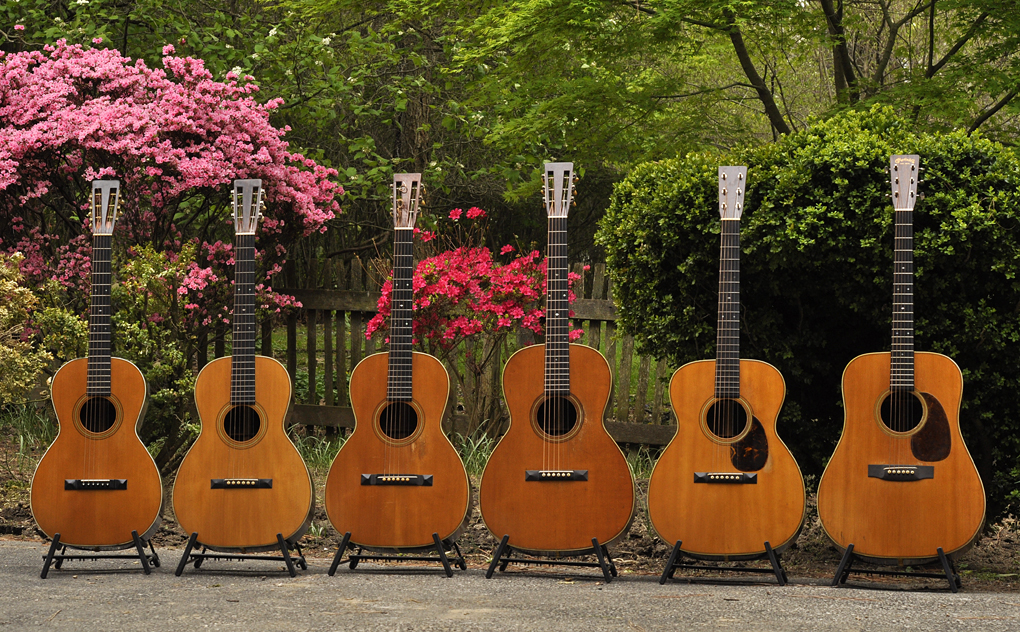
1-28, 0-28, 00-28, 000-28, OM-28, D-28
These are the sizes of guitars common in Martin's first decades.

Stauffer Martin, Hudson Street Martin, Size 3, Size 2 1/2, Size 2, and Size 1.
Martin Guitar Sizes
In the 1960's, the Martin guitar, and more specifically, the Martin Dreadnaught, became identified as the industry standard for all serious guitar players, not just for Bluegrass, but for all players in the "Folk" movement that swept the world. Even a 000 size Martin was considered too small to be relevant. By the early 1970's, the D-35 became the preferred side-arm of the growing crop of singer-songwriters.
By the 1980's, the 000 size, with the help of Eric Schoenberg's discovery of the OM, and a photo of Stephen Stills with a pre-war 000-45, became recognized as the ideal guitar for fingerpickers. To this day, however, a 000 is considered a "small" guitar, and anything smaller is thought of as a "toy".
Martin started in the 1930's with relatively large Viennese style guitars, though by the 1840's Martin had reverted to the smaller "parlor" size guitar, and guitarists were very slow to accept larger guitars.
While perceived as a tiny guitar by today's standards, the size 1 was considered to be Martin's "Standard" size guitar, and was tremendously popular in Martin's early years, as was the beginner's size 2 1/2.
While the single 0, the first guitar designed specifically for use in "concert", as opposed to the "parlor", appeared in 1854, the larger 00 size "Grand Concert" did not appear until 1873, nearly 20 years later.
When the 000 was introduced in 1902, it sold very poorly, and was not widely accepted until the 1920's.
Martin has always been specific about the intended use for it's various size guitars.
0000, M, and F - Grand Auditorium
000 and C - Auditorium
00 and R - Grand Concert
0 - Concert
1 - Standard
2 - Ladies
2 1/2 - Child's
5 - Junior
With the introduction of the 2-17, the 2 size was referred to as an Amateur guitar.
Identifying Martin Guitar Sizes by Body Width
12 Fret
Dreadnaught - 15 5/8"
000 - 15"
00 - 14 1/8"
0 - 13 1/2
1 - 12 3/4"
2 - 12"
2 1/2 - 11 5/8"
3 - 1 1/4"
3 1/2 - 10 11/16"
5 - 11 1/4"
14 Fret
Dreadnaught - 15 5/8"
000 - 15"
00 - 14 5/16"
0 - 13 1/2
5 - 11 1/4"
The 1898 Martin catalog includes descriptions of the various sizes:
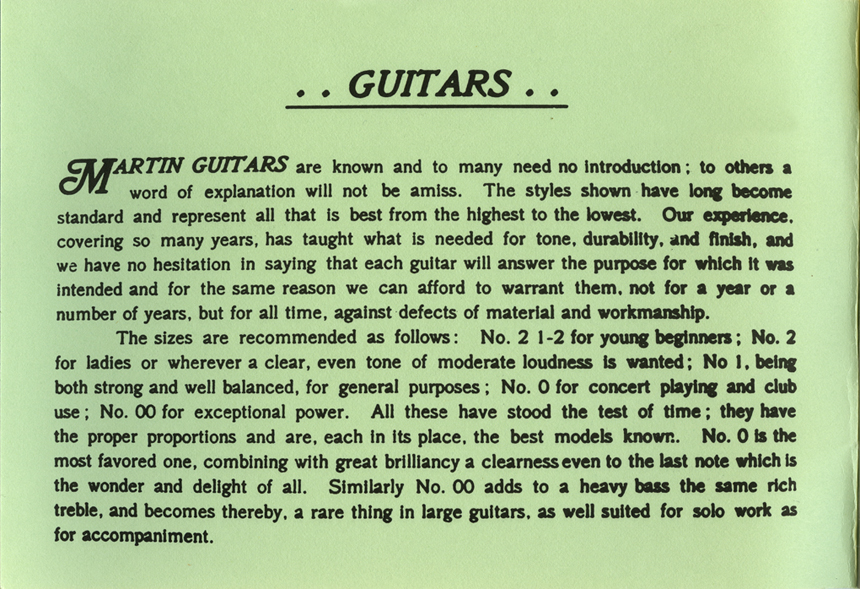
Martin was consistent over the years in the size 0 being their favorite guitar when extra volume was not necessary.
Some folks believe a larger body is required to provide adequate bass, and feel that less than a 000 or Dreadnaught is inadequate in this regard.
I've discovered that a single 0 has a wonderful bass response, providing a well defined and more 'concise" bass that is often heard more clearly in the mix.
Comparing Martin Guitar Sizes by Area and Volume
While 00 12 and 14 fret tops are almost identical in top size, the 000 12 fret top is noticeably larger than a 14 fret 000 top.
I always thought a 00 12 fret compared quite well to a 000 14 fret. In fact, the top of a 000 14 fret is only a bit larger than halfway between the size of a 00 and 000 12 fret.
Circumferences of Tops
Size 0 12 fret 54.5"
Size 0 14 fret 55.25"
Size 00 12 fret 57.025"
Size 00 14 fret 57.375"
Size 000 12 fret 61"
Size 000 14 fret 59.5"
Areas of Tops
Size 0 12 fret 186 sq. in.
Size 0 14 fret 190 sq. in.
Size 00 12 fret 203 sq. in.
Size 00 14 fret 206 sq. in.
Size 000 12 fret 233 sq. in.
Size 000 14 fret 221 sq. in.
Depth at Neck
Size 0 12 fret 3.375"
Size 0 14 fret 3.4"
Size 00 12 fret 3.25"
Size 00 14 fret 3.3125"
Size 000 12 fret 3.25"
Size 000 14 fret 3.25"
Depth at End
Size 0 12 fret 4.1875"
Size 0 14 fret 4.25"
Size 00 12 fret 4.125"
Size 00 14 fret 4.125"
Size 000 12 fret 4.125"
Size 000 14 fret 4.125"
The single 0 Martin is slightly deeper than a 00 Size Martin.
Comparing the volume of 14 fret, the 00 is 800 cu. in. compared to 754 for the single 0.
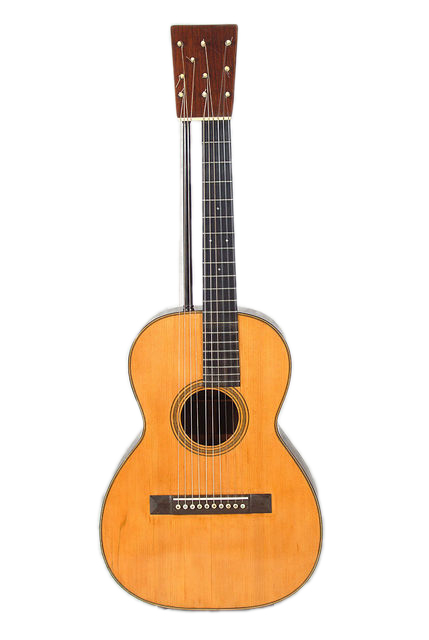
The first 000 size Martin was introduced in 1902. The early larger 000 were produced to accommodate 10 strings:
The first two 000-42 Martins, including this steel string Ditson, appeared in 1918.
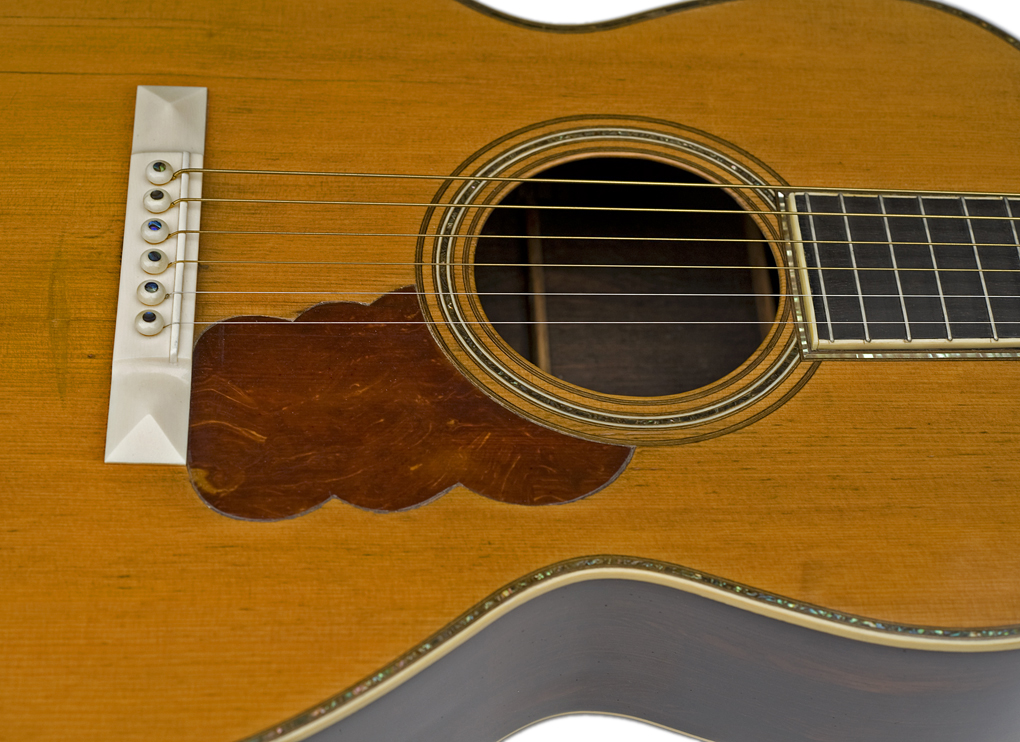
In the first twenty full years of 000 production, Martin never sold more than five individual examples per year of any one model in that size.
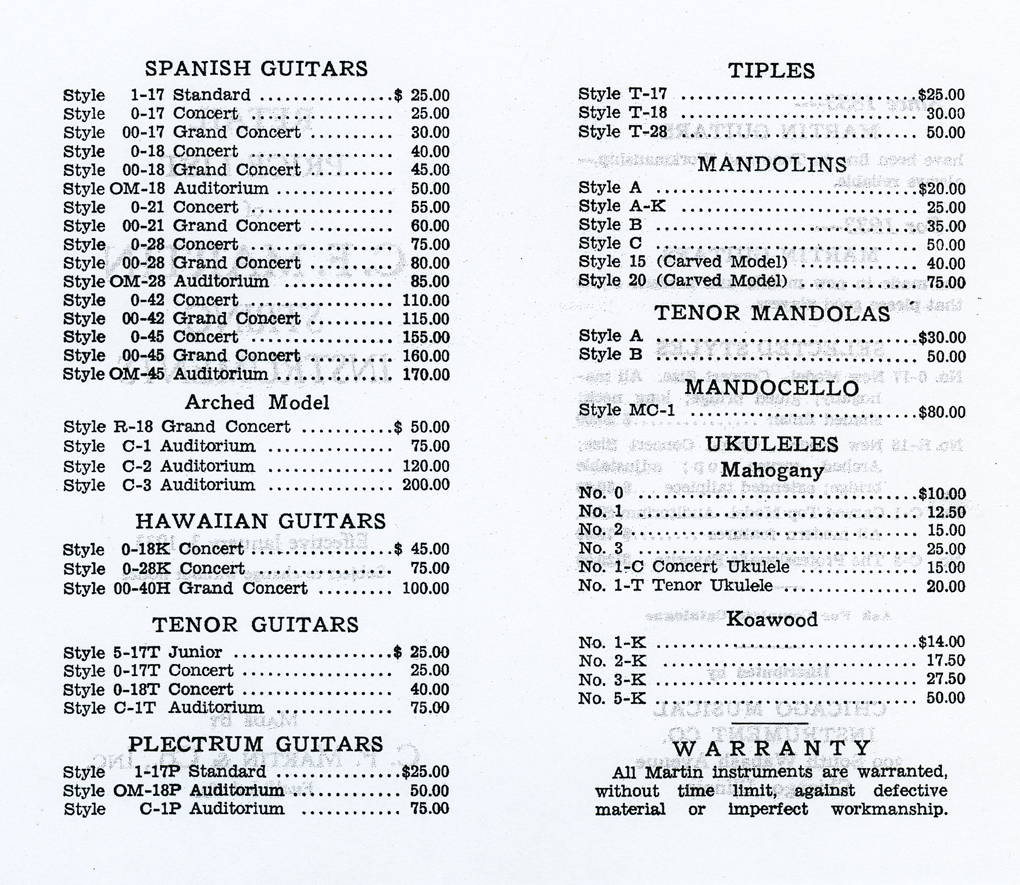
The 1930's catalogs included a listing of sizes:
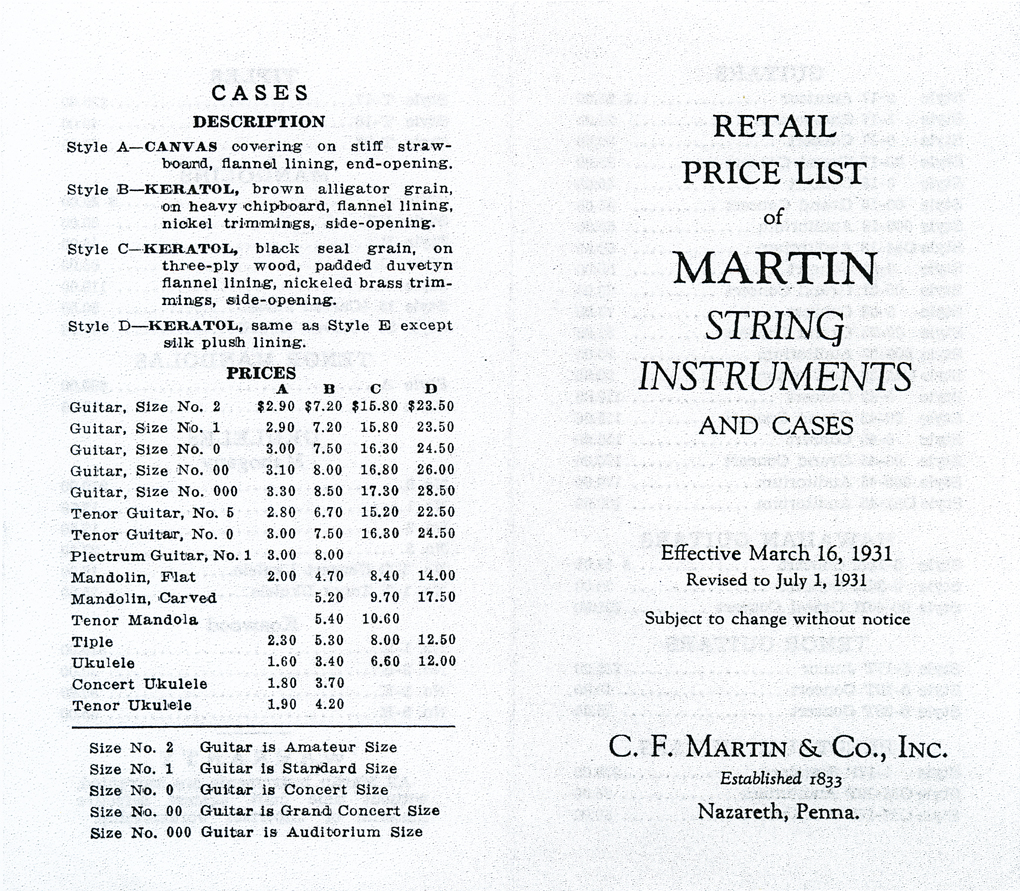
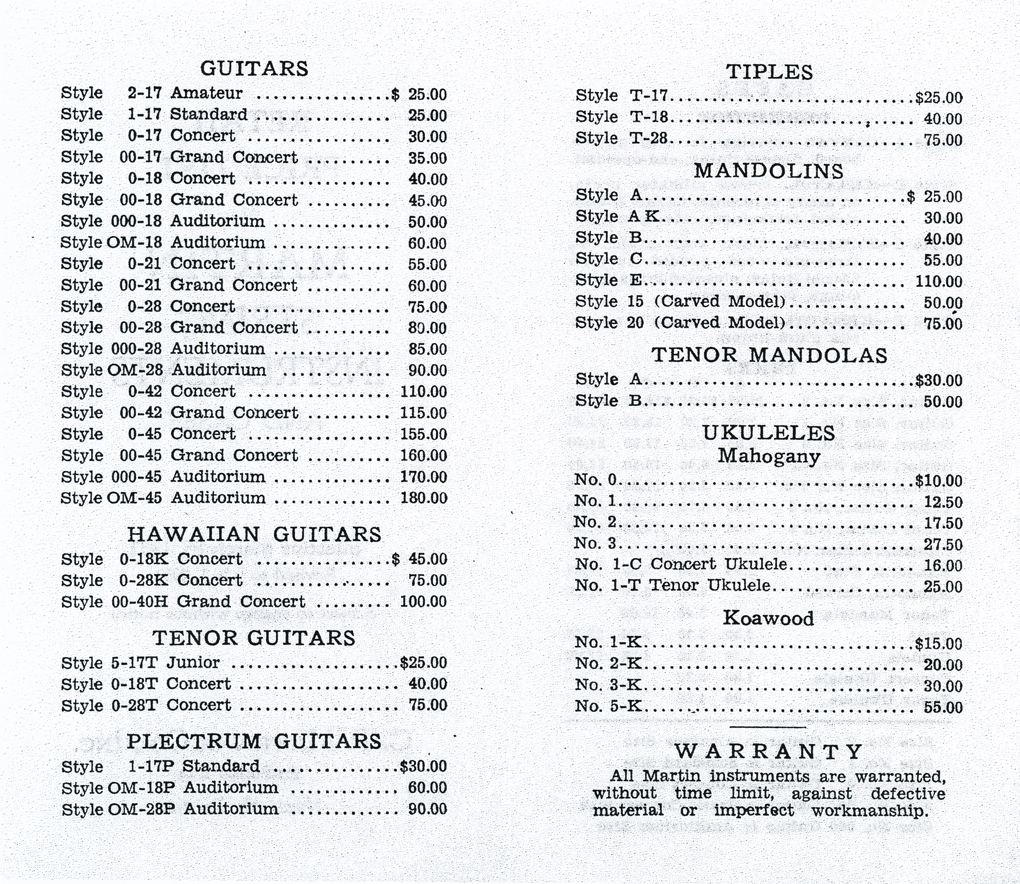
The 1933 Catalog includes archtop guitars:
The sizes of the 14 fret Style 18
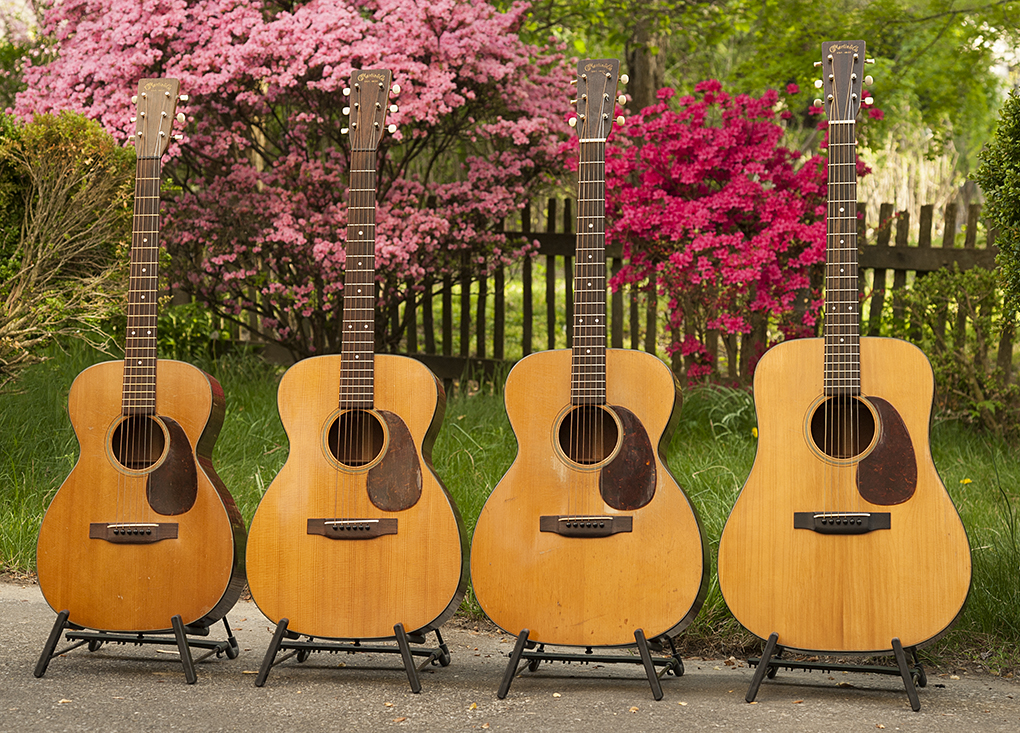
Martin 0-18. 00-18, 000-18, and D-18, all from 1945.
The sizes of the 12 fret Style 18
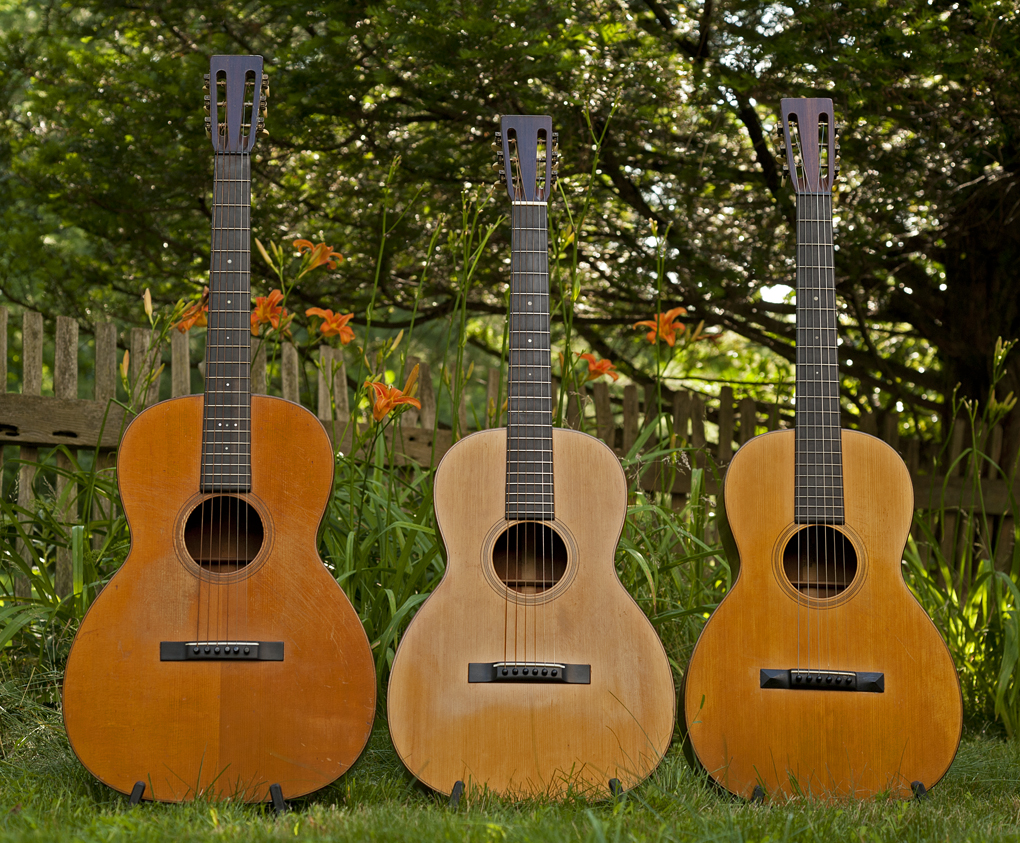
Martin 12 Fret 000-18. 00-18, 0-18.
Martin only began to produce the 000 in the 20th century, and only a handful were produced before the 1920's. The entire 12 fret production run only reached a total of 1,038 000-18 and 329 000-28 before ending in 1931, shortly after the OM was introduced, so while the 12 fret 00 has lived on through the years in the form of the 00-21, few people have even seen a pre-war 000 12 fret to see how relatively huge these guitars are, while most folks think of anything less than a Dreadnaught as a "small body guitar".
1902 to
1919 1920 to
1931
000-17 1
000-18 14 1024
000 - tenor 2
000 - plectrum 49
00-21 18 6
000 harp 4
000-28 27 302
000-42 2 12
000-44 3
000-45 16 126
000 - 7 string 1 2
total # 000's 86 1523
000-17 1
000-18 14 1024
000 - tenor 2
000 - plectrum 49
00-21 18 6
000 harp 4
000-28 27 302
000-42 2 12
000-44 3
000-45 16 126
000 - 7 string 1 2
total # 000's 86 1523
Comparing 12 and 14 Fret Martin Guitars
As we can see in this comparison with the 14 fret 000-28, the longer bodies make the 12 fret Martins surprisingly large guitars compared to the 14 fret Martins with the same size designations.
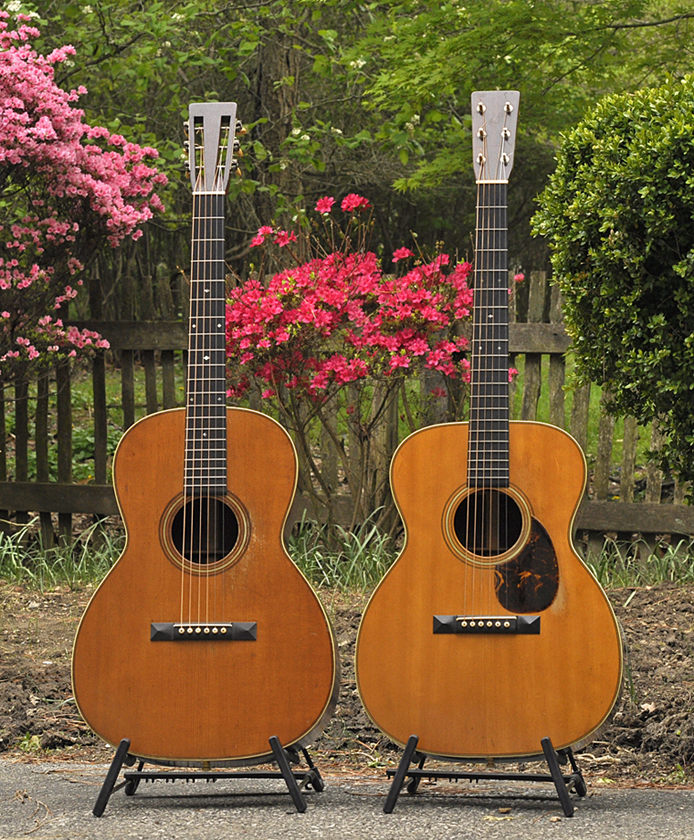
The 12 Fret 1928 000-28 and early 1930 OM-28
Sizes of Early 12 Fret Martin Guitars
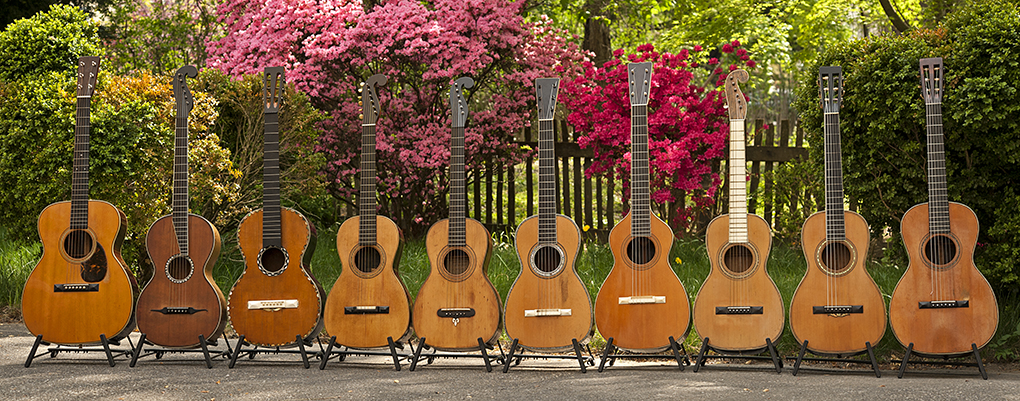
Early Martins, from a Martin Stauffer and Hudson Street Martin to various assorted parlor size guitars, roughly equivalent to but from before the standardization of the size 2, 2 1/2 and 3, to a size 1 with alternative X bracing, with an early 14 fret Orchestra Model on the far left for comparison. In context, the size 1 is a surprisingly large guitar, as with the 000 above, making up for in length a good part of what it lacks in width compared to a modern 14 fret guitar.
Production of the size 1 in styles 21 and above ended in 1921, and the style 18 in 1926, with the 1-17 and plectrums holding on until 1932. The entire 20th century production of all size 1 Martins only reached 3,506, 1,569 of which were the inexpensive Style 17 and plectrums, which were less likely to be cared for or survive. So while the size 0 has remained in production to this day, relatively few people have seen a size 1 Martin. The size 1 is in actuality a relatively large guitar by traditional standards, and only a small bit smaller than a size 0, however it's obscurity has led people to think of the size 1 as "one of those tiny little early Martin parlor guitars".
These are the special sizes in which Martin produced guitars for the Oliver Ditson Company.
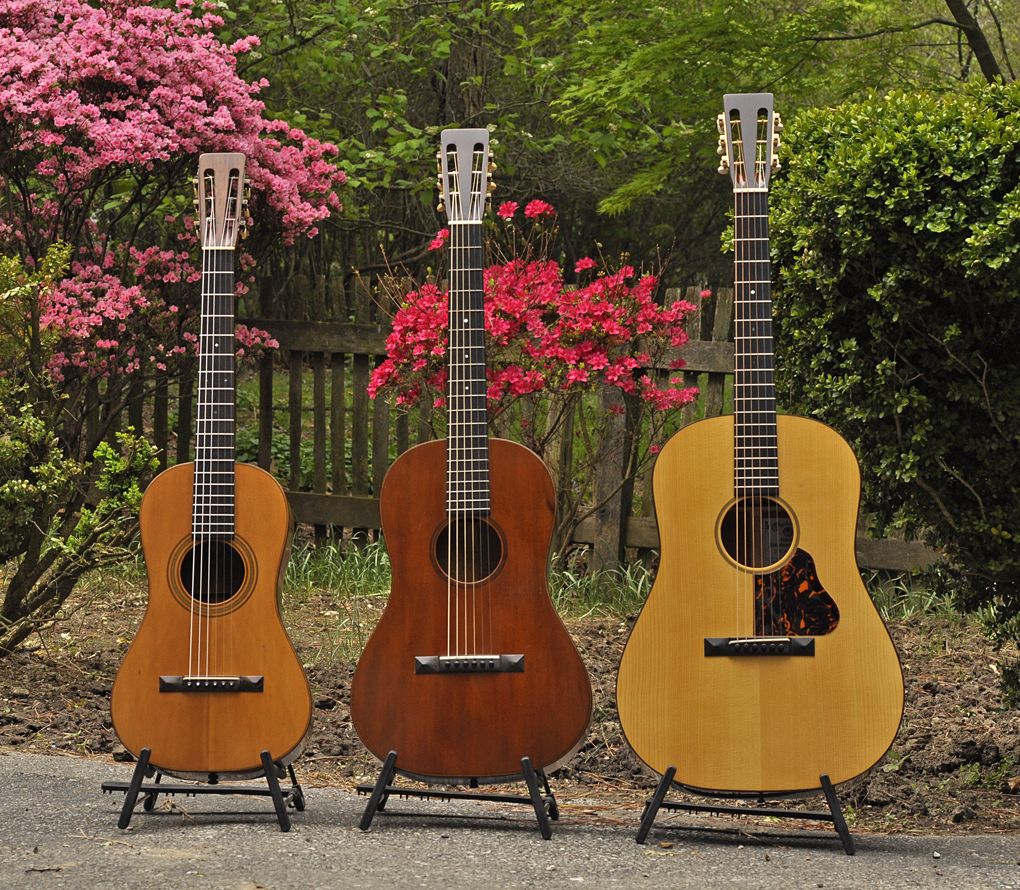
Size 1 Standard, size 11 Concert, and size 111 Extra Large or Dreadnaught
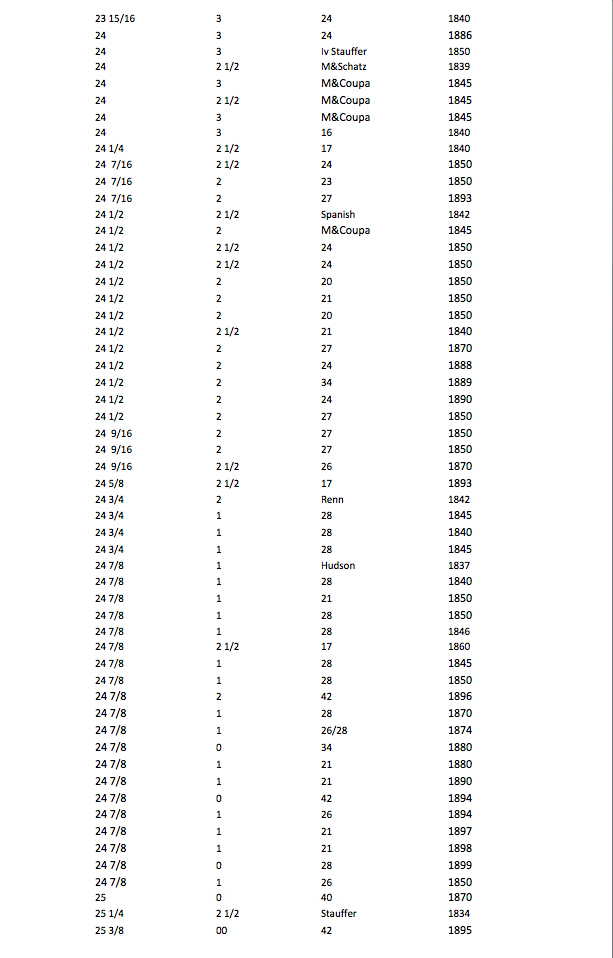
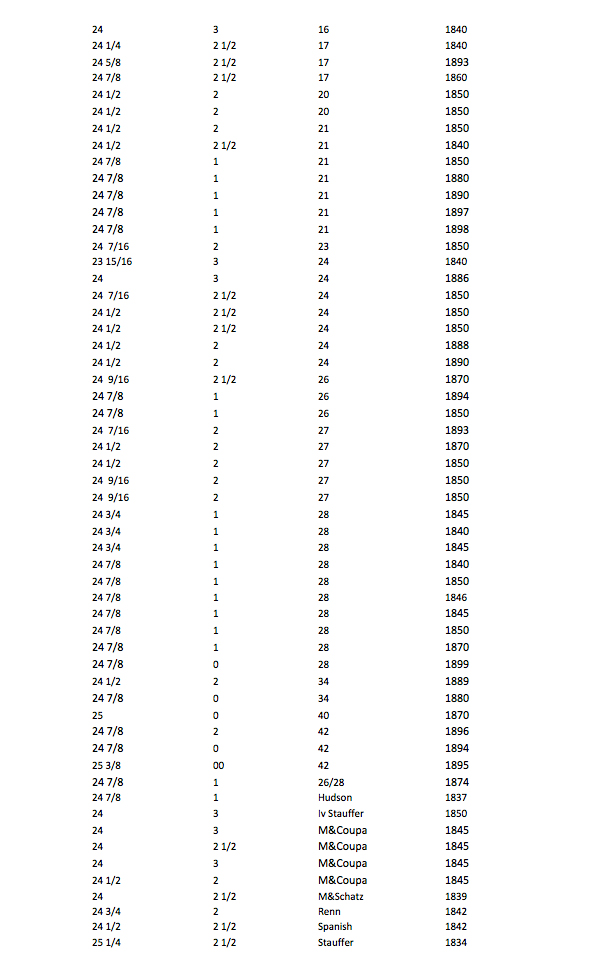
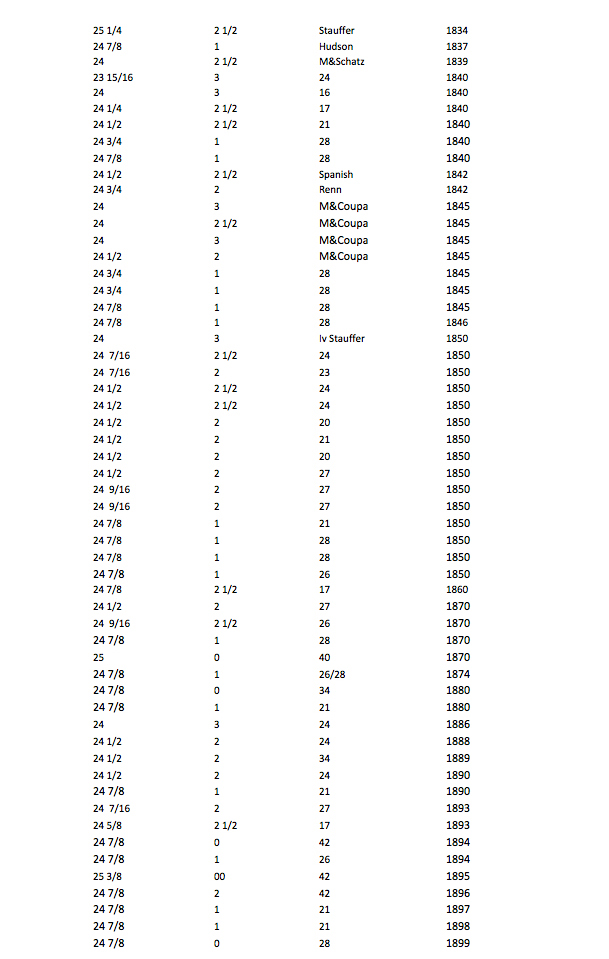
SCALE LENGTHS OF 19th CENTURY MARTINS
The following is a sampling of the scale lengths of early Martins illustrated on this web site.
The
following are sorted by scale length, size, model, and year, so we
can look for patterns:
The
earliest Martin scales were quite long, following by a period
of 24" scales.
The pearl top Martins, 0-40, 2-42, and 00-42, are more often "long scale".
The pearl top Martins, 0-40, 2-42, and 00-42, are more often "long scale".
The early size 1 tend to be 24
3/4"
Later size 1 and 0 are 24 7/8"
The size 2 and 2 1/2 are mostly
24 1/2", though the 2 1/2 are often early and these vary the
most.
The size 3 and early small
models tend to be 24"
BY SCALE
BY
SIZE
BY
MODEL
BY DATE
earlymartin.com
To See Robert Corwin's Classic Photography of Folk and Roots Musicians, visit:
For Information on Photography for
Exhibition, Publication, CD's, Promotion, Web Pages, Tour Books,
to Purchase Photographic Prints, or
If You Have Questions About An Early Martin Guitar:
e-mail: Robert Corwinentire site copyright ©1998 through 2017 Robert Corwin/Photo-Arts. All rights reserved.