STRUNG OUT
Strings on Martin Guitars
"Built for Steel"
The first question one asks about a vintage Martin guitar is often "was it built for steel strings?"
We should make a distinction here between "built for steel", "shipped with steel strings", "regulated for steel", and "capable of handling steel strings".
The Martin Style 2-17 Guitar
Thanks to extensive research in the Martin archives by John "Woody" Woodland, we now know that Martin began the process of shipping their standard (as opposed to Hawaiian) guitars, with steel strings as standard equipment, with two Martin Style 2-17 guitars, #16879 and #16887, shipped to the John Wanamaker Department Store in Philadelphia on March 27, 1922.
This is #16879:
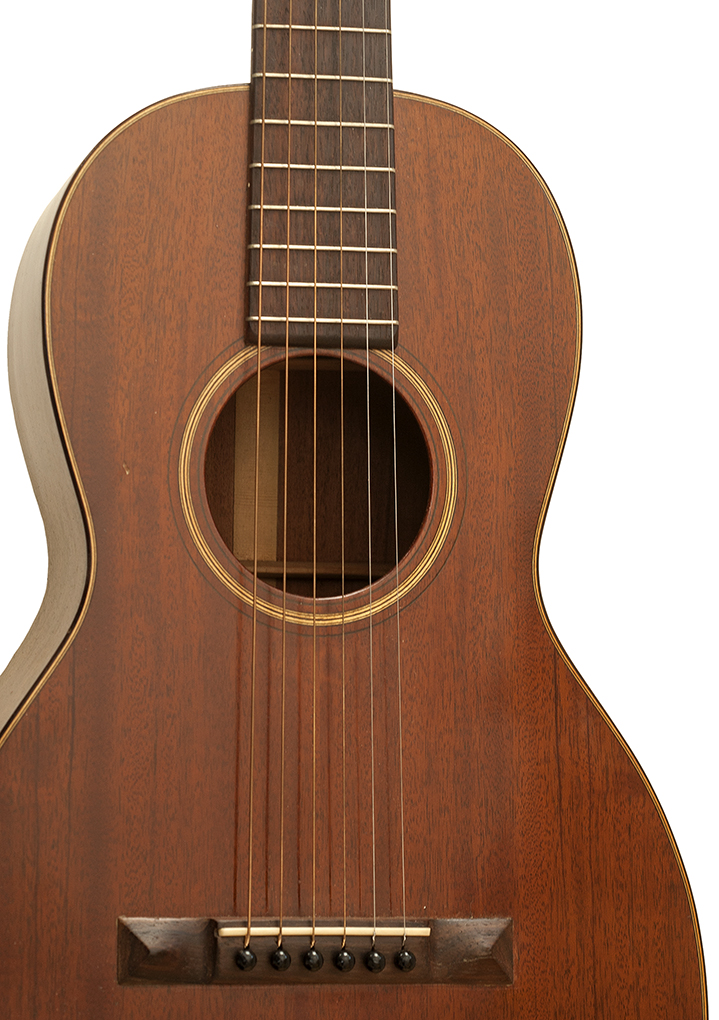
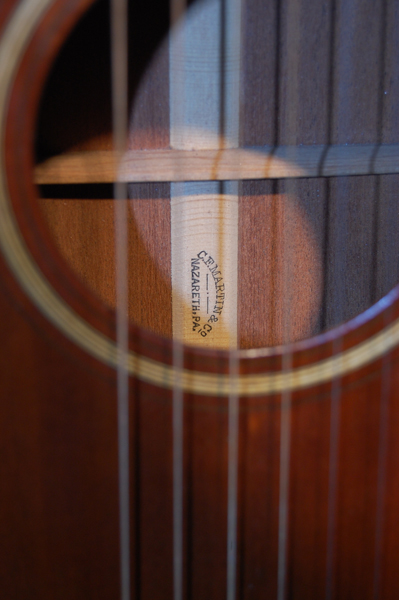
The Martin Style 2-17 sold for a price of $25 each retail, $12.50 wholesale, with canvas duck cases selling wholesale for $2.38 each.
The 0-17 and other Style 17 Martins followed, by shipping with steel strings as standard equipment soon after in 1922.
Martin announced the style 18 as shipping with steel strings as standard equipment on January 1, 1923.
The Style 28 was shipping with steel strings as standard equipment by 1926.
Martin did not speak of "bracing" their guitars for steel strings, and the dates that Martin began shipping guitars with steel strings do not necessarily correspond to changes in bracing.
So Martin guitars shipped with steel strings can not be identified by measuring features such as the bridge plate and top thickness or bracing. In fact, "X braces" were a feature of gut string Martins that preceded steel strings by some 80 years.
Martin increased the durability of bracing not in the year steel strings were first shipped, but incrementally, each year, for a number of years after steel strings were introduced. Martin thickened the bridge plate in 1927, after they had already been shipping their guitars with steel strings for several years.
Martin did speak of "regulating" for steel, by setting proper string height and cutting grooves in the nut to fit the width of the string type.
Once Martin began shipping guitars with steel strings as standard, they often shipped guitars with gut strings on request by taking a steel string Martin from stock, complete with braces designed to be capable of handling steel strings, and "regulating" the guitar for gut before shipping.
So perhaps the clearest physical difference that can be used to identify guitars regulated for steel is the width of the grooves in the nut, provided they have not been altered. Unfortunately, most dealers and repairers of Martin guitars don't yet have an understanding of such things.
The capability of any Martin guitar to handle steel strings is also highly dependent on the condition of the individual guitar in question.
Martins made before 1922 and not built for steel strings may be able to handle extra light gauge steel strings, or silk and steel strings, but should be evaluated with extreme caution.
Most Martins built after 1934 should be capable of handling medium gauge steel strings.
The exceptions to the above are the "C" and "G" model Martins, which were specifically built for nylon or gut strings, and the NY models built in the '60's, the earliest of which shipped with nylon strings, and most of which shipped with silk and steel strings, but all of which were built to handle light gauge steel.
As the year the guitar was built is no guarantee that any individual guitar is in the optimum condition required to handle the recommended strings, any Martin should be evaluated with care, and a top that lifts significantly in the bridge area is a sign that lighter strings should be used, or that the guitar is in need of attention by a qualified repair person.
While some consider it sacrilege to put steel strings on a guitar intended for gut, the issue of whether or not to put steel strings on a guitar built for steel has been addressed well by Eric Schoenberg, guitarist and proprietor of Schoenberg Guitars in Tiburon, California:
"The way I see it, Martin had the wrong bracing for gut strings. By pure serendipity, their X happened to be a phenomenal structure for steel. Classical players abandoned the Martins as soon as the first European, post-Torres fan-braced guitars showed up over here in the early 1920's I believe. These are a lot lighter than the average early Martin. A friend has a fairly early 00-28 that happens to sound unbelievable with nylon strings, but in general, these guitars, though they were the consummate American gut-strung guitar in the 19th Century, don't make it compared to the newer technology of the modern classical guitar. However, properly set up with steel strings, they can be the best sounding steel string guitars ever. You might not be able to play them as hard as a modern heavy guitar, but that modern guitar will not have the certain extra-special beauty, sweetness, fulness and relative power as a good early small bodied Martin with steel strings. One thing I've been feeling recently is that the extra light construction needs the proper gauge - too heavy a string can overpower it tonally, and each guitar will be different. Light gauge on some of these, even if the guitar can handle them, may be overdriving a body that vibrates freely in every square centimeter of it's body, giving a strained tone without the richness of a properly-driven box.
As far as structural integrity, Extra-Light (.010-.047) has very little tension. And if that happens to be too much, the Earthwood Silk & Bronze (actually made exclusively for them by D'Addario) come in three gauges, the lightest of which I don't think could hurt a flea."
Eric
As luthier John Arnold notes:
"Too much torque on the top can cause it to stiffen up, reducing the vibration. That is especially noticeable in the bass response. There is an optimum tension (sweet spot) for a given guitar, based on the structure and the string height above the top."
Personally, I would only put nylon or gut on smaller, earlier, and fan braced Martins, but agree with Eric that X braced Martins work best with light tension steel. I've had good luck with extra lights, and especially like the Ernie Ball Earthwood 2045 "Silk and Steel Soft" on my rosewood Martins of this size, and from this period. This combination can really sing like nothing else you've heard.
Opponents to the idea cite the number of early Martins with destroyed tops as evidence of the danger of putting steel strings on guitars intended for gut.
Remember, most old Martins damaged from steel strings were damaged years ago, not from modern strings, but from a time when steel strings rivaled the trans-atlantic cable. According to Eric: "Most if not all steel strings those days were heavy gauge—that's heavier than our current medium."
Strings for Hawaiian Style Martin Guitars
It should be noted that the first Martin guitars to be designed for steel strings were guitars designed for the Hawaiian Style of music as early as 1916.
Guitars Made for the Southern California Music Company.
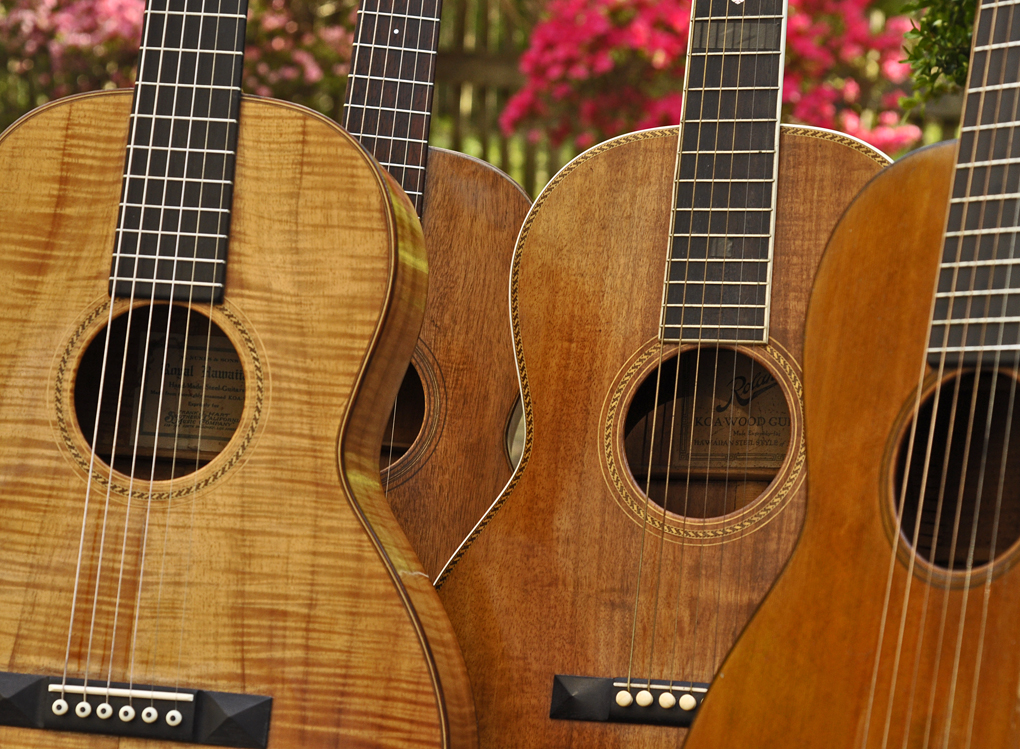
In July of 1916, with Hawaiian music all the rage, the C. F. Martin Co. shipped six samples each, of Hawaiian koa wood guitars with appointments generally similar to Martin's styles 0-18, 0-21, and 00-28, to the Southern California Music Company of Los Angeles, a chain of Southern California music stores, and one of Martin's largest accounts. SoCal provided Martin with the koa wood from Hawaii, and asked that the trim on these guitars, designed for playing in the Hawaiian style, be as close as possible to those of SoCal's popular ukuleles. To appeal to the Hawaiian market, SoCal asked that the Martin stamp be replaced with the Southern California Music Company stamp, and affixed decals on the headstocks bearing the name "M. Nunes & Sons, Hawaii" and labels inside with either the name "M. Nunes & Sons" or "Rolando". These early samples had koa wood back and sides and tinted spruce tops, but after seeing the samples, SoCal decided to offer all koa guitars, and to market the three models as the 1350, 1400, and 1500. The first of the new SoCal models was shipped in November of 1916.
These guitars, and those Hawaiian guitars designed at about the same time for the Oliver Ditson Company, were the first Martins to be built for steel strings. And while Martin had previously used fan bracing only for their gut string guitars in the Spanish Style, and had since switched it's production to X-bracing, Martin curiously decided to build these early heavier steel string guitars with braces in the shape of a fan. The Model 1500, however, for reasons we may never know, has X bracing.
The first "Hawaiian" Martins were actually not made specifically for Hawaiian playing, with high nuts and flush frets. Those features were only added in 1925.
From the time they were first made in the teens, "Hawaiian" Martins were cataloged with "steel strings and nut adjuster for Hawaiian playing. Suitable for regular playing with nut adjuster removed." The "H" models, with high nut and flush frets, were first produced after the change, in the late 20's.
As you'll see in the new Longworth book (p.234), "Unlike later Martin Hawaiian models, the Ditsons had conventional raised frets."
The same was true of the early Hawaiian models made for the Southern California Music Company, the precursors to the "K" models. As the new edition of the Longworth book says (p. 245) "Although called Hawaiian models, the guitars had raised frets and were often played as regular guitars with steel strings, with a metal "nut adjuster" used to convert the guitar for Hawaiian style playing."
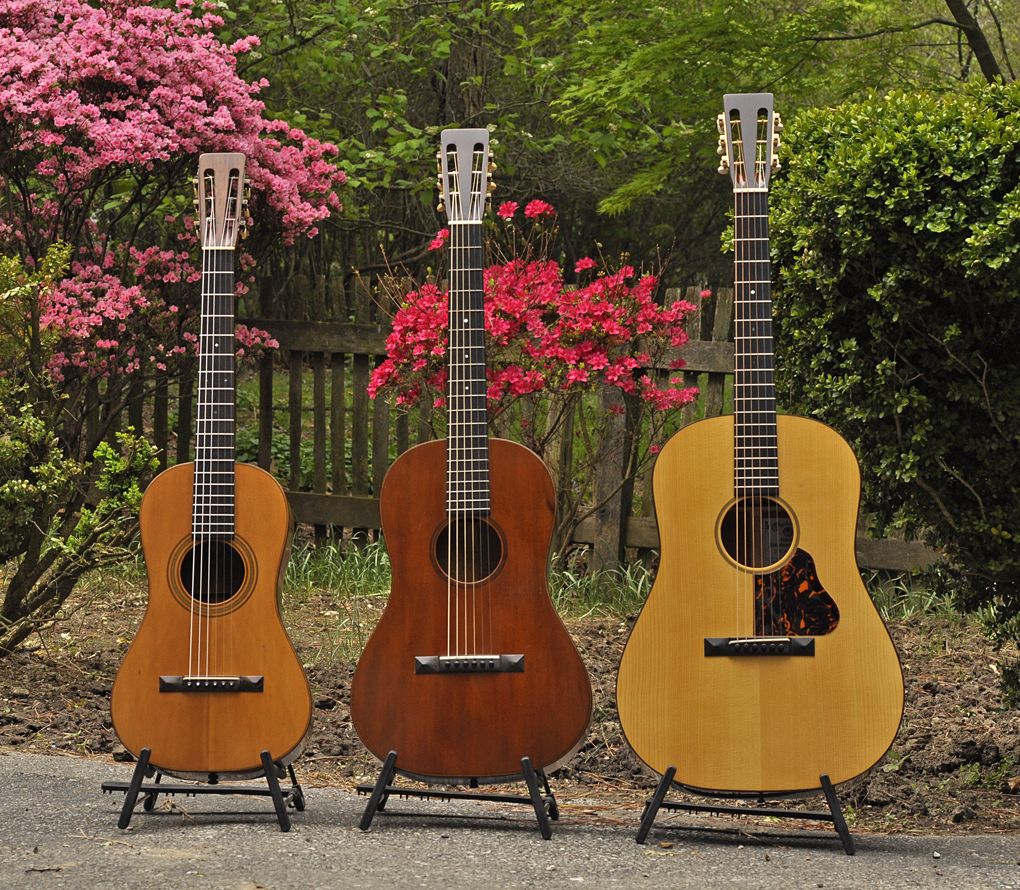
1916 Model 1400 #28, 1919 Model 1350 #14001, 1917 Model 1500 #181, and 1916 Spruce Top Sample with no serial number
C.F. Martin Guitars Hawaiian Guitars Made for Oliver Ditson & Co.
The "Standard" size Ditson Model 1-21, "Concert" size Ditson Model 11, and "Extra Large" (Dreadnaught) size Ditson Model 111 reissue.
Martin's "Ditson Model" guitars, with their wide waisted body shapes reminiscent of early European guitars, were made expressly for the Ditson Stores and came in three sizes, Standard, Concert, and Extra Large.
The Extra Large model, requested by Harry Hunt of the Ditson Company, and designed with the help of Martin shop foreman John Deichmann, became known as "the Dreadnaught", and was the first Dreadnaught guitar ever made.
The Ditson Models had their own model designations, and unlike other Martins, their trim level was designated as 1, 2, or 3, but their size was designated by the number of digits, ie. 1, 11 or 111.
While fan bracing is generally associated with lighter guitars made for gut or nylon strings, the Ditson models have the same style of fan bracing as seen on the koa wood guitars made for the Southern California Music Company, which were originally made to be played with heavier steel strings in the Hawaiian style.
The Model 111 was revived in 1923, and 19 more were made between then and 1930, with standard Martin X bracing replacing the earlier fan bracing.
C.F. Martin 1918 000-42
Serial Number 13364
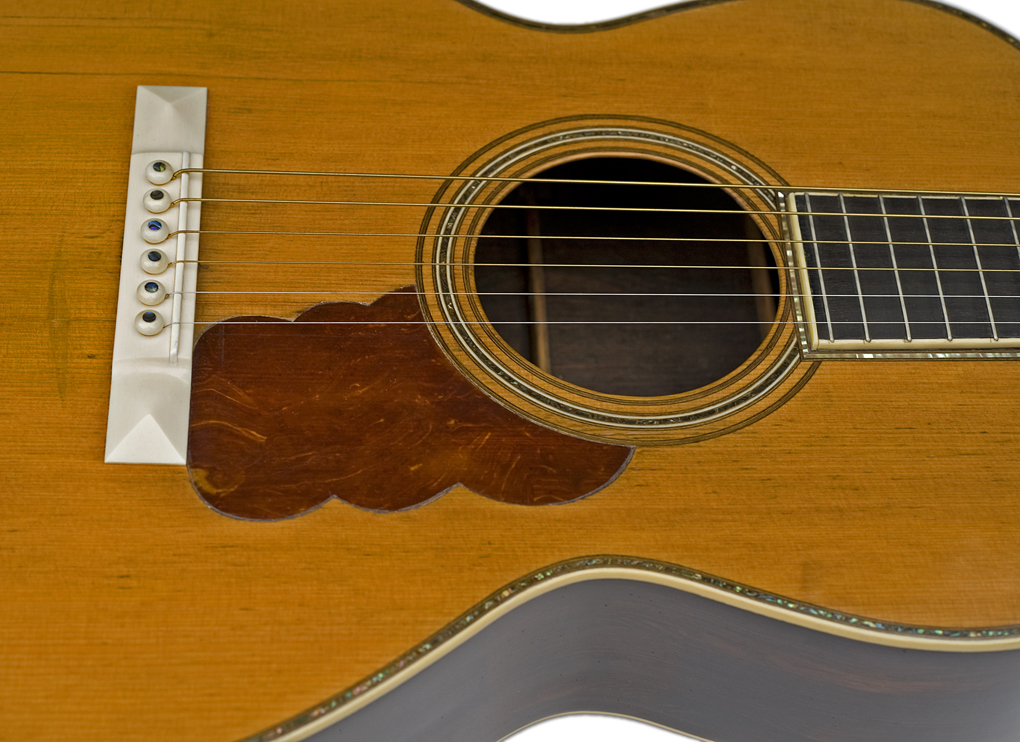
In 1918, Martin made their first two Style 42 guitars in the relatively new and larger 000 size. While one of the two was a rather conventional Style 42 in the 000 size, this 000-42 was special ordered by the Ditson Company in 1918 in the style of Ditson's new Dreadnaught guitars, which were built for Hawaiian style playing with steel strings. That makes this guitar a rare example of an extremely early 000 size Martin built for steel strings, as well as a rare example of a Martin built for steel strings with an ivory pyramid style bridge. As was true of the early Martin Dreadnaught, and all of Martin's early Hawaiian steel string guitars built for both the Ditson Company and The Southern California Music Company, this guitar was built with fan braces. This guitar was also special ordered with a cloud shaped pickguard inlaid into the top.
earlymartin.com
To See Robert Corwin's Classic Photography of Folk and Roots Musicians, visit:
For Information on Photography for
Exhibition, Publication, CD's, Promotion, Web Pages, Tour Books,
to Purchase Photographic Prints, or
If You Have Questions About An Early Martin Guitar:
e-mail: Robert Corwinentire site copyright ©1998 through 2012 Robert Corwin/Photo-Arts. All rights reserved.