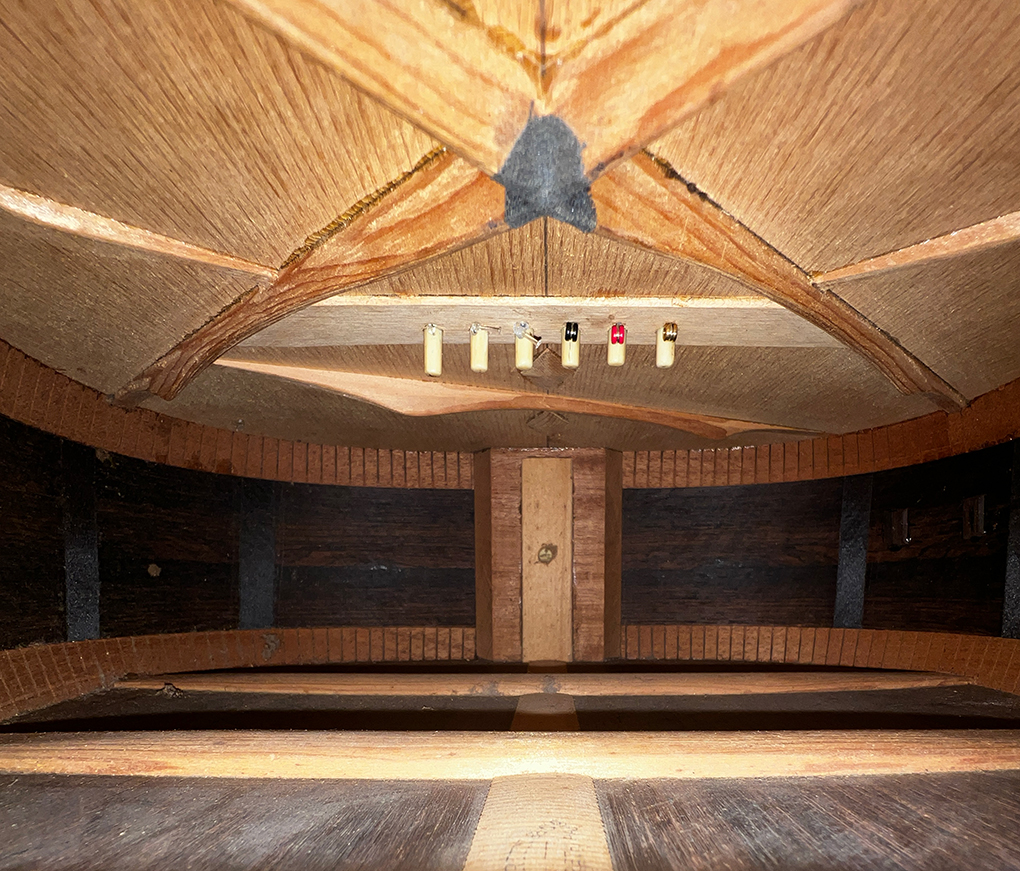
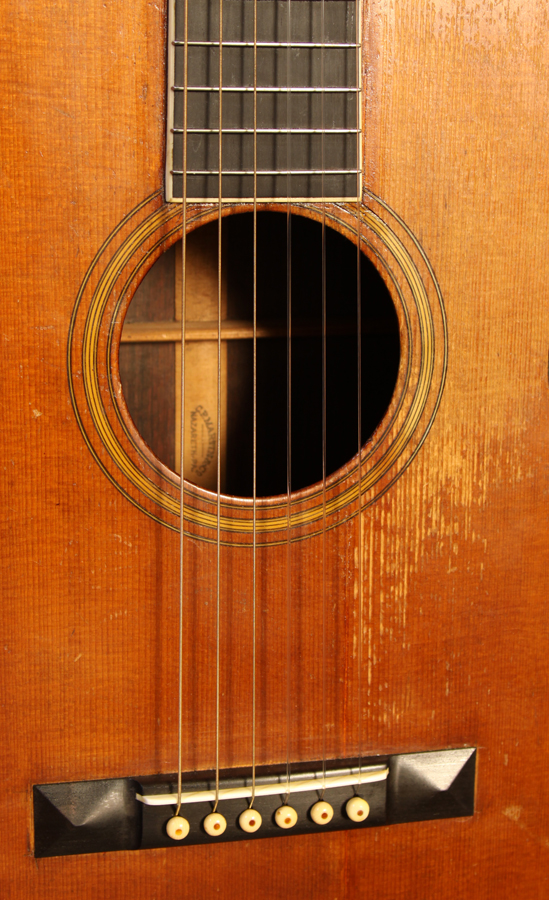
1922 Martin Olcott-Bickford 0-44 Guitar
Shipped
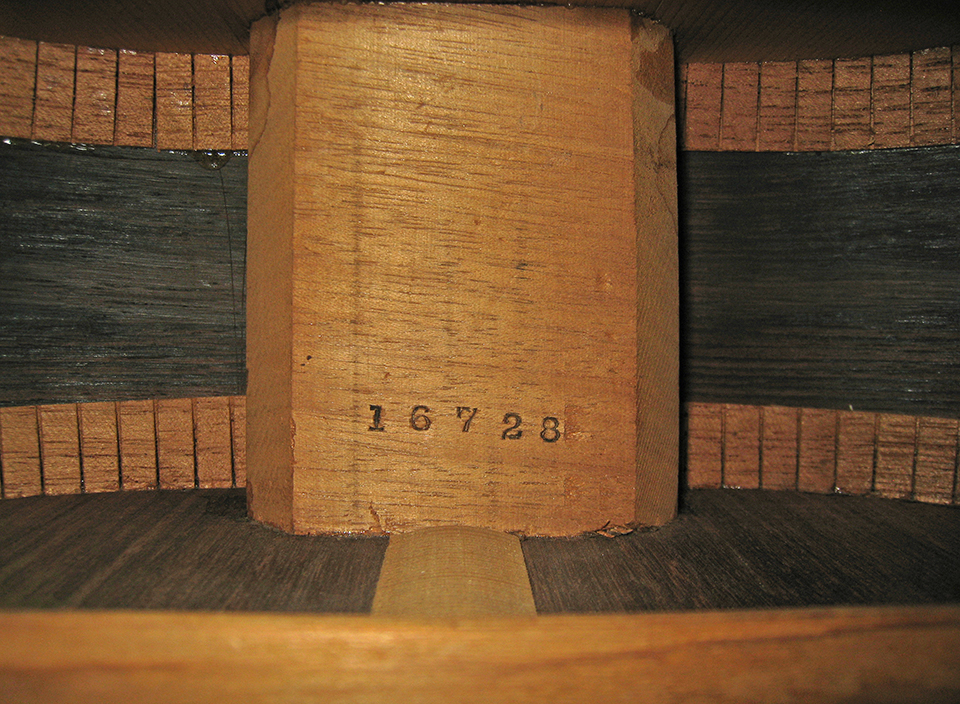
Serial #16728
Vahdah Olcott-Bickford (1885 -1980) was a prominent classical guitarist and teacher, arranger, composer, recording artist, columnist for "The Crescendo" and "Cadenza", author of method boooks and publisher, as well as being the founder and Musical Director of the American Guitar Society. She was the first woman ever to make a guitar recording, and was influential in promoting the guitar as a serious concert instrument.
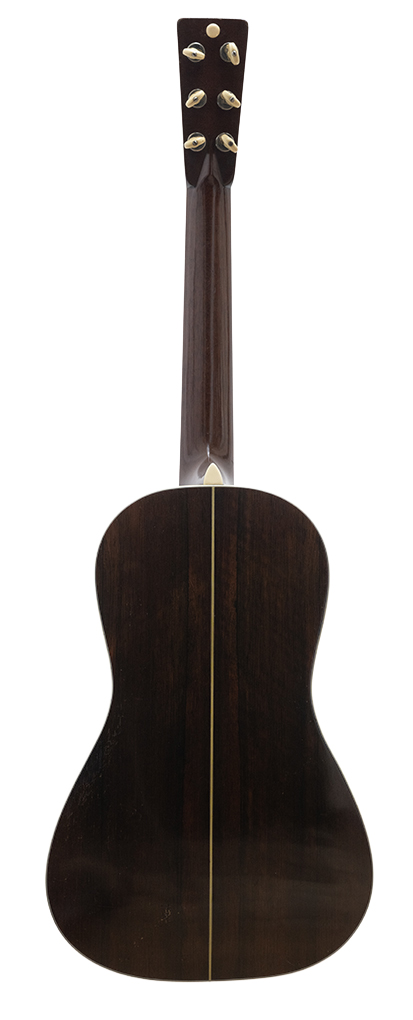
Olcott-Bickford had her own line of Martin guitars built to sell to her students. The Style 44 "Artist" and "Soloist" guitars were required to be of the highest quality wood and craftsmanship, equal to the Martin Style 45, but with minimal and conservative decoration. Even the back stripe is of simple black and white lines. Similar simple straight line top border later appear on Martin's archtop guitars, and then were borrowed for Martin's modern postwar "28" top borders replacing the prewar herringbone purfling.
It is often overlooked that the grading of materials was as important to Martin as was the degree of decoration on the higher models. Mr. Martin personally chose the pieces wood to be used for Olcott-Bickford's guitars.
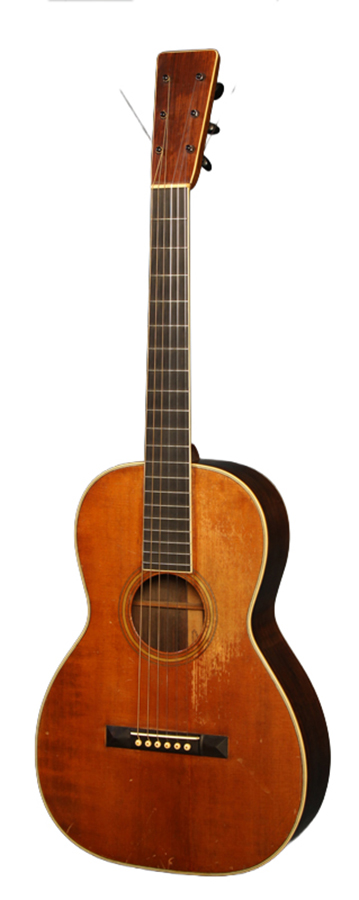
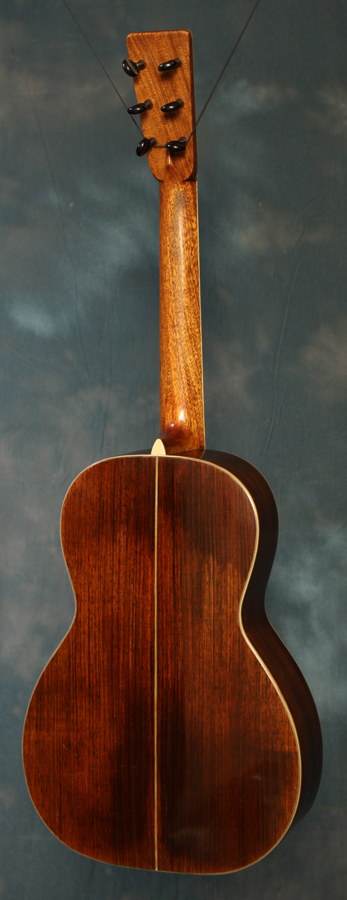
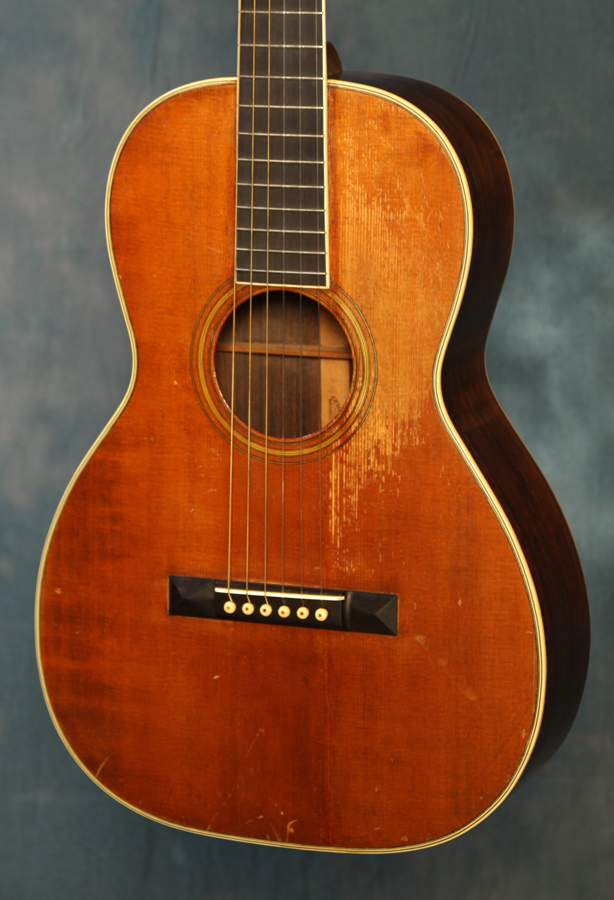
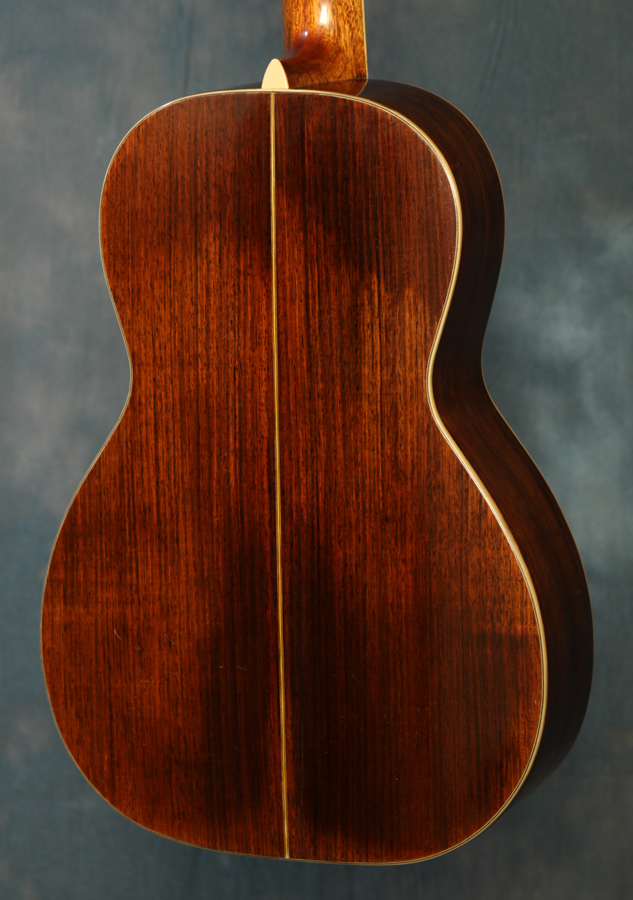
This Olcott-Bickford 0-44 is one of two samples that was produced in 1921-1922 for the new "Artist" model. As Martin describes later:
"The instrument is superior to the style 28 in that it has a finer selection of wood and more handsome inlaying."
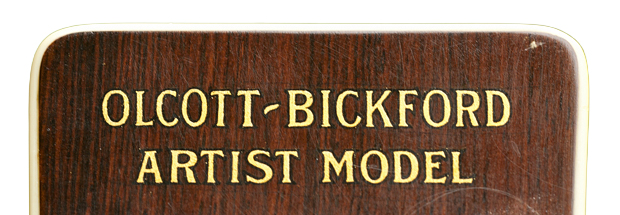
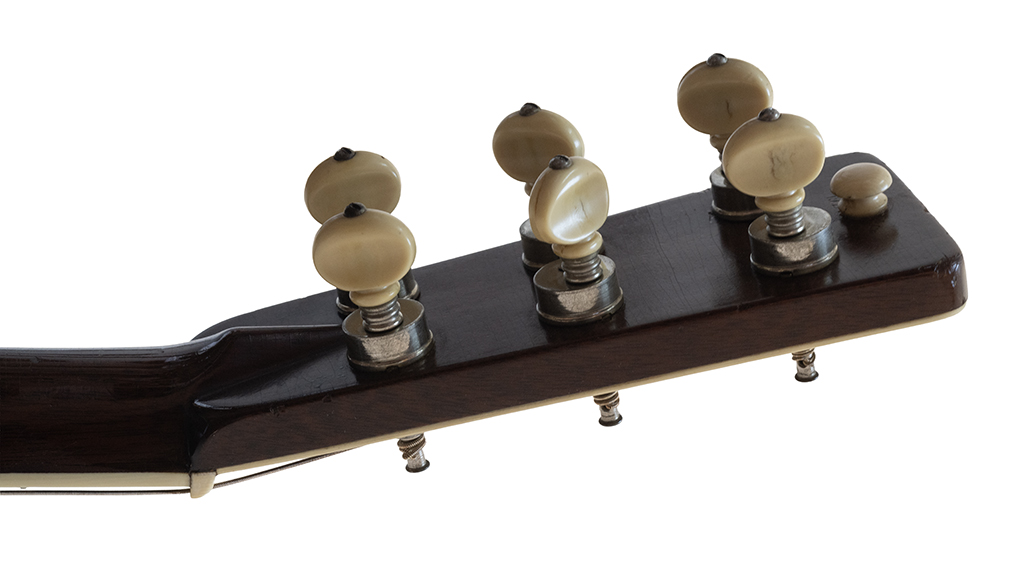
This guitar was stamped at the end of 1921, built to be ready for introduction at the Guild Convention the following April. In a letter on February 4, Vadah Olcott-Bickford notes that she has already had two inquiries about purchasing the new guitars, including one from a "teacher in New Jersey". At the time she makes design suggestions for inlaying the name on the headstock in white, possibly ivory, and asks about pegs.
One guitar was ordered, but Martin notes in a letter to Mr. Hunt at Ditson on February 6th that he has decided to "build a companion because of the advantages of building two at a time".
In the same letter he states: "A few hours ago we tested both instruments and found them very satisfactory in tone, both as to quality and volume. We feel sure that Mrs. Bickford will be well pleased with them."
On February 7, F.H.Martin states in a letter to Ditson that the guitars will be sent without the name inlaid, to be left to Ditson to take care of, since "the name is rather long and we're not sure we can do anything"
On the same day, Martin writes Vadah:
"We, here, are really interested in one thing above all others - to make good Guitars. Regular style or special style, a small number or a large number, nothing counts except to see that it is a good Guitar. These that are being built for you will have the benefit of all our knowledge, always admitting that wood is not certain and we are never able to promise that one Guitar will sound just like another."
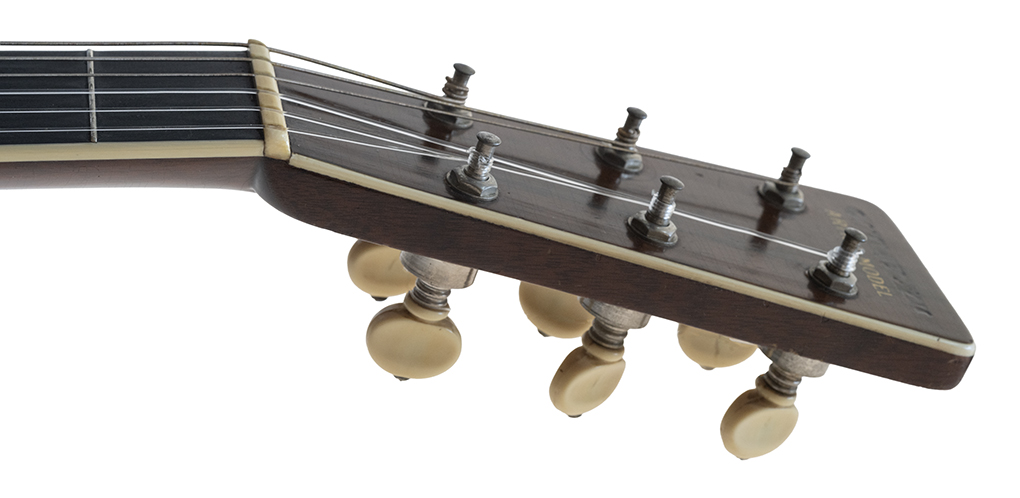
"Your style will have ebony pegs. We found it not practical to make Ivory at this time and celluloid is not very nice and I believe is apt to stick. Ebony is standard material on violins and we have used it on Guitars and know it will answer nicely."
Both F.H.M. and Vadah always spell the word "Guitar" with a capital "G".
On February 9, Harry Hunt at Ditson tells Martin that "we have had an artist draw up a design which will be made in decalomania, the same as gilt is put on piano keyboards. This will be put on under the varnish so that it will receive good protection and also look very neat. Therefore, you may cease to worry on this point."
"They are rare, but only a few people are likely to place a high value on them. The important thing is that the instrument suit the needs of the player and that seems to be so in this instance so we quite agree with you that you have a real bargain and we are happy to hear that you are well pleased with the guitar." It's likely Martin is referring to the darker reddish brown finish rather than the orange "pumpkin" colored top which is close in color to the tops to which she was accustomed on her Artist model Guitars. Getting back to 1922, there are numerous letters about the Guild Convention, and about presenting the new guitar there and in advertisements, "as the only solo instruments in both Guild concerts."
"The Martin Guitar"
The Solo Instrument of this concert. Started in 1833, used by soloists for generations, known and liked by players of every rank, the Martin Guitar is still the real Guitar of America. It is built to respond and it is built to last. It fills a concert hall and it modulates down to a small room. It is musical.
February 21, 1922."
The guitar was sent "in the white" to Ditson, where an Antique Violin finish was applied as Bickford requested. On March 23, Hunt writes to Martin saying "Mr. Lange is finishing up the Olcott-Bickford Guitars and they look quite nice. They are as you know made to look slightly antique. This is the wish of Mrs. Bickford."
On April 17, Ditson writes to Vadah that finished Martin's way, "dead finish, the guitar would retail for $120."
"To have the Antique Violin finish put on, same as those we have finished up, would retail for $130."
"...When one considers the quality of other guitars, these are really not too high."
On July 28 of 1922, H. Hunt of Ditson writes to Martin:
Gentlemen:-
We are sending you, by prepaid express, 1 Bickford-Olcott Artist Guitar - #16728- in leather case which is one of the first ones you sold.
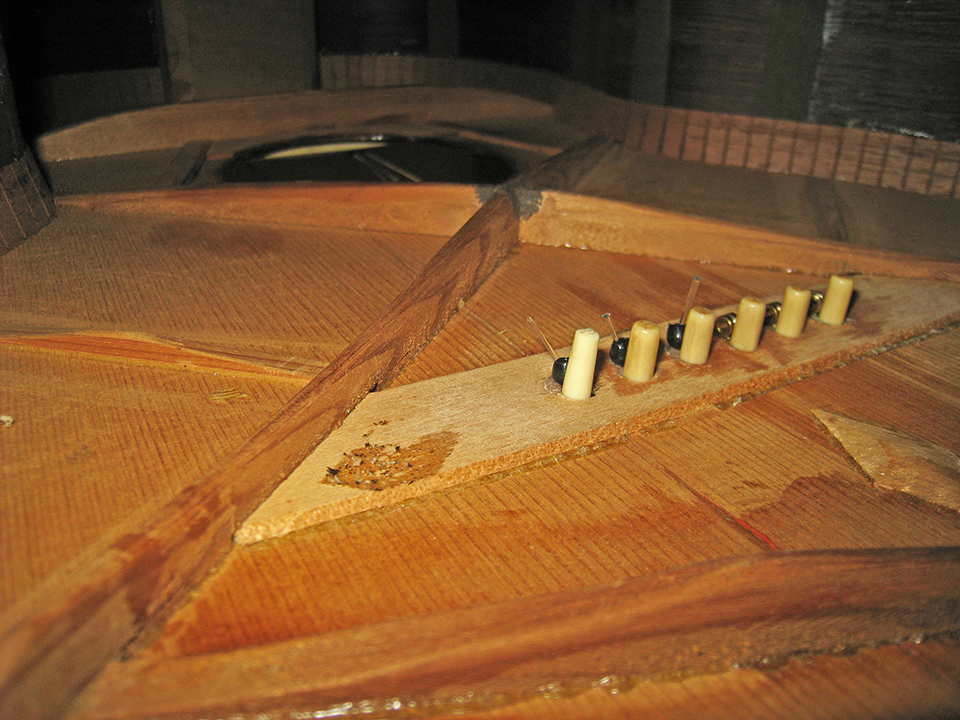
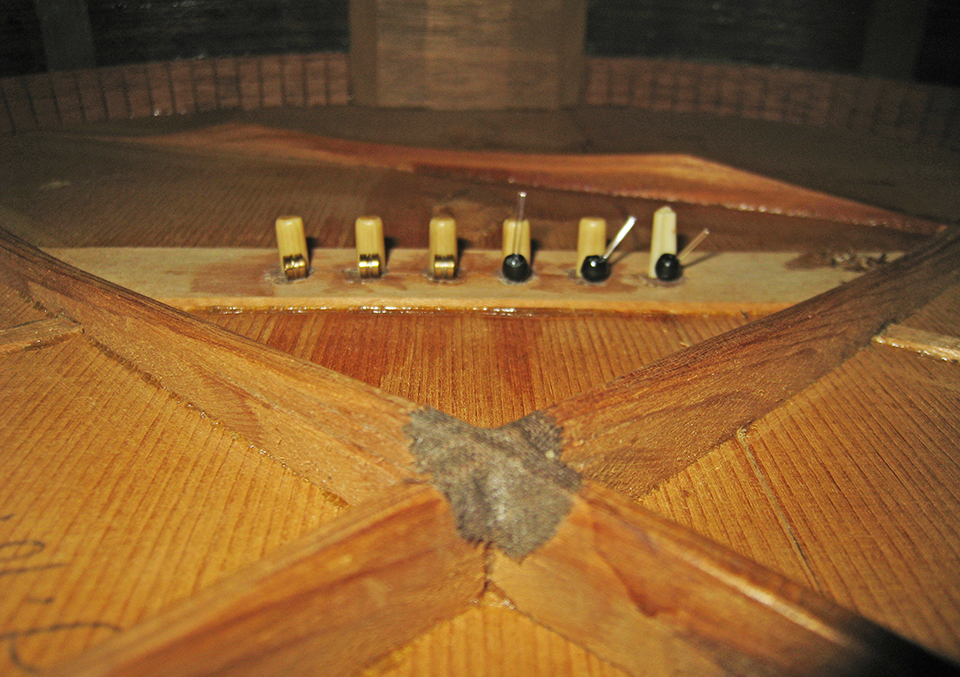
You will kindly note that the neck of this instrument has warped and the back is buckling up.
Will you kindly repair same as soon as possible and return to us?
Please drop a line advising when the guitar will be shipped.
Thanking you, we are,
H.L. Hunt
Chas. H. Ditson & Co.
P.S. This was sold to a professional musician named Boosma of Patterson NJ.
On August 1 Martin writes "it will be necessary to put on a new back. We will also correct the fingerboard and put the instrument in first class condition. We presume that you wish us to finish the back in our usual manner."
"From three to four weeks time is usually necessary for this work but we will do our best to speed it up for you."
The "Bickford-Olcott Artist Guitar - #16728-" is this guitar.
In a letter of May 6 Ditson notes to Martin that after the Bickfords moved to Los Angeles, Mr. Boosma had "taken over Bickford's business in New York."
What a treat having all this correspondence between Olcott-Bickford, H. Hunt of Ditson and Frank Henry at Martin concerning #16728 and documenting so many aspects of it's life, from the selection of materials, design, construction, personal testing by Mr. Martin, application of finish by Mr. Lange, back and neck repair overseen by F.H. Martin, and original leather case, to the ownership by the teacher and future business manager, Mr. Boosma of New Jersey.
1922 Martin Olcott-Bickford 1-44 Guitar
not a Ditson 450 Model!
Shop Order #450
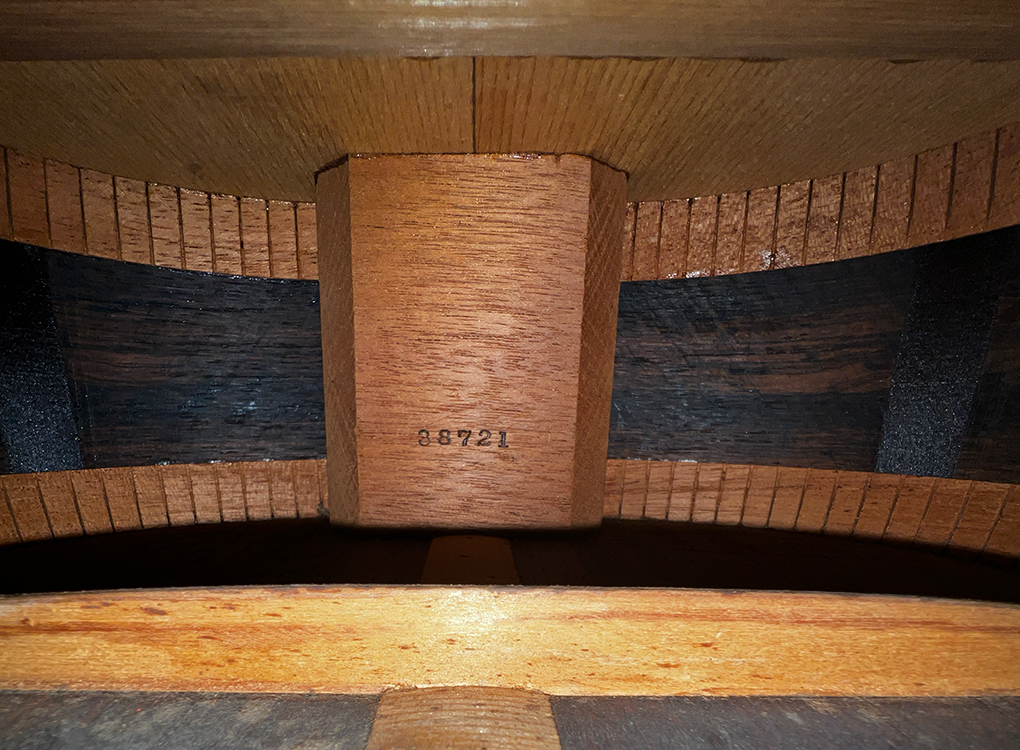
Serial #38721
Stamped May 29, 1929
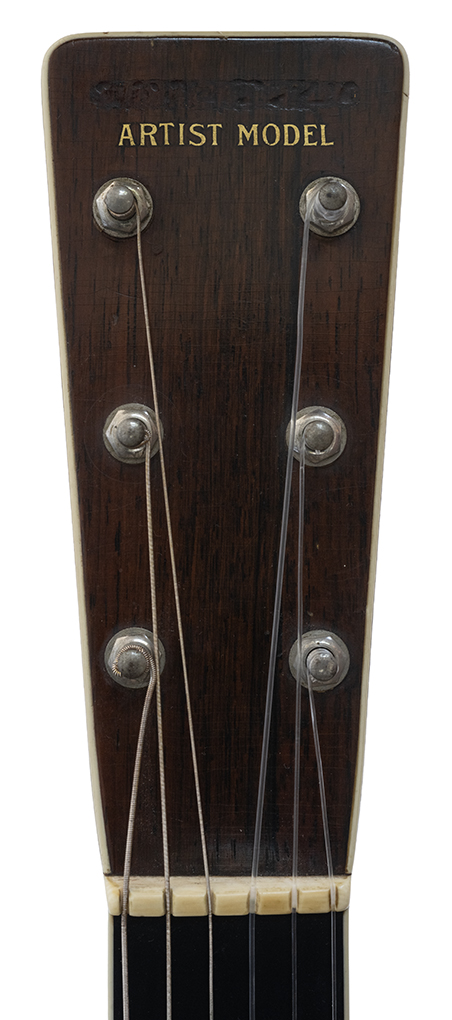
It appears that a former owner may have replaced Olcott-Bickfor's name with their own.
At a later date Vadah expressed her displeasure with the cheap look of gold transfers. White transfers were used in 1929. Martin ruined three in an attempt to label one guitar in August 1929, so more were sent. Several transfers were sent from Ditson to Martin with a note saying "You may use whichever you think best. We're not sure which one was placed on the last guitar you made for Mrs. Bickford. In the event that you remember, we suggest that you put the same decalomania on this new instrument." So there appears to have been a variety of designs used.
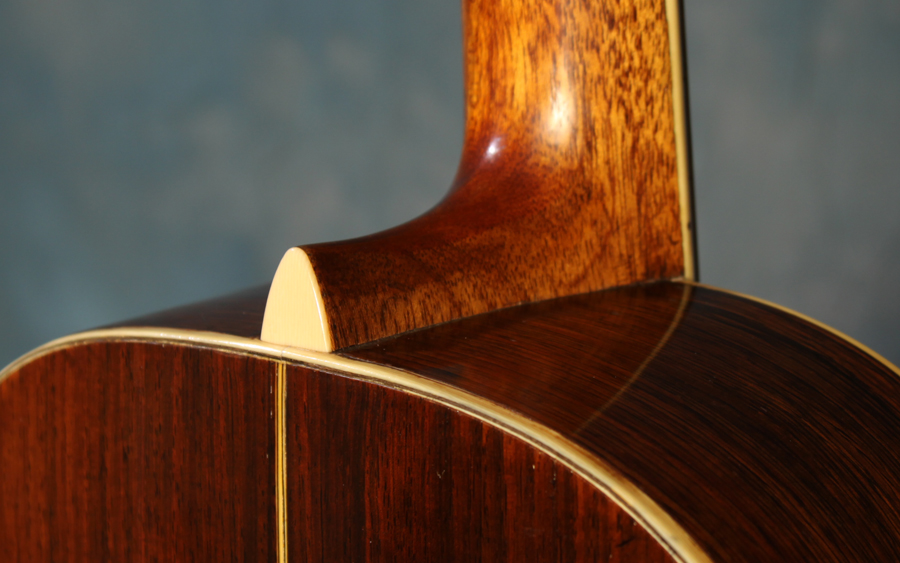
After customers complained about the lack of a "Martin" stamp, also that year, with one refusing to accept the guitar without Martin's name, Martin lent a metal stamping tool to Ditson. Vadah's preference for an ivory strap button on the back of the headstock was also made clear in 1929. And there was much discussion that year about fret height, rattling, strings cut from sharp frets, and rough frets that "hurt her fingers in sliding." Guitars were returned for adjustment.
All is clearly forgiven when Vadah notes: "the tone of both the instruments is very fine and resonant and responsive and we are both delighted with them. The finish is about the most beautiful I have ever seen. I certainly appreciate your fine workmanship in every way as exemplified in these two instruments" Martin was clearly giving Vadah all the attention a prima donna could ask for!
In September Vadah noted: The tone of both guitars is beautiful and I really wish I had one just like this for my own concert use, - I am so delighted with it. But at the present time I cannot afford it and have so much money already tied up in my several old Martin guitars that I cannot put any more in at the present time. My husband says that I am the chief living collector of Martin guitars and I have quite a goodly number of the old New York models of various types and periods."
In 1945 Vadah purchased "a fine old Martin Guitar with Ivory peg head". Frederick noted that "the red color was used on Martin guitar tops for a period of two or three decades, ending about 1898, and it is likely that several hundred red top guitars were made in that time. We seldom see one now, possibly because the old model is not really suitable for modern guitar playing and there are not a large number of guitarists who appreciate the fine points of the tone and workmanship of that period."
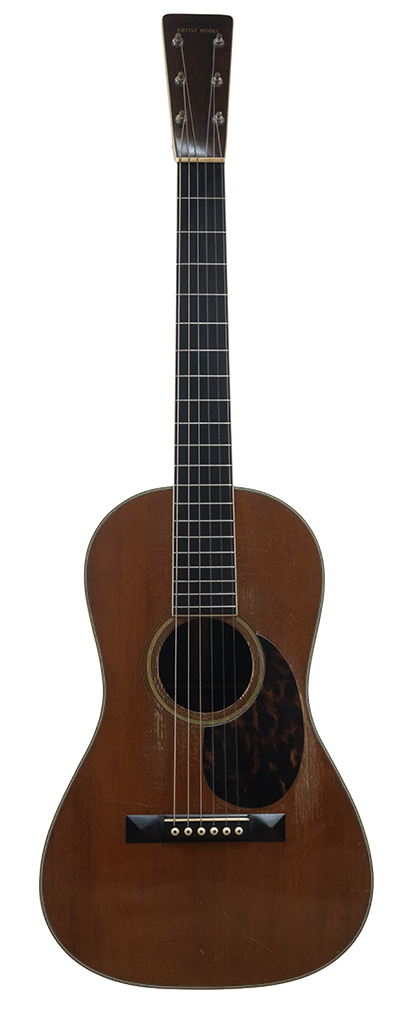
This individual guitar is noted in all the books as an Olcott-Bickford Ditson Special "450 Model". It is not.
There was a good deal of correspondence concerning this guitar between Vahdah and Frank Henry Martin, and also between Harry Hunt at the Ditson Company and Frank Henry Martin. Vahdah was a very fussy customer. But this guitar is not a Ditson model. It was ordered through Ditson because Martin had exclusive territorial sales agreements which required even Vahdah, a teacher selling her own line of guitars to her students, to order through an established dealer. Vahdah ordered through four or five different dealers over the years, settling on Ditson for this guitar.
To complicate things further, Mike Longworth misread his own notes.
Longworth listed this guitar in his log as:
"Ditson Special
Olcott-Bickford
Artist Model
(Stained Top)"
Appearing in the next column next to the words "Artist Model" is the shop order number "450". Longworth misread this as "Artist Model 450"!
He also confused this guitar with the "Ditson Specials" that were ordered for sale by the Ditson Stores.
While this guitar is not a Ditson Model, it does resemble one for good reason. Vahdah owned a Ditson terz model, and she requested a guitar with a similar shape. After some back and forth and compromise, a guitar was settled on that has some similarity, but is larger than a Standard Ditson model. Vahdah proclaimed this guitar to be the finest sounding guitar she had ever playeed, and it is in fact a magnificant sounding guitar.
Vahdah ordered a second one and was quite particular about it matching the first. It turns out that her pupil was a film star, who wanted a perfectly matching second guitar capable of standing in for the first in her films.
By the end of the decade Martin is finishing the guitars with a hand rubbed semi gloss lacquer. When Vadah asks for a duplicate in color, "the prettiest color I have ever seen on a Guitar. The more I see it the more I like it and my pupil is crazy about it." Martin responds: "Fortunately, the stain we used on the top of that Guitar can be duplicated quite easily because it is the same stain which we used on our Maple Mandolin "It took us about two weeks to build the last Guitar and we will try to do the same again but the season is not favorable for rush work because the high humidity retards drying both in the glue room and in the finishing room. Now that we are using lacquer there is less trouble in this respect but it is still necessary to be very careful with glue work in mid-summer."
With all this attention paid, only slightly more than 30 Olcott- Bickford guitars were produced during a relationship that spanned at least 32 years, and several were made for repeat customers. One instance involved discussion of duplicating the first guitar carefully enough so the second could be used as a stand in for motion pictures. Two of the smaller size 2 guitars produced in 1930 were sold to the same gentleman who had purchased the prior two size 1 guitars which Longworth failed to note in his logs.