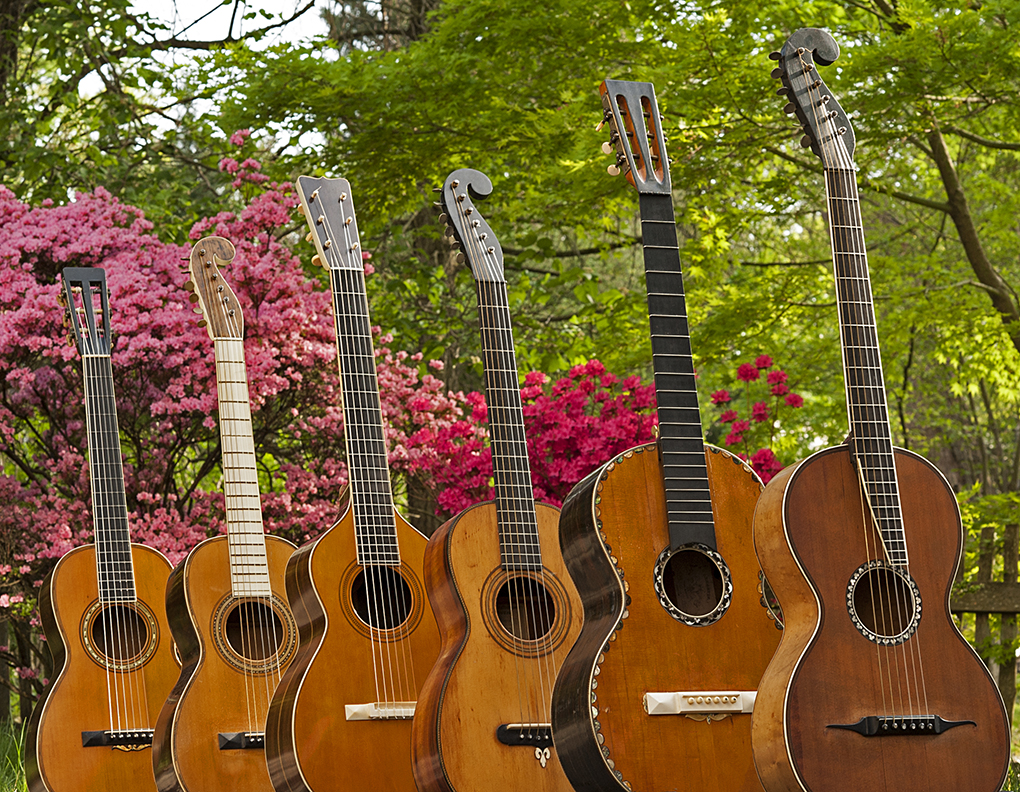
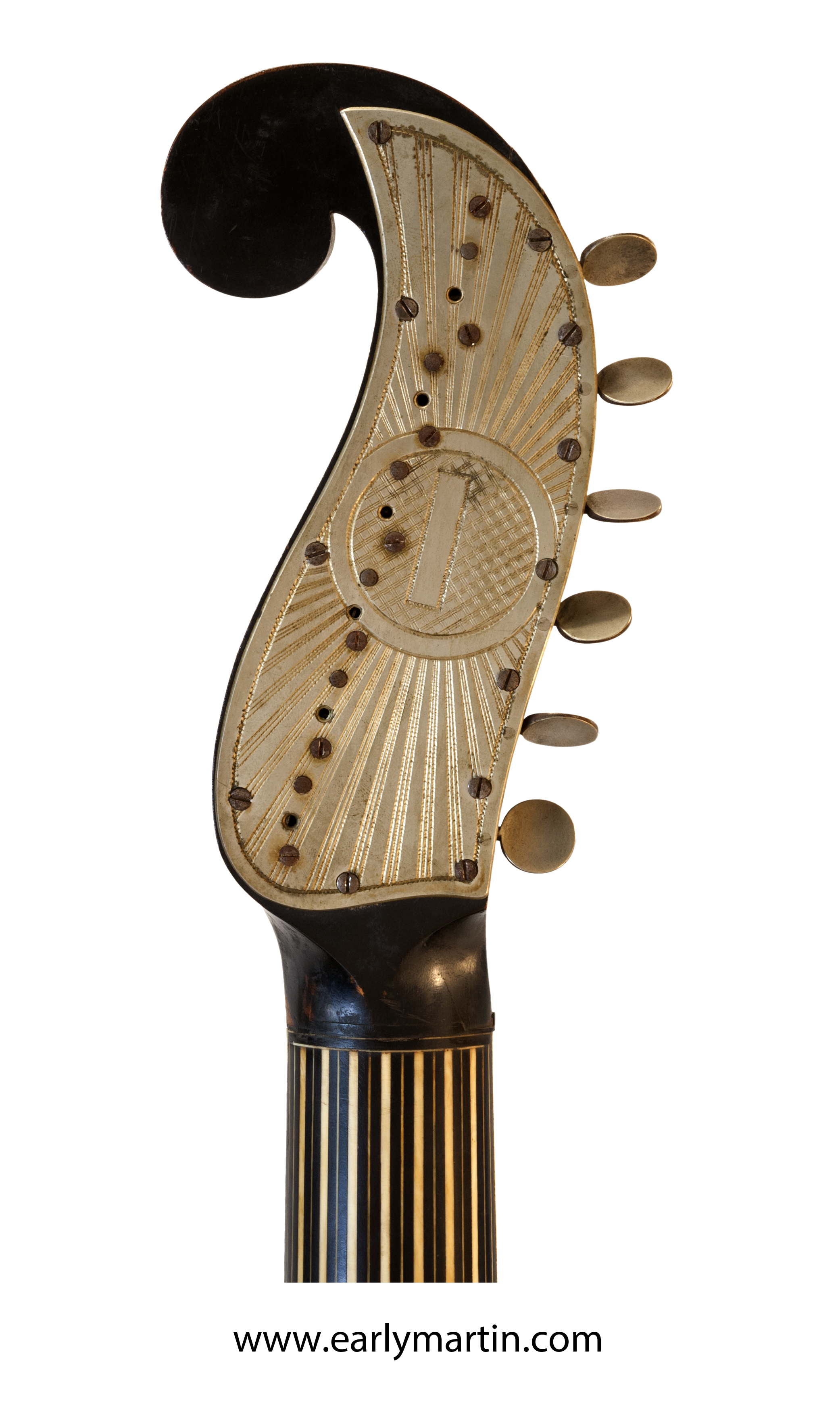
A Virtual Museum and Free
eBook of
Vintage
Martin Guitars
Illustrating and Exploring the Development of the Martin
Acoustic Guitar
Created by Folk and Roots Music Photographer
Robert Corwin
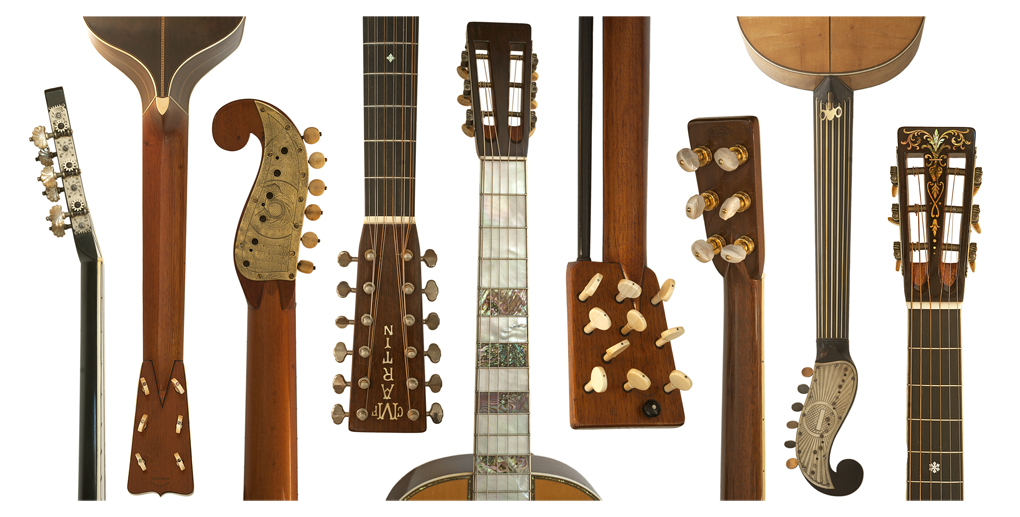
CONTENTS:
INTRODUCTION
THE
EVOLUTION OF THE MARTIN GUITAR PART 1
Early C. F. Martin Instruments as
the Styles Were Defined.
THE
EVOLUTION OF THE MARTIN GUITAR
PART 2
Creating the contemporary
steel string guitar.
FIRST
FEATURES
Defining the features of the contemporary steel string
acoustic guitar
LATER DEVELOPMENTS
MARTIN STYLES
of guitars and other instruments they've been defined
since the 1850's
MARTIN
GUITARS MADE FOR OTHER FIRMS
INSTRUMENTS MADE BY OTHER FIRMS
CLEANING
HOUSE
I absolutely love these, but I really should sell
these instruments to make a bit of room for new ones.
' ' ' ' '
' ' ' ' ' '
' ' ' ' '
Identifying C. F.
Martin Acoustic Guitars
A Martin Timeline
A Few
Words on Photographing Guitars
Truss Rods and Necks
Obtaining
Proper Permits for Shipping Vintage Instruments
Overseas from the USA
Complying with The Convention on International Trade in
Endangered Species of Wild Fauna and Flora (CITES) and the Endangered Species Act (ESA). This info is a bit old, so do verify,
but Gruhn Guitars did tell me that it was useful to them in
setting up to ship with CITES
Free
Diagram Downloads
Full size, 1:1 , with precise measurements of important
early Martin, Panormo, Recio of Cadiz, Schmidt & Maul
guitars, a 1917 Martin/Ditson Standard "baby Dreadnaught",
a 1929 12 fret 000-28, an early 1930 OM-28, and a 1944
000-18, all free for your personal use. ~
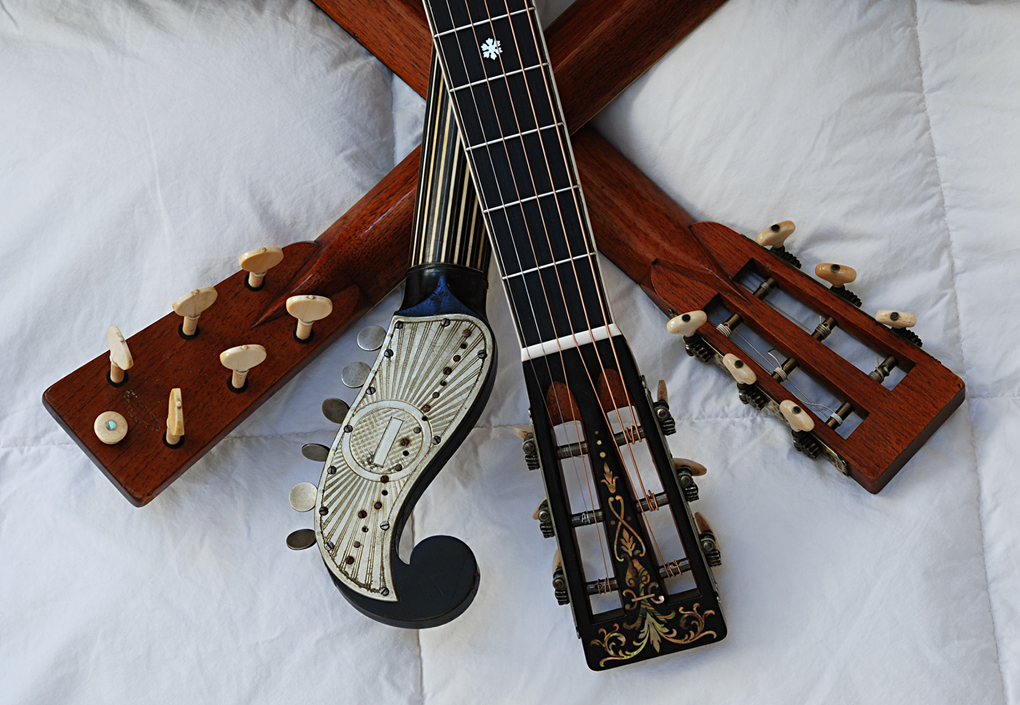
Welcome, I hope you enjoy this
site!
I've chosen to self-fund this project and make it available to
you on the web for free rather than publish a printed book so
you can have a comprehensive resource on your phone at any
time, from anywhere in the world, regardless of your
means.
Publishing on the web also allows me to make changes and add
new information, keeping us all from being stuck with pages of
typos and outdated info. I'm still learning new things
and discovering where I've gotten things wrong. So I
appreciate those who have pointed out where I've said "1938"
when I meant to say "1838". If I should ever decide to
publish a physical book, I still have no plans to replace
these free web sites.
This site covers Martin guitars from the first produced in
America in 1834 through the 1960's, generally accepted to be
Martin's "Vintage' years.
The instruments produced under C.F. Martin Sr. in his first
dozen or so years in America, and his grandson Frank Henry
Martin, who led the company ffrom the young age of 22,
following the death of C. F. Martin II in 1888, to age 89. virtually define the
evolution of the acoustic steel string guitar as we know it
today. So I've focused primarily on collecting and
studying these important transitional guitars.
C.F. Martin II, who succeeded C.F. Martin Sr., did not
introduce new models as much as standardize a line of models
which are virtually identical from one to the next from nearly
the inception of Martin's incorporation in 1867 to the turn of
the Century. This enabled the Company to provide their
distributor Charles A. Zoebisch and their customers with a
catalog of consistent products through the years.
Virtually all of the greatest advancements in the development
of the acoustic guitar were conceived of not at the Martin
factory, but at the request of Martin's customers. C.F.
Martin Sr. apprenticed with Stauffer of Vienna, and his shop
produced guitars in the Viennese style for his first five
years in New York until John Coupa introduced him to the
classical guitars of Cadiz Spain. Madame DeGoni
commissioned guitars with a prototypical form of X
bracing.
During the tenure of Frank Henry Martin, steel strings were requested by many
customers as "wire" strings were gaining in popularity by the turn of the century. The
first Martins to ship as standard with steel strings were
Hawaiian guitars commissioned with koa wood supplied by the
Southern California Music Company. The larger
Dreadnaught body style, with it's wider waist, was requested
by Harry Hunt of the Ditson Stores to fit neatly on the lap as
a Hawaiian guitar. The modern guitar shape is the result
of requests for a longer neck by banjo players who were
transitioning to guitar, as electronic amplification made the
louder sound of their banjos in jazz bands unnecessary.
Martin Shop Foreman John Deichman helped to realize many of
these ideas.
Having guitars in hand has allowed me to observe, measure, and
document these instruments with both exterior photos and mages
that allow us to take a virtual walk through their interiors,
to let the guitars speak for themselves, and let you see for
yourselves, limiting endless speculation and debatable
opinions. I also see way too many magazine articles and
videos these days with comments that say "so and so thought
that..." or "so and so did this because he wanted to..." when
this may make for a nice narrative, but is based on no
evidence whatsoever. I will try my best to ascribe
motives only when I have seen correspondence from the subject
that states them clearly, and to avoid unnecessary
speculation.
C.F. Martin & Co. has produced exquisite guitars, and I've
been fortunate to assemble a number of the most
beautiful. But I realized early on that any attempt at
serious research should also take the less expensive "bread
and butter" examples seriously, avoiding the trap of relying
on the "eye candy" of "presentation guitars" merely because
they impress. A surprisingly fortunate number of the
one-of-a-kind and most prized early examples have
survived. While the more affordable guitars were more
likely to have lived a tougher life, enough were built that
clean, original examples can be found.
I'm fortunate to have had a dad with a great eye for design,
who taught me well. I've been a President's Fellow in
Photography and Design at Rhode Island School of Design, been
a graphic designer with a background in publishing, have spent
over 60 years photographing musicians for CD covers and such,
and have worked to apply my learning to set a higher bar for
graphic, vivid detail photos of guitars. When I started
photographing guitars, I had to invent the wheel when it came
to interior photos. Fortunately it's become much easier over
the years, and can now be done with an iPhone. Producing
the photos myself has also allowed me to avoid the industry
funding that is usually necessary to cover the significant
costs of paying a commercial photographer, which also helps
keeps this project independent and free of outside
influence.
www.vintagemartin.com is
over 140 chapters long and growing, including more detail,
photos, and downloadable diagrams than any book could possibly
include.
To be honest, most books on guitars don't really generate much
money beyond what goes to printing, publishing, distribution
and sales. So why not put it on the web for free and let
folks enjoy it. I hope more people take my lead.
Bracing diagrams are thanks to the CAD skills of luthier Per
Marklund in Sweden. I look forward to adding more thank
you's soon to the other friends and experts who have helped
make this web endeavor possible, along with links to other
helpful resources. This site is indeed a work in
progress.
I presented and videotaped a workshop with the help of friends
including Noel "Paul" Stookey of Peter, Paul & Mary, who
played a number of my guitars to demonstrate the differences
while I explained the evolution of the Acoustic steel string
guitar. I hope to do more of this type of thing soon,
both in person and on the web. A number of exhibits are
also in the works.
Please let me know what you think.
Robert Corwin
August, 2026
`
` ` ` ` ` ` `
` ` `
Before
C.F. Martin arrived in New York from Markneukirchen, Saxony, and
established his music store on the lower East Side of New York
City, Martin is said to have apprenticed in the acclaimed
workshop of Johann Georg Stauffer of Vienna. The Stauffer
"Legnani" Model was said to be the most modern of European
guitars.
Ironically,
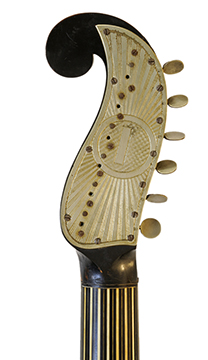
early Martin guitars are known for their "Stauffer
headstock", a distinctive headstock with six tuning
machines in line on a single side of the headstock, as emulated
today on Fender guitars, and which were referred to by Martin as
"Vienna Gears" or "One-side screws". In actual fact, the
iconic Legnani model Stauffer guitar has a "figure 8" shaped
headstock with ebony friction pegs.
Stauffer
guitars typically have a thin, wide "figure 8" shaped body with
an upper bout more equal in size to the lower bout which is
emulated on the earliest Martin guitars, as opposed to the
guitars of Spain, with a smaller upper bout on a narrow body, as
later adopted by Martin and still prominent today.
This
unique "Renaissance" Style Stauffer guitar was clearly the model
for the unique one-of-a-kind "Renaissance" Style Martin guitar
seen below, so we're lucky that both have survived.
Chapter
2.

1834
Martin Guitar
The history of Martin
guitars in America begins here. Several books show this
guitar, labeled as a Stauffer, along with what was considered to
be the earliest existent Martin guitar, to show the influence of
the Viennese Stauffer workshop on the first guitars built by
Martin in the new world.
When I compared this guitar to the 1834 Martin in the Martin
Museum side by side and photographed their interiors, the DNA
emerged of two near identical siblings, obviously conceived by
the same hands at the same time with minor cosmetic
variation. Other Martin experts now acknowledge that the
two are indeed twins. It was typical in the early days of
Martin, when they had an order for one guitar, to build a second
or third at the same time, with minor variation in trim to make
each guitar unique. These instruments feature small,
shallow, figure-eight shaped bodies with large upper bouts with
identical dimensions, and spruce tops and maple veneer backs
over spruce with maple sides. Both have Stauffer style
headstocks with Vienna gears, necks with inlaid stripes of ebony
and ivory, raised angled fretboard extensions, abalone soundhole
designs set in mastic, intricate ivory and ebony ice cream cone
heels with clock key adjustments, and hand shaped neck blocks
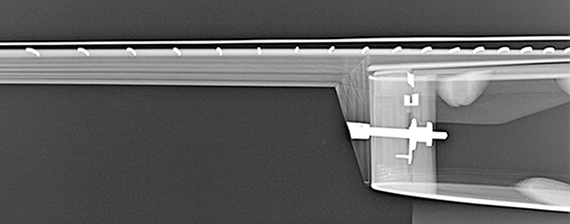
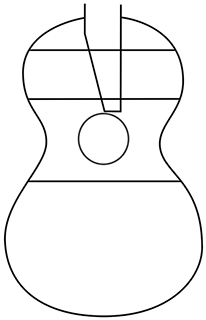
with identical hardware. Each guitar is ladder braced with
a similar "buttress" under the fretboard extension.
This guitar has no stamps or label, adding to the false belief
that it came from the workshop of Stauffer, not Martin.
Once I recognized that it came from the same hands as the other,
the question arose of whether this guitar and the Martin stamped
example might both have been built by others in Europe, with one
imported by Martin, adding both a Martin stamp and a label
proclaiming Martin as an "importer of musical
instruments". Or perhaps both were made by a fellow
immigrant living in New York City. Mr. Martin, after all,
was a busy owner of a Manhattan music store. Martin's
records, however, show that Martin imported only more affordable
guitars.
It now seems more likely that the guitar was built by Mr Martin,
with the help of his young apprentice Louis Schmidt, or by
Martin's friend from Saxony, Heinrich Schatz, who also trained
with Stauffer in Vienna, and who was a partner in building guitars with Mr. Martin
before and after Martin's move from New York to
Pennsylvania. Schatz was a fine builder, who's work was similar to and every bit
as skilled as the finest early Martins, and Martin a busy
shopkeeper. Schatz quite possibly built this guitar as Mr.
Martin was tending to his store, preparing for the move to
Pennsylvania, or establishing his new workshop
there. Perhaps the one with the Martin stamp was
sold by the store, while the one without was kept by Mr.
Schatz. We may never know.
These guitars, if not typical, are the pinnacle of guitars
offered by C. F. Martin when he first came to America.
Illustrated in Washburn
& Johnston, "Martin Guitars: An Illustrated Celebration of
America's Premier Guitarmaker":
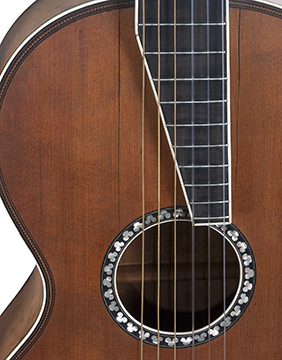
"The similarities between these two guitars are
startling... Note the almost identical bridge, soundhole
rosette, and angled cut at the end of the fretboard, as well as
the adjustable neck with fretboard floating above the
soundboard. Both guitars also have maple backs and
sides, though Martin would soon shift almost exclusively to
rosewood."
Illustrated in Gura, "C. F.
Martin and His Guitars, 1796-1873"
Illustrated in Bacon,
"History of the American Guitar"
In the Martin Museum, a
photo of this instrument sits in the display case with their
1834 Martin.
Chapter 3.
1837 C.F. Martin
"Ferranti" Hudson Street Viennese Style Guitar
While the earliest Viennese influenced Martins had rather
small figure-eight shaped bodies with large upper bouts, the
"Hudson Street label" Martins built c. 1837 are surprisingly
large and deep bodied guitars for their time. These
guitars, like their Viennese predecessors, had simple ladder
bracing.
"In October, for
example (Coupa) ordered two "small DeGoni” at $20 each, two
large ones with pegs, and one "Ferranti"...The "Ferranti" was
named for another well known player, Marc Aurelio
Ferranti, guitarist to the king of Belgium. His
instrument was also described as large, of a more "circular”
form - that is, with both bouts about the same width.”
Gura, p 76.
Coupa to Martin, New York, October 15, 1849.
This large guitar
appears to be in the Style Mr. Martin referred to as a
"Ferranti".
While a
typical Martin of the period might be 11 5/8" wide and 3 1/4"
deep, this Martin is 12 5/8" wide and 4 1/4" deep, close to the
depth of the famously deep Nick Lucas.
This
guitar is typical of what Martin was building in the late 1830's
before leaving New York for Pennsylvania. While most
people associate the Viennese influenced Martins with Stauffer
style headstocks with Vienna gears, a few have slotted
headstocks with machines. It's difficult to say if these heads
are original or not.
While the back and sides
appear to be built from Brazilian rosewood, the back is in fact
a rosewood veneer over spruce. Most early Martins were
built in this fashion, with the customer choosing from a variety
of quality hardwood veneers placed over either spruce or
mahogany.
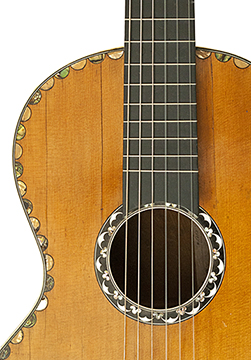
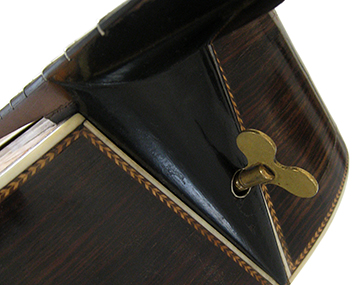
Most of the Hudson Street
Martins have a top border of "thumbprint" inlays as well as the
"herringbone" trim that has distinguished Martins for many
years. The inlays were likely crafted from halves of
button blanks from neighboring lower East Side garment dealers.
Illustrated in Washburn
& Johnston, "Martin Guitars: An Illustrated Celebration of
America's Premier Guitarmaker":
"Martin ledgers from the
1830's suggest that most of C.F. Sr.'s guitars were small and
plain. The eye catching inlays on this fancy model
probably ensured it's survival, while most of the simple guitars
from this period were discarded long ago."
Featured in "Vintage Guitar Magazine".
Chapter 4.
1839 Martin & Schatz
Guitar
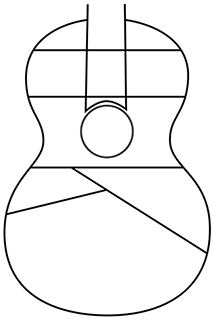
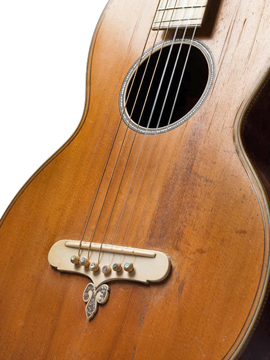
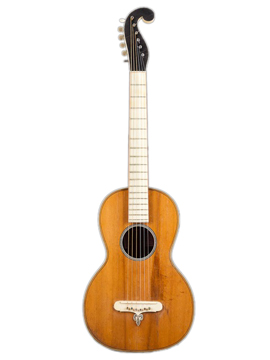
One of the most
significant early Martins, this rare double
label Martin & Schatz / Ludicus and
Wolter guitar resided in a glass case at the
new Martin factory in the years preceding
the addition of a formal Martin
Museum.
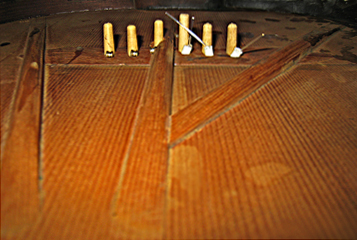
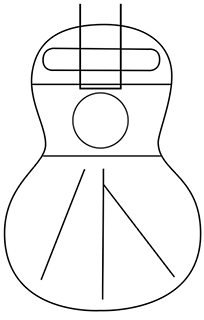
In the year
or so before leaving New York City, C. F. Martin's
discovery of the fan braced guitars of Cadiz, Spain
greatly influenced the design of his guitars.
Built in the old world tradition with Viennese gears,
one of a handful of Martins with an elephant
ivory fingerboard, and one of a small few with an
ivory shield shaped bridge, this was also one of the
first Martins built with a variation of fan bracing
and the narrow early Spanish "plantilla" or body
shape.
This instrument was built with a rosewood veneer over mahogany
back and with rosewood sides.
This guitar has an early form of the shelf under the neck block
that we see in many of the 1840's Martin & Coupa
guitars. I suspect that this was a design developed by
Heinrich Schatz. We also see a similar shelf in the Martin
& Schatz / Martin & Coupa guitar that follows.
When Martin left New York for Pennsylvania, he sold his stock of
guitars to Ludicus and Wolter.
Illustrated in Gura, "C. F.
Martin and His Guitars, 1796-1873"
Illustrated in Washburn & Johnston, "Martin Guitars:
An Illustrated Celebration of America's Premier Guitarmaker".
Illustrated in "Inventing
the American Guitar: The Pre–Civil War Innovations of C. F.
Martin and His Contemporaries". A diagram in the book
erroneously shows a significantly different shorter bracing
pattern from what actually exists in the guitar. The
narrative implies an evolution from ladder to fan bracing, while
in fact Martin, copied the bracing from the Spanish guitars he
observed.
Illustrated in "The Martin
Story: A Brief History of the Martin Guitar Company", .C.F
Martin & Co.
Illustrated in Carter
"Acoustic Guitars and Other Fretted Instruments".
Illustrated in Bacon,
"History of the American Guitar"
Chapter 5.
1839 Martin &
Schatz / Martin & Coupa Guitar
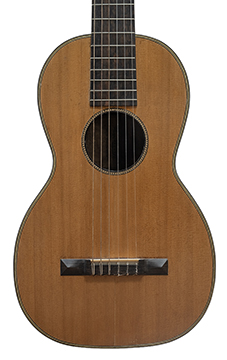
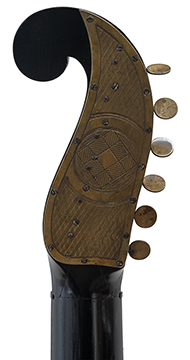
This double
label Martin & Schatz / Martin &
Coupa was one of the first guitars sold by
John Coupa, a
classical player who both
introduced Martin to the guitars
of Cadiz, Spain, and then sold
the Spanish Style Martin guitars
to his fellow players in the New
York guitar community,
becoming
Martin's
distributor in
New York
as the Martins made the move to start a
new life in the countryside of
Pennsylvania. It may very likely
have built by Martin's friend Heinrich
Schatz, who preceded Martin to both
America and Pennsylvania, while Martin was
settling in his new home and
workshop. The Martin family, eager
to leave the city, had been staying with
the Schatz family while Mr. Martin had
been settling his affairs in New York.
Built in the old world tradition with Viennese gears,
this guitar also includes the fan bracing adapted from
the guitars of Cadiz, Spain as well as the narrow
early Spanish "plantilla" or body shape, and is also one of
the first Martins known with a pyramid style
bridge.
This instrument was built with a two piece rosewood back with no
center strip, and rosewood sides.
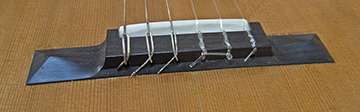
Illustrated in Gura, "C. F. Martin and His Guitars, 1796-1873"
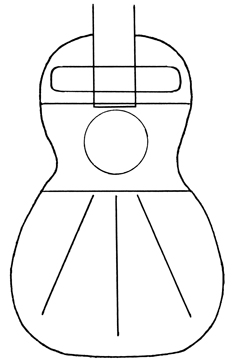
Chapter 6.
1852
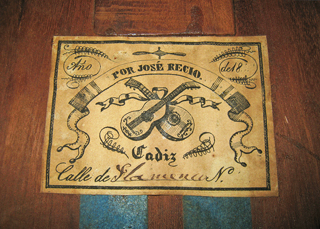
Jose Recio, Cadiz Guitar
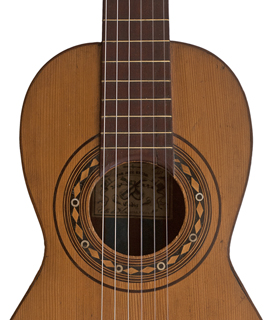
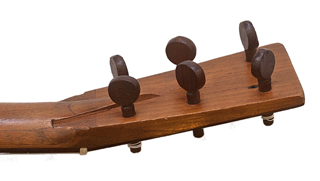
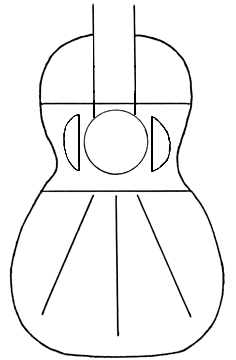
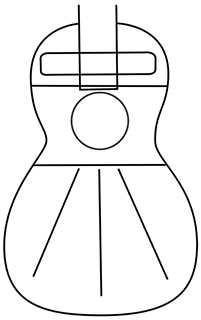
The developing shape of the Martin guitar, with a smaller upper
bout, was influenced by the guitars of Cadiz, Spain. The
"Spanish" style Martin guitars of the 1840's copied many of the
features of guitars of Cadiz, including fan bracing, the cedar
neck with thin curved heel, square headstock with "volute",
tuning pegs, "Spanish foot", two piece sides, rosette with
thinner outer rings, and tied bridge with ivory or bone inset.
Chapter 7.
c. 1840 Martin &
Coupa Goncalo Alves Guitar
Once the Martin family moved from New York City to rural
Pennsylvania in 1838, distribution of the guitars remained in
New York, handled by guitar teacher John Coupa, and the guitars
were either affixed with a "Martin & Coupa" label, or
continued to be stamped "C.F. Martin, New York".
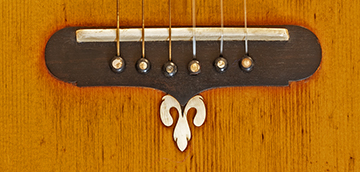
This is a typical early
Martin parlor guitar, showing a mix of Viennese and Spanish
influenced features: Still with the Stauffer Style
headstock and Vienna gears, ebonized neck and "ice cream cone"
heel, combined with Spanish fan bracing, an early precursor of
Martin's faux Spanish foot, extending the width of the upper
bout, and an early version of Martin's typical Spanish
influenced body shape, with a smaller upper bout than the
Viennese influenced guitars, and a flatter base of the lower
bout than is found on later Martins.
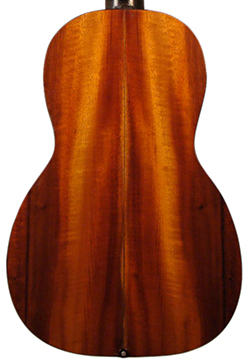
This instrument has been noted in several books as an
early illustration of Martin's use of Hawaiian koa wood, long
before koa was first thought to have been used
during the Hawaiian craze
of the teens. Recent testing has shown this
wood to in fact be not koa but Goncalo Alves from
Eastern Brazil, commonly referred to as "Tigerwood".
The back is a Goncalo Alves
veneer over
mahogany.
Illustrated in Washburn
& Johnston, "Martin Guitars: An Illustrated Celebration of
America's Premier Guitarmaker":
"You don't often find
Hawaiian koa on mid-nineteenth-century guitars; in fact, you
don't find much koa on anything at that early date. Around
1915, when the Hawaiian music craze swept the nation, Martin
began to make lots of instruments from this beautiful wood, but
one can only speculate why C.F. Sr. chose to try it on this
Martin & Coupa from the 1840's."
Illustrated in Carter
"Acoustic Guitars and Other Fretted Instruments":
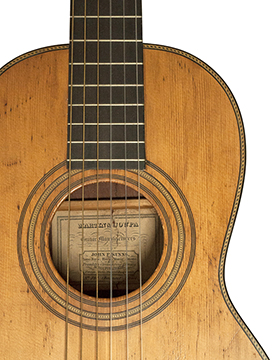
"Stuck over the Martin
& Coupa label is one indicating that the guitar was "Sold by
John F. Nunns". Martin & Coupa claimed the largest
assortment of guitars that can be found in the United States."
Chapter 8.
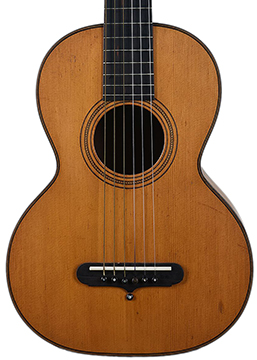
 c. 1842 Martin
BirdsEyeTerz
c. 1842 Martin
BirdsEyeTerz
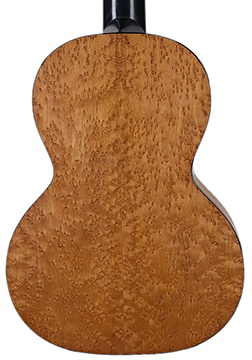
This guitar was likely built at close to the same time as the
Tigerwood Martin and Coupa above but with three
differences. It is a smaller "Terz" guitar. It was
built with a bird's eye maple veneer over mahogany rather than
Goncoa Alves. And it has a single "C. F. Martin, New York"
stamp in place of the "Martin & Coupa" label.
The Terz is a small guitar, still made by Martin today, and made
popular more recently by Marty Robbins.
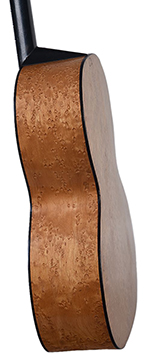
While this guitar was build at approximately the same time as
the Martin & Coupa, the Martin & Coupa label was used
only on guitars distributed by John Coupa in New York, while
Martin was also selling a number of guitars directly from his
workshop at his new home in Cherry Hill, Pennsylvania.
Illustrated in "Inventing
the American Guitar: The Pre–Civil War Innovations of C. F.
Martin and His Contemporaries".
Chapter 9.
c. 1841 Martin &
Coupa Spanish Style Guitar
This example epitomizes the
Martin guitar at a critical point in it's evolution. The
"Spanish" Martin is a distinct style with specific features
clearly showing Martin's awareness of the pre-Torres guitar of
Cadiz, Spain. This guitar retains features of Martin's
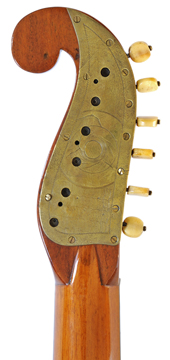
earliest Viennese influenced guitars, including the headstock
with "Vienna Gears", while adding features of the Spanish
guitar.
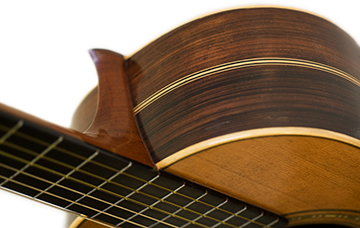
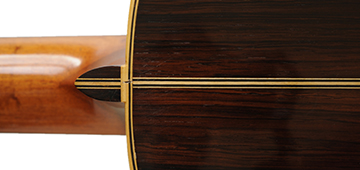
This fine early example shows a Martin guitar with features
closest to the pure Spanish form, with many prototypical Spanish
features: cedar neck with elegantly curved Spanish heel,
Spanish style interior false foot, tie style bridge with ivory
inset, fan braces, two piece rosewood sides with simple
lengthwise center strip dividing the two pieces, and both
bindings and simple back strip with straight lines made of holly
extending into the heel.
This guitar is also shows features that would become hallmarks
of Martin design for years to come, such as the ebony pyramid
style bridge, and Martin's version of the Spanish body shape
with a smaller upper bout than the Viennese influenced guitars.
This could be the earliest Martin we've seen to have solid
Brazilian rosewood backs and sides in place of a back of
rosewood veneer.
Illustrated
in Evans, "Guitars: Music, History, Construction and the
Players, from Renaissance to Rock"
While interviews related to a recent museum exhibit of early
Martin guitars infers that the "Spanish Connection" is a recent
discovery, the importance of this instrument in illustrating the
significance of the influence to C.F. Martin of the "Pre-Torres'
guitars of Cadiz, Spain was clearly recognized here by Evans, in
these words published 46 years ago, in 1977, and reprised in the
1997 writing of Washburn and Johnston:
"This instrument has a combination of features that is, to our
knowledge, unique on a Martin guitar. The head design is
similar to that used by Martin in the 1830's, with the tuning
machines concealed under a metal plate and buttons on one side,
after the manner of Stauffer. The body, however, does not
have the Stauffer-inspired, wasp-waisted shape of the 1830's,
but is closer to the mature Martin style of twenty years
later. The shape suggests strongly that Martin had had the
opportunity to examine a Spanish-made guitar of about 1840, and
was
experimenting with Spanish-style construction."
"This supposition is reinforced by the presence of Spanish
features such as we have seen on no other Martin guitar,
including simple fan bracing with three radiating struts, and a
Spanish head and slipper foot into which the sides are
slotted. The division of the rosewood sides by a narrow
decorative hardwood strip is another feature borrowed from the
nineteenth-century Spanish guitars. The presence of this
strip weakens the sides; to give them strength, Martin fitted
several vertical braces into which the cross struts of the top
and back are notched, framing up the body."
"The design of the bridge is very modern for it's date. In
shape it conforms to the "pyramid" bridge pattern used by Martin
throughout the latter half of the nineteenth century and the
first quarter of the twentieth. But this is one of the
very few nineteenth-century Martin guitars to be made with a
tied rather than a pin bridge. The strings pass over a
broad, backward sloping ivory saddle-piece before being secured
at the rear of the bridge."
"This guitar proves that C.F. Martin was one of the few makers
outside Spain in the early nineteenth century to be aware of the
possibility of fan strutting on the guitar, and that he
experimented with it before developing his own famous X-bracing
system. It shows the American gut-stringed guitar,
theancestor of the steel-sting guitar, at a critical point of
it's evolution, about to break away from the diverse European
influences to which it owed it's beginnings."
Illustrated in Washburn
& Johnston, "Martin Guitars: An Illustrated Celebration of
America's Premier Guitarmaker":
"The most interesting parts
of this Martin & Coupa are what you can't see. The
neck has a Spanish-shaped heel, with the sides slotted into a
neck block with an interior "foot". The top is also fan
braced, a feature this guitar shares with several other Martin
& Coupa instruments. Other small details from this
experimental period at Cherry Hill strongly suggest that C.F.
Sr. was turning away from Northern European guitar design and
incorporating ideas found on Spanish instruments predating
guitarmaker Antonio Torres's guitars.
Illustrated in "The Steve
Howe Guitar Collection"
Chapter 10.
1844 Schmidt & Maul Spanish
Style Guitar
The Martin & Coupa above has been touted as containing a
singularly unique combination of features not found on any other
known Martin guitar, including elements showing Martin's
Viennese and Spanish influences, as well as the beginnings of
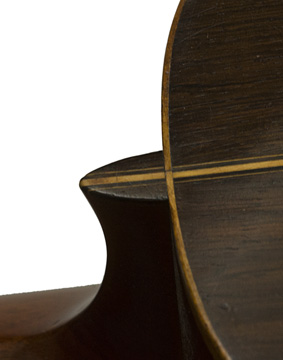
his own style. When I purchased this 1844 Schmidt
and Maul guitar at auction from Christie's, I was shocked to
discover that it contained every single one of the unique
elements recognized by Evans in the Martin & Coupa above,
including Viennese gears and Spanish fan bracing, split sides
with marquetry, simple holly borders and back strip following
through the Viennese Style headstock with gears, and Spanish
Style cedar neck with a distinctive raised volute that has been
flattened to fit under the gear plate. This guitar shows
us that Schmidt & Maul were also influenced by Spanish
guitars at an early date. It makes sense, since Louis
Schmidt had been Martin's apprentice since coming over on the
boat to America with the Martin family, leaving to work on his
own as Martin was preparing to leave New York, and then joined
with George Maul, with whom he built guitars in the same
building as John Coupa on Broadway, on the floor above.
Chapter 11.
c. 1840 Transitional
Viennese/Spanish Style Martin & Coupa Guitar
Some folks studying early
Martin guitars make a point of presenting the guitars in
chronological order to establish a sequence of events.
This can be a difficult endeavor, as once Martin introduced a
new feature, it was added to his menu of available options for
customers to choose from, so not only do features show up far
after one would have thought them to be obsolete, but guitars
with early features keep popping up with other features that we
thought to have come far later.
It doesn't help that Martin records from the 1840's, perhaps the
period of greatest change, are missing.
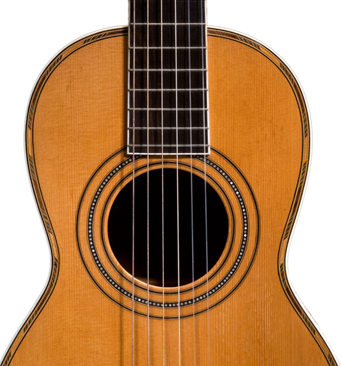
This guitar has some features associated with the Martin &
Coupas, including the ebony pyramid tie style bridge with inset
ivory saddle, the "shelf" style of "Spanish foot", and five
strut fan braces. The wide, open rosette is more
reminiscent of Panormo or the guitars of Cadiz, Spain.
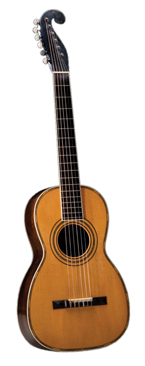
This guitar has a Viennese influenced ebonized neck with Vienna
Gears and an "ice cream cone" heel. We see the herringbone
border on the sides that are usually found on Martin's earliest
guitars from the Hudson Street days. And we are surprised
by a wide marquetry top border of the style generally found on a
Style 34, after Martin's styles were established in the 1850's.
Not surprisingly, this guitar shares features with some of
Martin's simplest guitars, while the herringbone side trim is
seen on Martin's most decorative guitars, and the delicate back
border is only seen on a handful of early Martins. The
back is rosewood veneer over mahogany.
By comparison, the Spanish Martin & Coupa above looks
similar from the front with it's Spanish shape, "Stauffer" head,
and ebony tie bridge with inset, but has an "earlier" three
strut fan, which generally defines the era, and a later Spanish
heel, while this guitar has the earlier ebonized neck with ice
cream cone heel and herringbone side trim, and a later style of
marquetry.
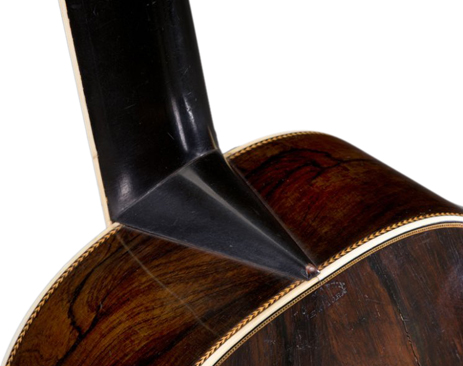
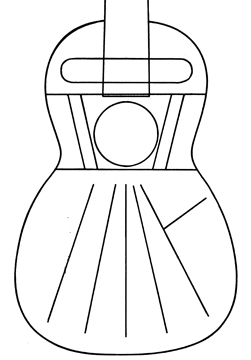
Chapter 12.
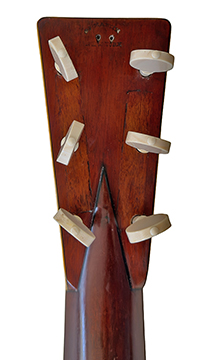
c. 1842 Martin Spanish Style
Presentation Guitar
This guitar is a uniquely
fine example of Martin's version of the Spanish guitar, with
many of the typical features: cedar neck with elegantly
curved Spanish heel, large, square headstock flared to a wide
end, with pegs, nickel silver nut, Spanish style interior false
foot, tie bridge, fan braces, two piece rosewood sideswith
decorative side filets and a decorative lengthwise center strip
with marquetry dividing the two sections, and back with rosewood
veneer over mahogany.
With the fancy appearance of perhaps the most jewel-like Martin
"presentation" guitar existent, with a top border of pearl
diamonds set in mastic, and a version of one of the three basic
pearl diamond-adorned soundhole designs with two rows of
glittering tiny pearl diamonds surrounding a solid band of
colorful abalone, this example was clearly built to be played,
with a large, long scale, modern feeling neck, which gives this
guitar the feel in-hand of a much larger guitar.
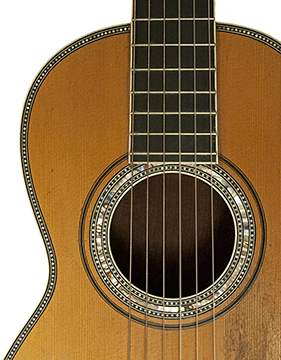
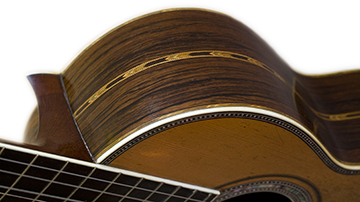
Illustrated in Gura, "C. F.
Martin and His Guitars, 1796-1873":
"This instrument has
rosewood sides and back (laminated); marquetry on back and side
edges and through the center of it's sides; pearl trim around
the center of it's sides; pearl trim around the top, and an
abalone rosette. Note in particular the beautiful abalone
soundhole and top trim, found on Martin's highest-style guitars,
and the ivory tie bridge."
Matt Umanov, Umanov Guitars,
New York:
"Most interestingly, it
also has a longer scale; at 24.5" it is nearly that of a grand
concert size Martin. This suggests possible construction
for concert use, as it gives the guitar an amazingly sonorous
tone, far out of proportion to it's size."
Chapter 13.
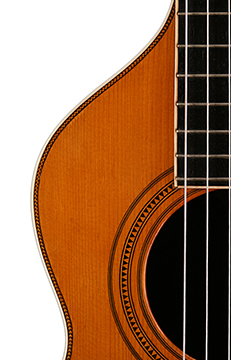
c.
1844 Martin Renaissance Style Guitar
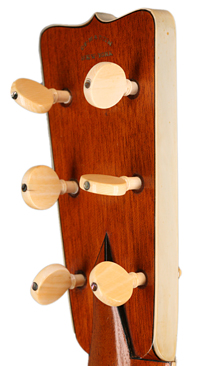
This guitar
shares many features with the 1840's Spanish Style guitar
above, including the ivory bound headstock with pegs
and thin ebony lines delineating all edges of the headstock,
volute and neck,
cedar neck, elegant heel, nickel silver nut, fan bracing,
identical ivory tie block bridge, 2 piece sides divided by
a longitudinal strip of marquetry, details of internal
construction, and a long modern feeling neck. This
unique "Renaissance" shape, however, can be seen on only a
handful of early Martin guitars.
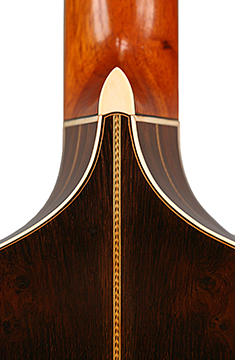
But the unique details go
further than that. This is the only known example of a
Martin with sides tapered to fit the contour of the neck heel in
a most elegant fashion. The neck is a full 2" wide, with a
24.75" scale, and this is one of only two Martins known to have
a unique peak at the tip of the ivory bound headstock.
Besides being one of the most unusual Martin examples known to
exist, the condition is breathtaking, all original and looking
like an almost new guitar.
This is another early example with solid Brazilian rosewood
backs and sides in place of a rosewood veneer back.
Richard Johnston, co-author "Martin Guitars, a
Technical Reference":
"This is the
earliest Martin guitar I have seen in many years, and without
doubt the most unusual. Words like “unique” and “extremely
rare” get tossed around frequently when describing vintage
guitars, but in this case we’re not exaggerating. Only seven
of these unusual “Renaissance” shape Martins have surfaced to
date, and only this one has the sides tapered to fit the
contour of the neck heel."
Illustrated in Washburn & Johnston, "Martin
Guitars: An Illustrated Celebration of America's Premier
Guitarmaker":
"This
elegant peghead has been seen on only a handful of early
Martins... The ivory sides... later evolved into a thin
border on only the uppermost edge of the peghead."
"The compound curve of the guitar where the sides meet the
neck is sure to inspire admiration from any serious
woodworker...no other Martin guitar has surfaced in which the
sides form a continuous, smooth transition into the
neck. The low-profile shoulders would make playing in
upper positions on this guitar almost as easy as on a cutaway
guitar.
Please note: I'm proud to say that the "Renaissance
Martin" shown above, as well as it's "likeness" or image, are
the sole property of the Corwin Collection.
Sadly, numerous images of this important guitar were
reproduced in the book "Inventing the American Guitar: The
Pre–Civil War Innovations of C. F. Martin and His
Contemporaries" by Szego and Shaw without proper attribution,
and without obtaining the necessary permission requested and
required to legally reproduce it's image for commercial use.
The image and "likeness" of this guitar and other sole
property of the Corwin Collection may not be legally
reproduced without permission.
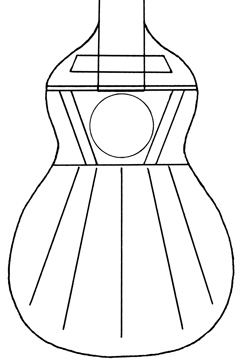
Chapter 14.
c. 1840 Martin & Coupa
"Small DeGoni" Hybrid X Braced Guitar
It is believed by many that Martin developed X_bracing.
X braced guitars, in fact, were ordered by Madame De Ghoni
from both Martin and Schmidt & Maul. The similarity
of the treatments show more than similar interpretations of
the same request. An investigation into the development
of X bracing on Martin and Schmidt & Maul guitars leaves
us wondering again about the relationship between the two
firms.
Besides Henirich Schatz, we now know that Louis Schmidt was
also an employee as early as 1834 or 1835. The longer we
study this guitar, the more we must wonder if Mr. Maul also
played a large part in building early Martin guitars, and
perhaps continued to consult with Martin after Martin left New
York and moved to Pennsylvania, playing much of the role in
the development of X braces and the modern guitar, that Mr.
Deichmann played in the development of the 14 fret guitar and
the Martin Dreadnaught. Schmidt & Maul were
certainly familiar with Martin guitars, and if a customer of
John Coupa returned a guitar for repair, it certainly would
have been more convenient to deliver the guitar upstairs for
repair rather than return it to Nazareth!
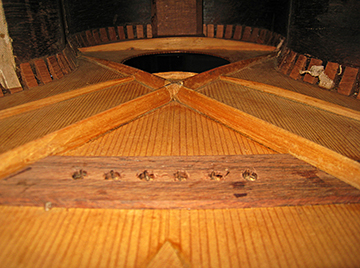
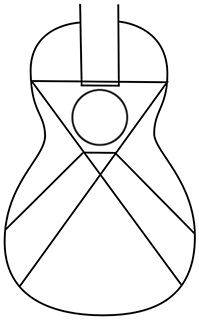
This Martin was built with what I believe was the first
experimental variation of X-bracing, appearing at about the
same time on a handful of Martin and Schmidt & Maul
guitars. One Schmidt & Maul, not necessarily the
earliest, is dated 1845, while the example produced by Martin
for Madame DeGhoni is dated 1843.
"Coupa could be much
more specific in his requests. In October, for example
he ordered two "small DeGoni” at $20 each, two large ones with
pegs, and one "Ferranti". The “DeGoni" was a model named
after Delores Nevares DeGoni, a well-known performer who
occasionally appeared on the stage with Coupa.
When she came to the United States in 1843 she brought a large
patterned Spanish guitar, copied by both Martin and Schmidt
and Maul, which thus may have provided Martin with the
incentive for producing some guitars
in
what was termed the"Spanish style”.
Gura, p 76.
Coupa to Martin, New York, October 15, 1849.
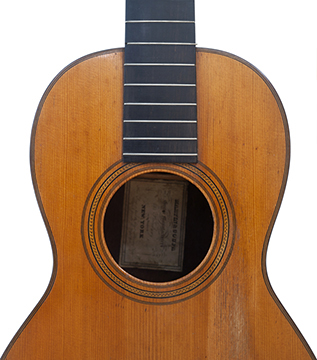
This guitar appears to be what Martin called the "Small
DeGoni" While most DeGoni Style Martins were Size 1, this
example is quite close in size to a standard Size 2
Martin. This guitar also foreshadows a standard Martin
Style 21, with simple, tasteful appointments including a
herringbone rosette and back strip and a top border consisting
of simple light and dark lines. The back is a rosewood
veneer over mahogany.
Illustrated in Carter "Acoustic Guitars
and Other Fretted Instruments":
"By 1839
Martin had moved his workshop from New York to Pennsylvania,
and this relatively plain example of a Martin & Coupa
guitar was
probably made at the new location. Note also the squared
off headstock with rear-facing tuning pegs rather than the old
Stauffer-influenced design."
Illustrated in Washburn & Johnston, "Martin
Guitars: An Illustrated Celebration of America's Premier
Guitarmaker" with Schmidt & Maul Guitar:
"The mystery
of which is the first X-braced guitar will probably never be
solved, but these two early candidates were clearly made by
builders who were aware of each other and may have even been
acquaintances. The fact that two very similar guitars -
both sold in New York in the latter 1840's and both made by
German immigrants - have nearly identical X-patterns under the
top suggests that there was a considerable pool of talent at
work. Whether X bracing was a concept shared among
compatriots or pirated by competitors is the only question
left unanswered. (This) guitar bears a Martin & Coupa
label, and Martin historian Mike Longworth's research into
insurance policies held by C.F. Martin Sr. on Coupa's 385
Broadway address suggests that Martin had guitars there as
late as 1851 and certainly for several years before
that. Regardless of which came first, Martin was the
firm that went on to make X bracing a standard feature of the
American guitar."
Chapter 15.
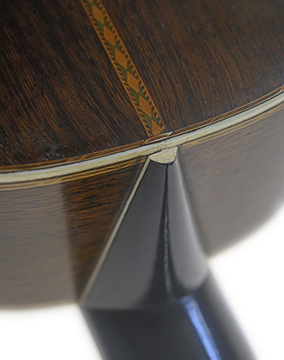
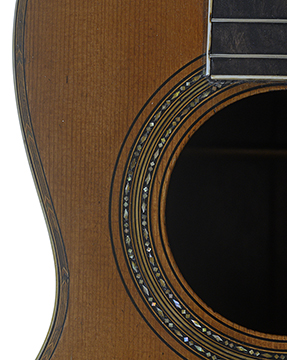
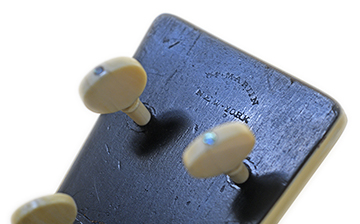
c 1842 Ornate Martin
"DeGoni" Hybrid X Braced Guitar
The Martin produced for Madame DiGoni is one of several that
were rather plain, while some were quite fancy. This
example has a number of high end features, including the jewel
like rosette, fancy marquetry side filets, and a few unique
features. This is a rare example with marquetry on
all borders. A handful of other Martins have fancy wood
marquetry on the top and side borders, but surprisingly, not on
the back border as on this one. A handful of other Martins
have the headstock edge sheathed in ivory. This rare
example has a handsome contrast of ivory sheathing on a black
faced headstock, finished off with pearl inlaid ivory
pegs. Like other Martins of the period, this example has
the faux Spanish foot and nickel silver nut. This example
also has an ivory pyramid style pyramid bridge with the vestigal
scooped back.
Chapter 16.
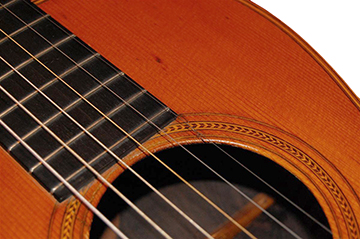
1847 Schmidt & Maul Alternate
X Braced Guitar
This Schmidt & Maul, dated 1847, has another experimental
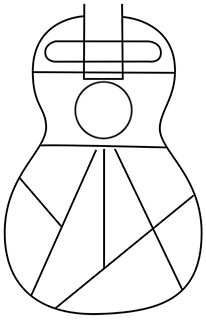
form of bracing, consisting of fan braces, with three struts,
and a tone bar that extends past the treble end of the bridge
and across the treble strut to form a small X under the treble
side of the top.
The Schmidt & Maul contains many elements similar to the
Martin, including herringbone trim, a Spanish false foot,
ebonized neck with ice cream cone heel, ebony tie style pyramid
bridge with ivory inset, and a similar company stamp on the
upper back near the heel, not surprising since Louis Schmidt
worked for Martin ten years earlier.
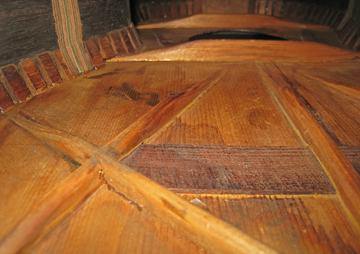
I suspect that this variation was an early one, as it contains a
complete three strutted fan, while the other variation, seen on
Martins, Martin & Coupas, and Schmidt & Mauls, contain
only the outer struts of the fan in combination with a large X.
Chapter 17.
c. 1842 "Small DiGoni" Hybrid
X Braced Spanish Martin Guitar
While the instrument made for Madame Di Goni is thought by
some to be Martin's first X braced guitar, this size 3
Martin,
which fits the description of a "Small DiGoni" has the same
hybrid of X and fan bracing with a number of Spanish
influenced features that precede those on the Di Goni guitar,
which has no features indicating an earlier age..
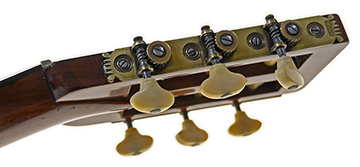
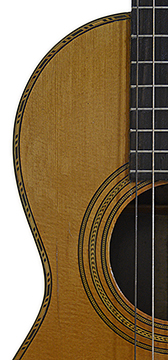
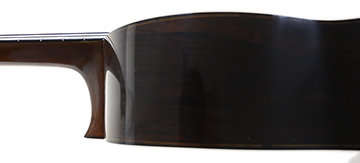
While Martin often mixed older features with newer ones, this
guitar, an early version of a Style 3-24, has an early tie
style bridge rather than a later pyramid pin bridge, an early
elegantly curved Spanish heel, a back strip of straight holly
lines, an early wide version of the slotted headstock with
large bone rollers, a rosette more reminiscent of a Martin
& Coupa with tiny dentils, rather than the more standard
Style 21 herringbone, and a broad full 2" wide neck width,
along with a faux Spanish foot, and an earlier rounded
popsicle brace.
Chapter 18.
c.
1845 Size 1 Martin Hybrid X Braced Spanish Guitar
This Martin, with the exact same experimental variation of
X-bracing appearing on the Martin & Coupa in Chapter 11,
also has several distinctive 1840's features, including a
Spanish foot, Spanish heel, nickel silver nut, and large
abalone fretboard markers on the side of the neck, as well as
the colored diamond backstrip, outer rosette rings with a tiny
rope pattern, and checkerboard binding sometimes seen on early
Martins.
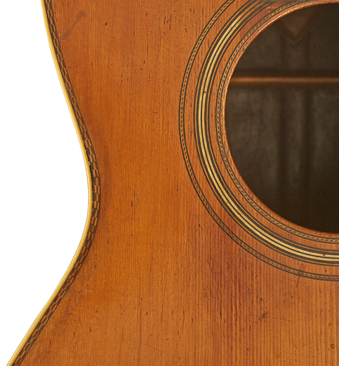
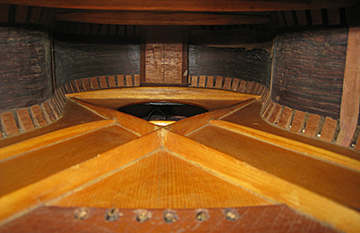
This early Spanish Style Martin appears in a larger Size 1,
with a variant of the classic three ring soundhole rosette
with double ivory center rings that later distinguished the
Style 28.
Chapter 19.
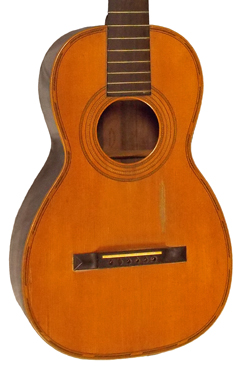
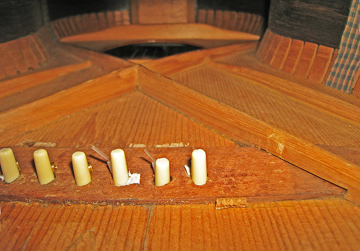
Schmidt & Maul Hybrid X Braced Guitar
This Schmidt
& Maul also has the "Hybrid X" bracing identical
to that in the Martin & Coupa in Chapter 11 and Martin in
Chapter 13.
This instrument includes many of Martin's features of the
period, including a Spanish cedar neck with slotted headstock,
a pin style pyramid bridge, a Spanish false foot, neck block
and center strip stamps, a three ring rosette with green
"tooth" inner ring and small "rope" outer rings, "half
arrowhead" marquetry top and side borders, and an "arrowhead"
marquetry back strip.
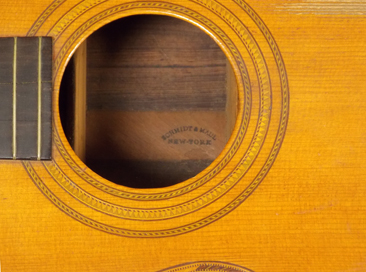
Chapter 20.
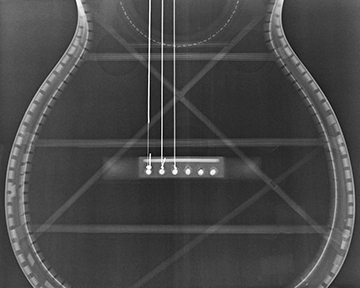
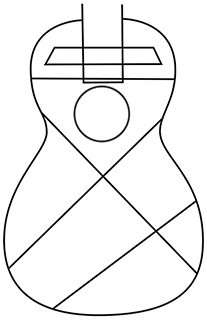
c. 1842 Martin Alternate X
Brace Spanish Style Guitar
This Size 1 Martin has another experimental variant of X
bracing, similar in concept the
Schmidt & Maul in Chapter 12, with a large X, and a tone
bar below the bridge crossing the treble brace of the X to
form another, smaller X. Following
a similar train of thought as the Schmidt & Maul, with a
tone bar crossing on the treble strut of the fan to form a
smaller X, this appears to be the first of the variants to
contain a large, complete X.
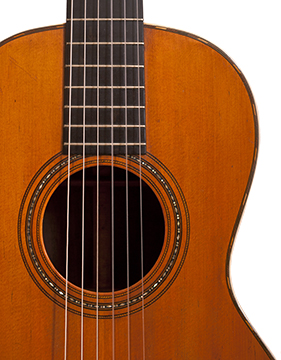
The soundhole of this guitar has another variation of the
diamond rosette, with a tasteful single center ring of
alternating long and short abalone diamonds. This
example also has features typical of a mid-1840's Martin,
including a Spanish foot, Spanish heel, nickel silver nut,
large abalone fretboard markers on the side of the neck, ebony
pyramid bridge with a "scooped" or "lipped" back, and a large
diamond end strip and outer rosette rings with a tiny rope
pattern of early Martins and arrowhead backstrip of later 19th
century Martins.
Chapter 21.
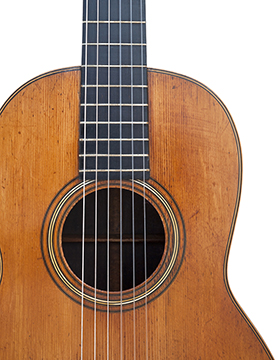
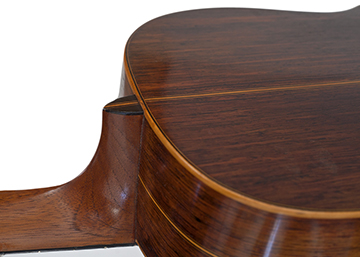
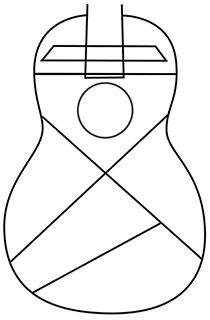
c.1846 Martin Mature X
Braced Spanish Guitar
This Spanish Style guitar has been called perhaps the earliest
known Martin to feature a mature X brace, essentially
the same as it has appeared for many years
since. Still with the earliest typical Spanish features
such as cedar neck with Spanish heel, two piece rosewood sides
with a simple lengthwise center strip dividing the two pieces,
distinctive holly binding, and simple back strip with straight
lines extending into the heel. The heel
on this guitar is thicker and not as elegantly curved as on
earlier examples, and the Spanish foot has been eliminated.
Bill Capell, from the essay "Early C.F. Martin Guitars":
"This is the
earliest known example of this style bracing that would go on
to become the standard for all modern acoustic guitars."
Images of
this important guitar were also included in the book
"Inventing the American Guitar: The Pre–Civil War Innovations
of C. F. Martin and His Contemporaries" by Szego and Shaw,
without the required permission, and were erroneously
attributed to the Martin Collection, which has never owned
this guitar.
Chapter 22.
c. 1845 Martin Size
1 Spanish Style Guitar
This highly unusual guitar is the
only example of a Spanish Style Martin known to have a Spanish
heel neck with an ebonized finish and no volute, with the
exception of an early Martin harp guitar who's ebonized neck
could easily have been designed to match the ebony
support. This may be an extremely early example, and
perhaps the first incarnation, of a Spanish neck Martin.
Being identical in many aspects to the Martin in Chapter 11
with "Hybrid X" Bracing, this is likely to also be one of the
earliest examples of a Martin with "mature X" bracing.
This is also an early example of a Martin with a solid ring of
pearl in the rosette. Many of the finer early Martins
had elegant decorative rings of "white pearl" diamonds and/or
squares. By the early 1850's, the jewel like rings of
pearl are replaced by a thin central ring of solid
abalone. This example has an elegant, somewhat wider
7/64" solid ring of pure "White Japan Pearl", most likely a
transition from the white pearl diamonds and squares, to the
5/64" wide solid abalone ring found on the standard Style 27
and Style 30 and higher Martins.
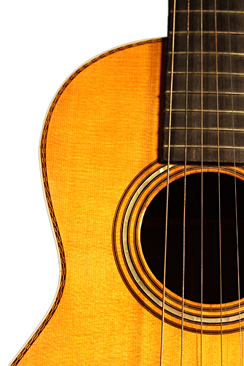
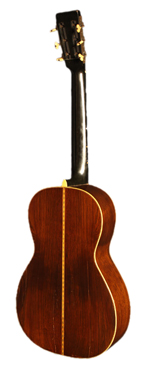
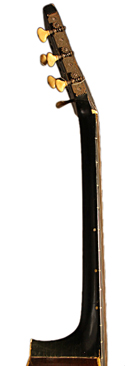
George Gruhn:
"An incredibly rare and historically significant
instrument. I do not recall having seen any with a
Spanish heel, lack of a volute on the back the peghead, and
black neck finish like this one."
Chapter 23.
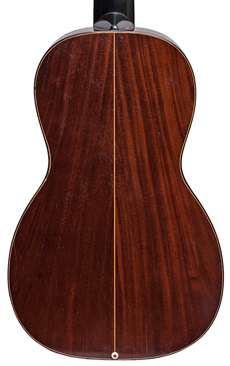
c. 1842 Martin Mahogany Size
3 Guitar
C.F. Martin Sr. rarely used mahogany for backs and sides of
his guitars, choosing instead Brazilian Rosewood, maple, and
even "Tigerwood" sometimes veneered over mahogany. The
first cataloged model with mahogany was the Style 17 when it
was reintroduced in 1906 by Frank Henry Martin.
In the 1840's, however, before
standardizing models, Martin did build a number of Size 3
guitars selling for $16 with mahogany backs and sides.
The typical $16 size 3 Martin had no binding and a simple
center strip of holly on the back.
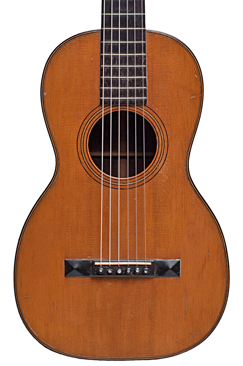
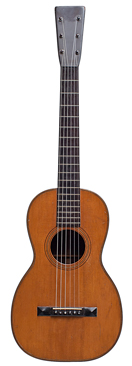
This highly unusual example has a rare combination of ebonized
neck with a solid headstock and pegs, beautiful figured
mahogany, rosewood fingerboard,
and fancy binding on the back, as well as a Martin stamp on
the upper back, an original scooped back pyramid bridge, and a
strap pin on the back.
Chapter 24.
1850's Martin Ivory
Fingerboard Vienna Gear Spanish Style X Braced Presentation
Guitar
Martin sometimes held over features for many years, offering
guitars with a mix of features from many periods on
request. The Stauffer Style headstock with Vienna gears
on an ebonized neck with ice cream cone heel is an early such
feature. The mature X braces are a later feature.
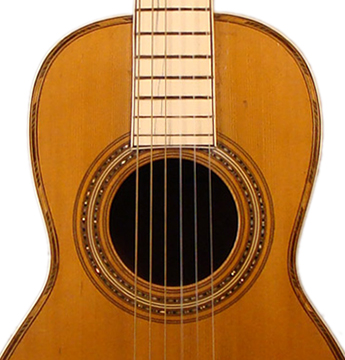
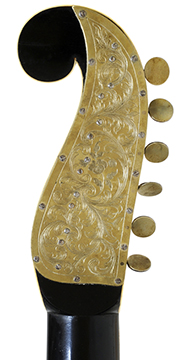
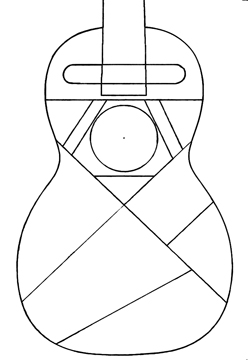
This fancy, small size 3 presentation guitar, another example
with a real elephant ivory fingerboard is indeed an elegant
"presentation guitar".
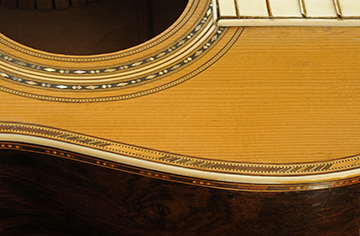
This example has a third elegant pearl diamond
soundhole design, with twin bands of tiny alternating long and
short pearl diamonds, as well as fancy wood marquetry bordering
the top, the sides, and the back, as well as rare, gold plated
frets. The back is a fine Brazilian rosewood veneer placed
over spruce.
Illustrated in Bacon, "History of the American
Guitar":
"Gradually,
Christian Martin began to bring to the guitars he made more of
his own ideas on construction and design. The most
obvious visual change when comparing this example to the
earlier Stauffer-style is the narrower upper body, giving an
overall shape that is more like a modern guitar."
Chapter 25.
1850's
Martin Pearl Rosette and Pendant Guitar
This final example combines decorative details typical of
earlier Martins with construction elements that would be
standard for years to come. With a beautiful decorative
pearl rosette that is possibly one of the earliest examples to
contain a version of the continuous thin band of pearl seen on
the rosettes and borders of pearl Martins until WWII replacing
the rows of tiny pearl diamonds found on the finer Martins of
the mid-1800's, but interrupted by segments of unusual vibrant
aqua colored pearl. The bridge is decorated with an
abalone pendant similar to the ones adorning the bridges of
early Hudson St. Martins. The back is made of beautiful
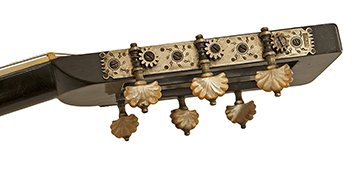
Brazilian rosewood veneer over spruce. The early Jerome
tuners with large bone rollers have intricately carved pearl
buttons of the type appearing on only the smallest handful of
Martin guitars, while more typically seen on ornate 19th
Century presentation banjos.
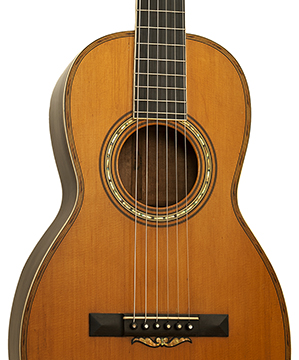
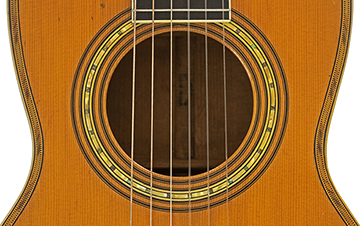
The body is a size 2 1/2, and the basic appointments follow
the form of a Style 30, making this perhaps a $33
guitar. This guitar is possibly one of the last before
Martin models would become standardized.
Chapter 26.
Heinrich "Henry" Schatz, Boston
In the second half of the 1840's, after working with Martin in
Pennsylvania, Henry (Heinrich) Schatz moved to Boston where he
produced guitars under his own name.
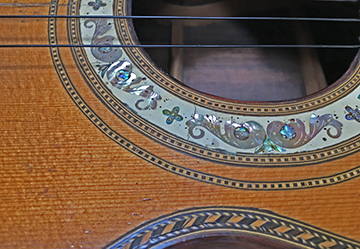
This is one of a number of Schatz guitars with pearl inlaid in
a white mastic, as opposed to the black mastic used in the
Martins he helped produce in the previous decade, creating a
distinctly different effect.
' ' ' ' ' ' ' '
' ' ' ' ' ' ' '
PART 2
Defining the Acoustic Guitar in the
20th Century
DEVELOPING
THE CONTEMPORARY STEEL STRING GUITAR
Chapter 27.
Martin 1902 00-42S / Style 45
Prototype
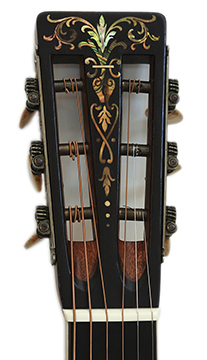
In 1902, three custom ordered Style 42 guitars were built with
pearl inlay added to the border of the sides and back, as well
as having an inlaid "fern" design added to the peghead.
The first of these had a fancy inlaid pickguard of the style
common on the higher end Martin mandolins of the time, and an
intricate vine pattern inlaid on the fretboard.
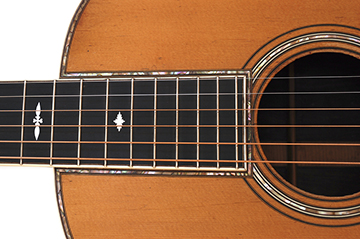
The example below was the first to have the more prototypical
fingerboard inlays of the type seen in 1904 when this design
was introduced as the C. F. Martin Style 45 Guitar.
More on Style 45
Illustrated on p. 2 & 28 of
Johnston, Boak & Longworth, "Martin Guitars, a Technical
Reference"
Subject of full page article by George Gruhn and Walter Carter
on page 42 of May, 2008 Vintage Guitar Magazine
"This 1902 guitar features the
first version of the Style 45 peghead inlay, which is
sometimes referred to as the “fern” pattern. Martin pictured a
Style 45 guitar with this inlay in the 1904 catalog and the
same photo appeared as late as the 1909 catalog, but Martin
had actually begun using a simpler pattern, known today as the
“torch,” by 1905, and that version lasted until about 1927."
"The initial designation – Style 42 special – understated just
how special Style 45 Martins would become. In the pre-World
War II years, it was only surpassed briefly by the OM-45
Deluxe (produced only in 1930), which featured additional
inlays in the pickguard and bridge. In today’s vintage market,
Style 45s follow the same pattern as they did in their
original listings."
"Although Martin has offered models in recent years with
higher model numbers than Style 45, along with many
limited-edition, commemorative or artist models with fancier
appointments, Style 45 remains today as it was when this
“pre-45” guitar helped to get the Style 45 ball rolling –
simply Martin’s top style."
Chapter 28.
Martin 1902 000-21 10
String / Martin Grows in Size to a 000
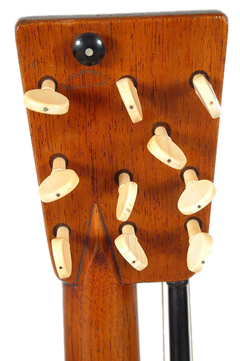
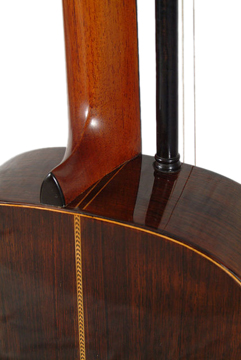
I look for important transitional guitars for this web site to
illustrate the development of the steel string guitar, and this
is an essential one. As a harp guitar, or more accurately, a "10
string 000-21" ( Martin only used the term "Harp guitar" to
refer to instruments with 2 complete necks ) this is a
curiosity, although a fabulous one.
More importantly, this instrument plays an integral part in
illustrating the history of the 000 size Martin. This guitar was
the first 10 string 000-21 designated as a 000, making it the
second Martin of any type ever designated as a "000" size
Martin.
In January 1901, Martin
built an "Extra Large Style 21" with a 15" wide body that was
5'16" deeper than what became a standard 000, followed by an
extra large 10 string guitar.
In 1902, Martin built one 9 string 00-21, and shortly after,
built a 10 string 000-28 followed by two 10 string 000-21,
apparently believing that the 000 size body was necessary to
accommodate the wider bridge needed for a 10 string guitar.
The 000 was slow to catch on as a standard size.
In 1903, Martin built a single "standard" 000-21, their first
six string 000, and three more were built in 1904.
From 1902 to 1910, Martin built only 23 "000" size guitars. Ten
were "harp guitars". In 1907 and 1908, the only 000 built was a
000-45 Harp guitar.
In total, only 13 standard six string "000" size guitars were
built in these first nine years.
Illustrated on p.84 of Washburn & Johnston, "Martin Guitars:
An Illustrated Celebration of America's Premier Guitarmaker"
Subject of a full page article by Richard Johnston on page 106
of July, 1997 Acoustic Guitar Magazine
Chapter 29.
Martin 1905
00-42S with Pearl Fingerboard
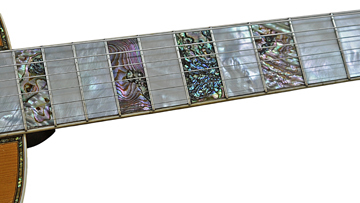
This singular
original example disproves the myth that C.F. Martin, unlike
their competitors, never lavishly embellished their
fingerboards with pearl.
Entire fingerboard made of genuine white pearl, with intensely
designed abalone on frets five, seven, nine, and twelve.
Subject of a full page article by George Gruhn and Walter
Carter on page 42 of February, 2009 issue of "Vintage Guitar
Magazine".
Chapter 30.
Responding to the "Hawaiian Craze" with Martin's First
Production Steel String Guitars
Southern
California Music Company Guitars
Martin 1916 Southern
California Music "Rolando" Model 1350 Prototype
No serial number
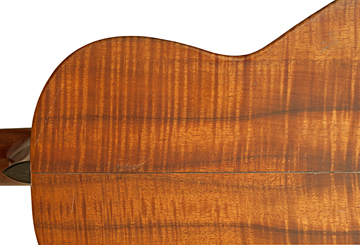
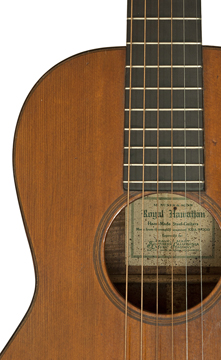
One of six samples made for
the California Musical Instrument Company, the first Hawaiian
Guitars made by the Martin Company.
To meet the demands of the "Hawaiian Craze", Martin built three
models of Hawaiian guitars with koa wood supplied by
SoCal. The first samples were made with spruce tops.
Thefirst batch of production guitars used koa for the tops as
well, and introduced specially designated serial numbers taking
into account the early samples previously produced.
Martin 1916 Southern California Music
"Nunes" Model 1400
Serial number 28
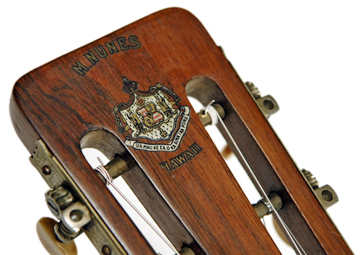
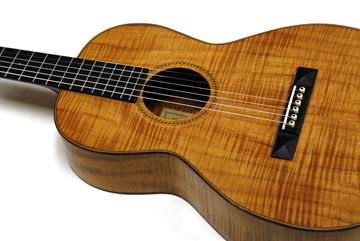
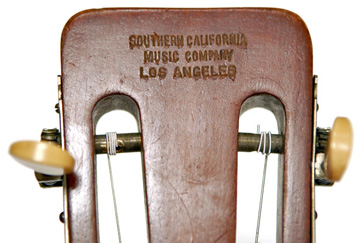
The first production "Nunes" Model 1400 made for the Southern
California Music Company in 1916.
Illustrated on p.113 of
Washburn & Johnston, "Martin Guitars: An Illustrated
Celebration of America's Premier Guitarmaker"
Illustrated on p. 247 of Johnston, Boak & Longworth, "Martin
Guitars, a Technical Reference"
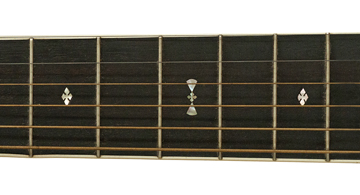
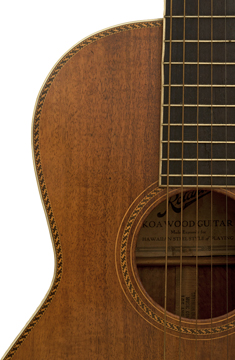
Martin 1916 Southern
California Music "Rolando" Model 1500
Serial number 181
Chapter 31.
Martin Develops the
Dreadnaught
Ditson
Ukes
Martin 1916 Ditson Style 3
Ukulele
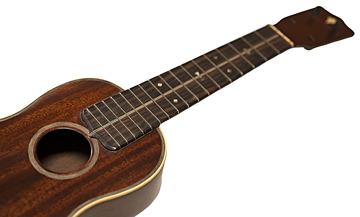
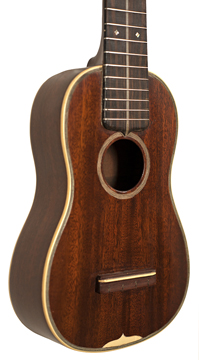
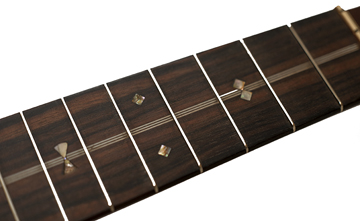
In the early 20th Century the Ditson Company operated the
Oliver Ditson & Co. Store in their home base of Boston as
well as the Charles H. Ditson & Co. Store in New York.
Ditson was a large Martin dealer that ordered many standard
Martin models as well as special models designed specifically
for Ditson. The Ditson stamp was applied to both the
regular Martin models, otherwise identical to Martin instruments
sold elsewhere, and the special Ditson "Dreadnaught" guitars.
Martin used the Dreadnaught shape on ukuleles and tipples as
well as guitars in three sizes, defined by Model designations
with one, two, or three digits, and three levels of trim,
designated as 1, 2, and 3. The Dreadnaught guitars were
originally Hawaiian guitars which, interestingly, used fan
bracing to support their steel strings, as did the Hawaiian
guitars built for the Southern California Music Company.
Note
that on this website uses the traditional spelling of
"Dreadnaught" with an "A", since we are speaking here of pre-war
examples, as opposed to the more recent spelling of
"Dreadnought" with an "O", as commonly used today, but only
since it's adoption in the 1960's.
Chapter 32.
Ditson Hawaiian Guitars and the First Dreadnaught Guitars
Besides the standard range of Ditson Hawaiian Guitars, Martin
produced a small number of the distinctively shaped Ditson
Standard Guitars with the appointments of typical Martin Styles
18, 21, 28, 30, 42, and 45. The 1-45 is often referred to
as a "baby D-45".
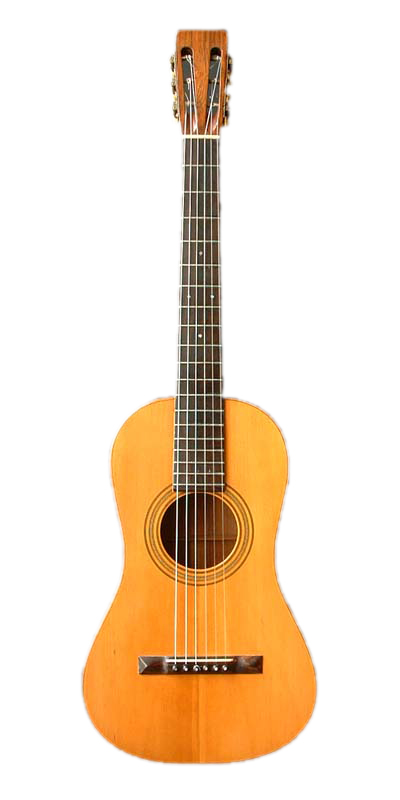
This is one of 26 Ditson Standard Style 21 guitars.
Martin 1917 Ditson DS-21 (1-21)
Martin 1916 Ditson Model 11
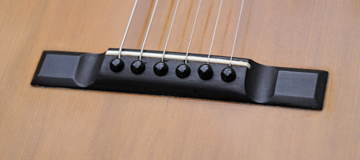
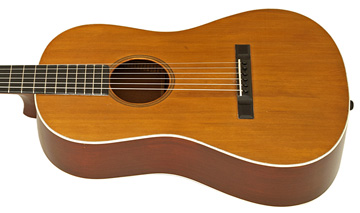
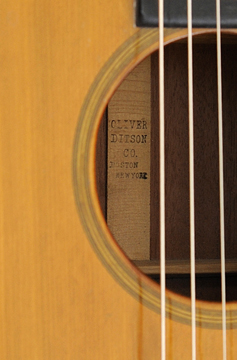
With the tremendous demand in production in 1916, Martin sourced
Chicago style bridges for the early Ditson guitars.
Martin 1920 Ditson Model 33
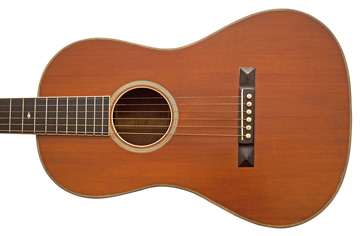
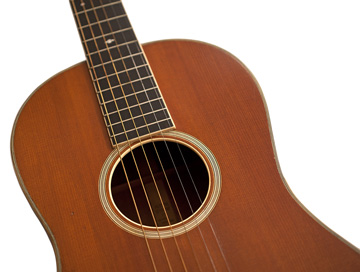
Martin 1919 Ditson 3/4 Size
Terz Guitar
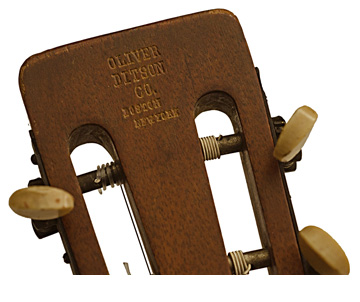
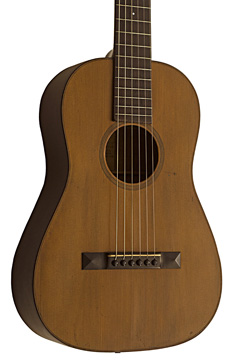
One of two 3/4 size guitars made for the Ditson Company that
were likely the prototype for the "Travel Guitars" of today.
Chapter 33.
Martin Learns from the Teachers
Martin
1916 Foden Special Models C, D and E
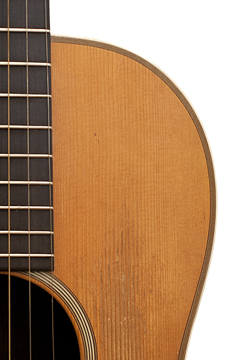
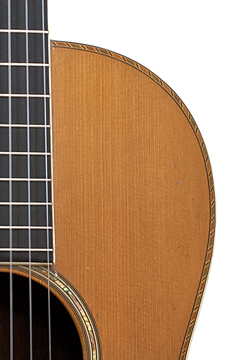
William Foden ordered guitars with several levels of trim for
his students.
The Style E combines the fretboard extension with no pearl of a
Style 40 with the inlays on the backs and sides of a Style
45. The Style E also used the same "propeller" fingerboard
inlay found on the SoCal 1500.
It is said that Foden was the first to request 20 fret necks for
his guitars, but I've also noticed several Martins made in 1902
with 20 fret necks.
Martin used single ring rosettes for the Foden guitars similar
to those used for Ditson, Wurlitzer, and other private label
guitars, but not on the top of the line Style E.
Chapter 34.
1922 Martin Vahdah Olcott-Bickford
Style 0-44 Soloist and The Mystery of the "Ditson" 1-44
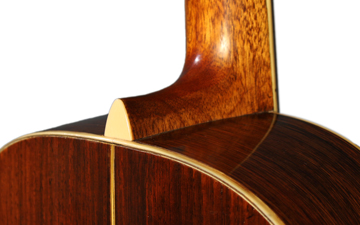
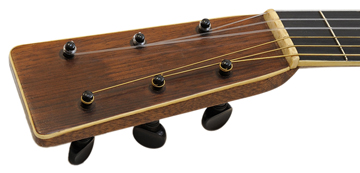
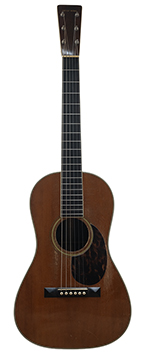
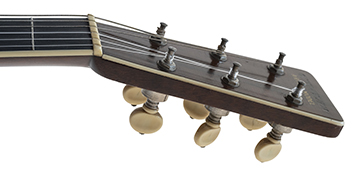
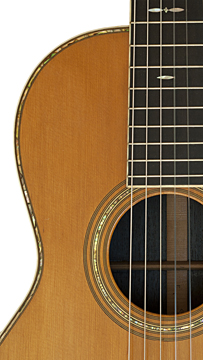
Vahdah Olcott-Bickford requested the finest Style 45 level
material in the guitars she ordered for her students, but
shunned ostentation, ordering guitars with simple straight line
borders and no fingerboard inlays.
Chapter 35.
The Model America
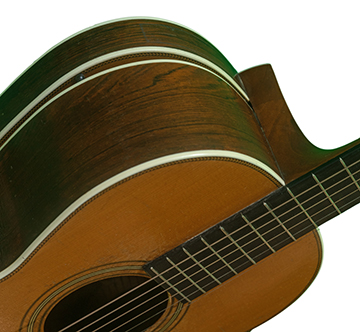
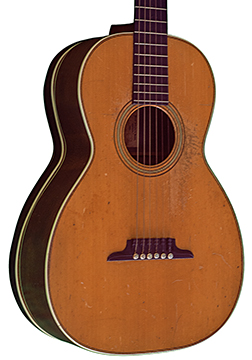
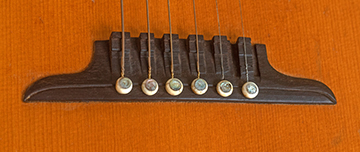
Chapter 36.
Pearl Makes the Transition from the "Ladies Parlor" to the Stage
Martin
1918 Ditson 000-42
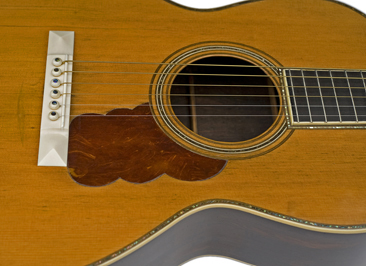
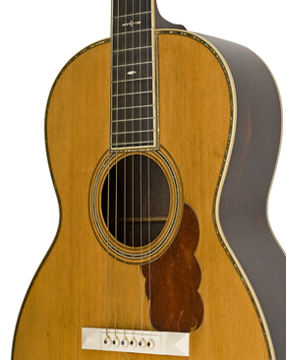
In 1918 Martin produced the
first two 000 size guitars with their top of the line 42 style
trim.
From the earliest years, Martin used fancy pearl inlays to adorn
"ladies size"parlor guitars. The idea of adding pearl to a
"man's" guitar must have seemed unthinkable at the time.
The 1918 000-42 illustrated here was built for the Ditson
Company as a steel string Hawaiian guitar with fan bracing, the
same build as a "Ditson Dreadnaught". This guitar ends the
myth that steel strings were never meant to be used with a
pyramid bridge, never mind one made of ivory!
This guitar is an early example of a Martin with a
pickguard. The early guards were inlaid into the top.
Illustrated on p. 41 of Johnston, Boak & Longworth "Martin
Guitars, a Technical Reference"
Chapter 37.
An Early Introduction to
Western Spruce
Martin
1919 0-45
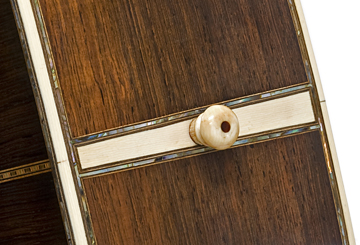
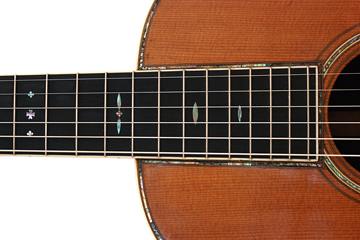
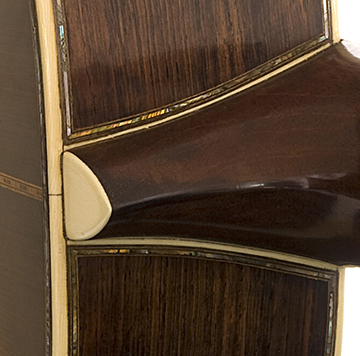
In 1945 Martin began to have difficulty sourcing suitable
Eastern red spruce of suitable size for guitar tops and switched
to the huge Western Sitka trees for top wood.
It is little known, however, that in 1919 Martin experimented
with the use of what was then referred to as "airplane spruce"
for guitar tops. By the time World War II ended in
November, 1918, production of Sitka spruce for aircraft by the
Spruce Production Division of the Army had reached 10,000 sq.
ft. per month, and left the newly built infrastructure and 1
billion board feet of Spruce.
Illustrated on p. 80 of Johnston, Boak & Longworth, "Martin
Guitars, a Technical Reference"
Chapter 38.
The Style 45 Goes Small
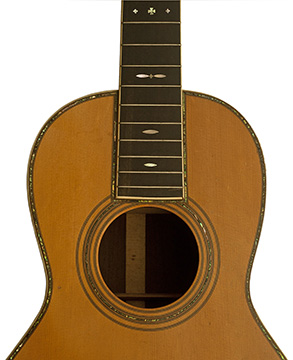
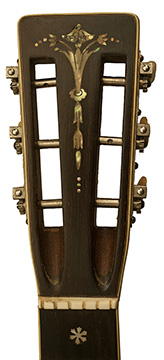
1925 Martin 2-45
Chapter 39.
Martin Ships it's First Production Steel String "Spanish" Guitar
Martin
1922 2-17 With Steel Strings
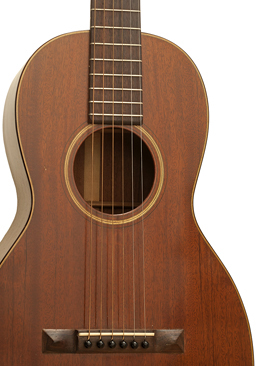
The first Martin guitars to ship with steel strings were the
Hawaiian guitars built for the Ditson and Southern California
Music Companies.
In 1922, Martin built the all mahogany model 2-17 with steel
strings, the first production steel string Martins for standard
"Spanish" style guitar.
Martin began the process of shipping their standard guitars with
steel strings as standard equipment with two Martin Style 2-17
guitars, #16879 and #16887, shipped to the John Wanamaker
Department Store in Philadelphia on March 27, 1922.
This guitar is #16879.
Chapter 40.
Martin's Experiments Resonate
1930 Wm. L. Lange Paramount Style L Hawaiian Six String and
Tenor Resonator Guitars
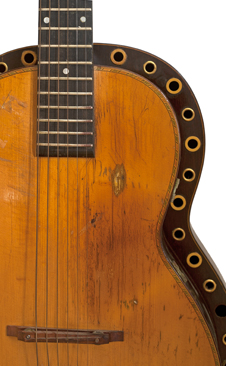
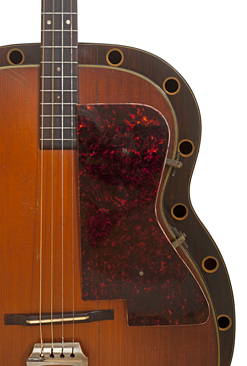
Martin made approximately 32 resonator guitars in 1930 with the
Paramount name for William Lange.
The Paramount Guitar was offered in three styles, all built with
a double rosewood body:
Regular Spanish Guitar, a Hawaiian Steel Guitar, and a Tenor
Guitar
These guitars varied greatly, some natural top and some shaded
tops, some with pickguards and some without, some with
soundholes, but most without.
The Tenor and Hawaiian Styles both had a moveable bridge and
fixed tailpiece. The Spanish Style guitar had a permanent
ebony bridge with ivory saddle.
Chapter 41.
Martin Enters the Market for Catalog Guitars
Martin 1030 Montgomery Wards
0-17S
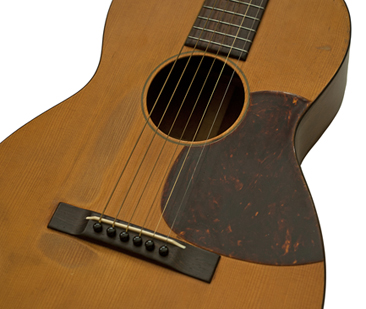
While Gibson and other large makers built many Recording King
and other guitars for the lucrative Montgomery Ward Catalog
market, Martin built only a few small batches of this
distinctive model, the 0-17S, for Montgomery Ward
Chapter 42.
The first 14 Fret
The Martin
Carl Fischer Model Tenor Guitar
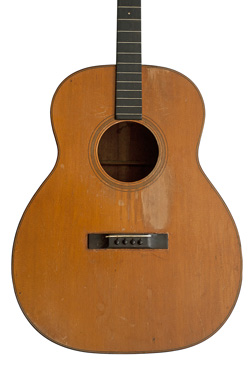
Credit for the 14 fret Martin design has been given to
Perry Bechtel, the buyer for the Cable Music Company in Atlanta
who requested the 14 fret OM guitar. In fact, it was Al
Esposito of the Carl Fischer Store in New York City who first
requested a 14 fret design for tenor guitars as suggested by two
local orchestra leaders to appeal to banjo players. Mr.
Bechtel's contribution consisted primarily of going fishing with
Mr. Martin. When Bechtel showed up to meet Mr. Martin for
their fishing
trip, he noticed the Fischer Model tenor guitars on the factory
floor, and asked if the same could be done with six strings to
give greater access higher on the neck.
Chapter 43.
The
Orchestra Model
Martin 1929 000-28 - 12 fret
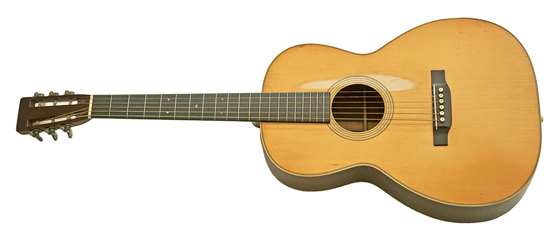
Martin considered the 12 fret design to have a superior sound,
but understood the practicality of the 14 fret guitar.
Martin 1929 00-28 G.P.
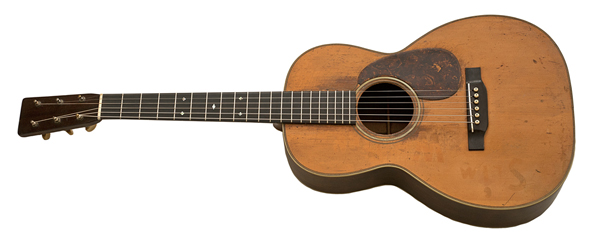
Martin built a small number of transitional guitars, such as
this "00-28 G.P.", for "geared pegs", which still had a 12 fret
body, but had the solid style headstock and "banjo style tuners"
of the OM. Pickguards and "belly bridges" were not used
until 1930, but many Martins built before 1930 sat in the
factory unsold, unfinished, "in the white", due to the slow
economy of the time, and were given a tortoise Celluloid
pickguard and "belly bridge" before leaving the factory in the
following years.
Martin 1930 OM-18P Plectrum
Guitar
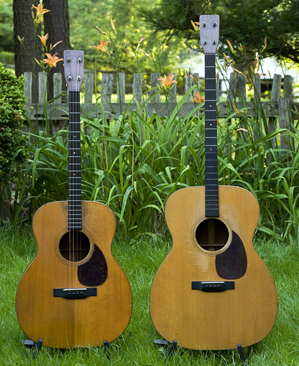
To appeal to long neck banjo players, Martin also began to
produce a long neck plectrum guitar in the OM Style.
Featured on the Television
Show "Pawn Stars"
Martin 1930 OM-28
January, 1930
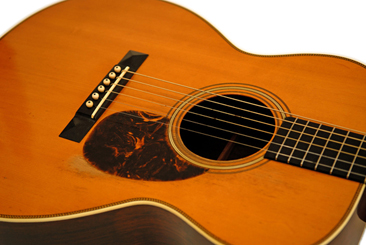
The first few OM guitars built for Cable Piano in 1929 and early
1930 had a pyramid bridge before the belly bridge, generally
associated with the contemporary flat top guitar, was
used. The small teardrop pickguard and banjo style tuners
were soon replaced by a larger pickguard and modern guitar
tuners.
Chapter 44.
The Orchestra Model Expands
Martin 1932 O-18 and 1933 0-17 Model 32
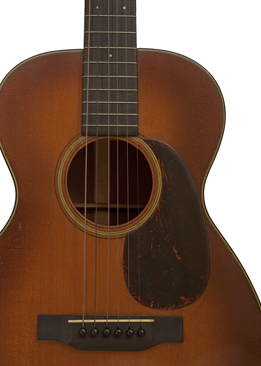
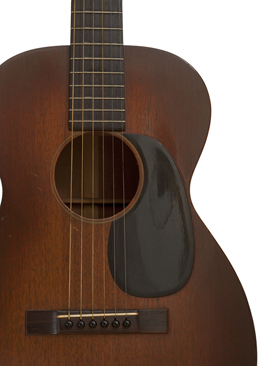
With the "Model 32" 0-17 and 0-18, Martin extended the 14 fret
body further into the product line.
Chapter 45.
Taking Ornamentation to the Next Level
Martin
1930 OM-45 DeLuxe
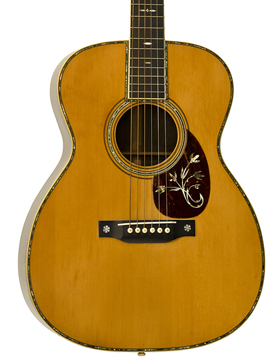
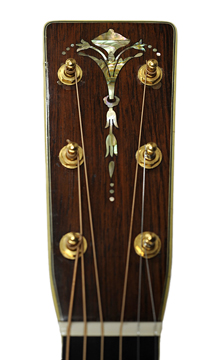
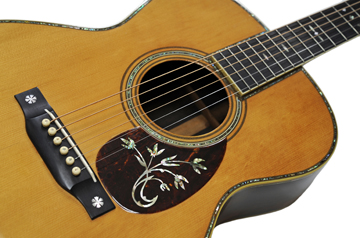
Featured in an article by Joe Konkoly
In 1930, Martin built only about a dozen "DeLuxe" style 45
guitars, the highest level production Martin to ever be made,
before shortages of the high quality materials forced Martin to
cancel all future orders after November 28th.
This example was built in September 25, 1930.
Chapter 46.
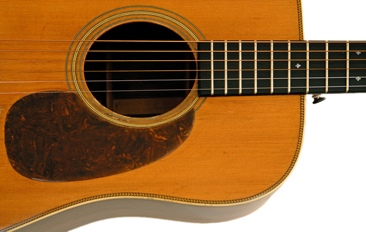
The "Bone"
Martin 1939 D-28
Chapter 47.
The Holy
Grail
The Pre-War Martin D-45


Chapter 48.
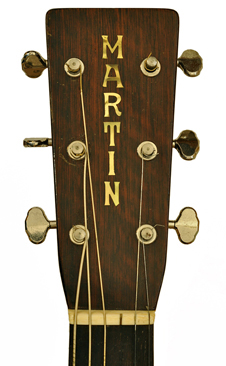
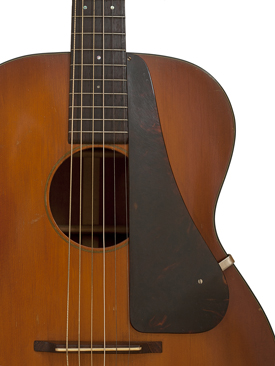
The
First Martin Archtop Guitars
Martin 1931 C-1 Prototype
Serial number 47368
Chapter 49.
Martin 1933 R-18
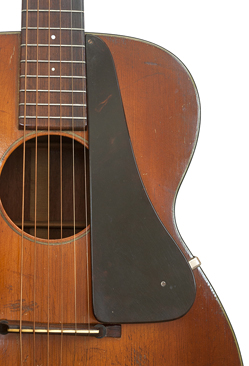
Chapter 50.
Martin's first 12 String
archtop guitar.
Martin 1932 C-2 12 String Archtop
Guitar
Serial number 50223
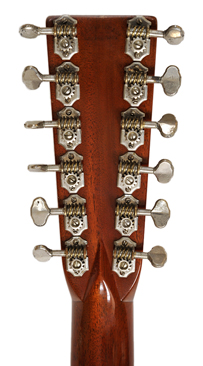
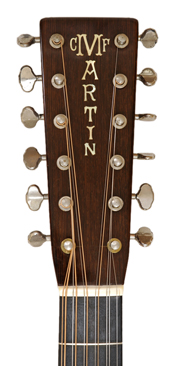
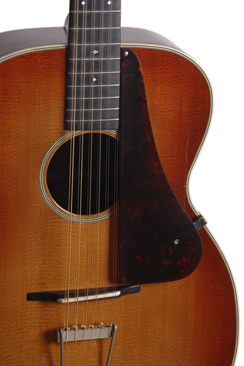
Illustrated on p. 172 of Johnston, Boak & Longworth, "Martin
Guitars, a Technical Reference"
Illustrated on p. 193 of Carter, "Acoustic Guitars and Other
Fretted Instruments"
Chapter 51.
The Last Martin Archtops
Martin 1942 F1
- from the last batch of Martin F Style Archtops -
Serial number 82431
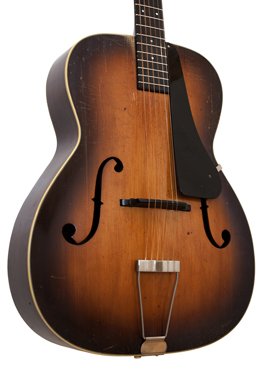
Martin 1942 R-18
- from the last batch of
Martin R Style Archtops -
the final Archtop Guitars built by Martin
Serial number 82855
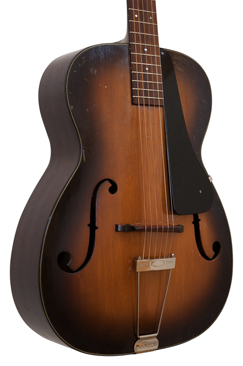
C. F. Martin's interest in
archtop guitars was relatively short lived, beginning with the
15" carved top, round hole C-1 above, #47368, and five other
examples, the first archtop guitars ever to grace the work
tables at Martin, on June 20, 1931.
By November of 1932, the C-1 was first built with F-holes as
it's former position in the lineup was filled by the slightly
smaller 14 3/8" pressed top roundhole R-18.
By the end of 1933, the R-18 had also become an "F" hole
guitar.
By mid-1936, the R-18 was also built with a carved top.
The F-1 and R-18 above, #82431 and #82855, were from the last
two batches of archtop guitars ever to be built in Martin's
North Street Factory, stamped on September 18 and November 20 of
1942.
Before building flat top 12 string guitars in the 1960's, Martin
built only six individual 12 string guitars, three flat tops and
three arch tops.
The 12 string above, #50223, was the first 12 string arch top
ever built by Martin.
Chapter 52.
Responding to the Limits of War
Martin 1944 D-18 - with
scalloped bracing and red spruce
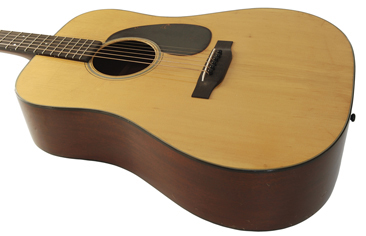
These examples illustrate the changes necessitated by shortages
of materials and personnel during the war years, as well as an
effort to build stronger guitars to handle heavier
strings. Due to strictly enforced limits to the amount of
metal to be used, the neck reinforcements in war time Martins
returned from metal to ebony rods similar to those used decades
earlier, necessitating a bulkier but lighter weight neck with a
different feel. The tuners were redesigned to use
significantly less metal, and the nut material changed from
ivory to ebony, all of
which contributed to a change in balance as the "top end" of the
guitar became lighter in weight.
Due to a change in finish formulations, many of the guitars
produced in 1944 developed a cloudy problematic appearance,
necessitating in many examples being oversprayed.
On February 24, 1943, Martin built a batch of 000-42 guitars,
the last batch of pearl inlaid Style 40, 42, or 45
Martins. With the last batch of D-28 in 1945 Martin
exhausted their supply of fingerboard inlays and began using
dots. With the first batch of D-28 in 1947, Martin
exhauted their supply of Germand made herringbone marquetry, and
instituted the use on D-28of the straight line borders first
used on Martin's archtops.
Chapter 53.
Transitional
Tapered Braces
Martin 1945 D-18
Martin 1946 000-18
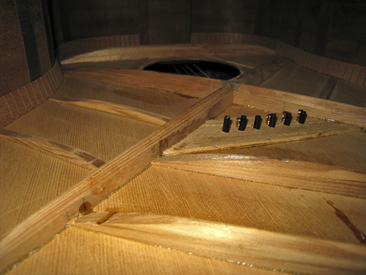
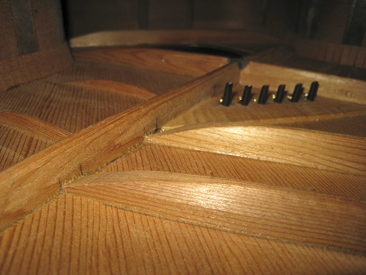
When old guitars became "vintage guitars", players looked more
carefully and noticed the "scalloped" top braces of pre-war
Martins, shaved to form peaks and valleys, as opposed to the
earlier "straight braces". More recently, folks have
noticed that "War Year" Martins have transitional "tapered"
braces.
Looking more closely, I've discovered that guitars built
in 1945 are distinctively different from those of other war
years, with their braces considerably more tapered, creating a
signature loud and "punchy" sound. The photos above
illustrate the slender braces of 1945 in constrast to the
heavier, rounder braces of 1946. I would not be surprised
if the more highly tapered braces have even less mass than the
scalloped braces of preceding years.
Chapter 54.
Electrifying!
F-50 #180644 and F-65 #179835 Electrics
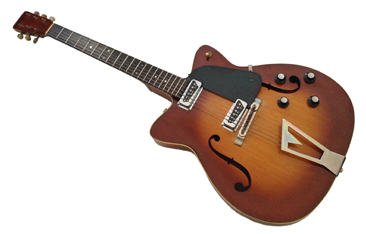
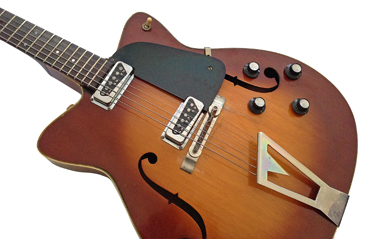
While Martin produced flat top guitars with DeArmond pickups in
the 1950's, in September of 1961 Martin made their first freshly
designed "thin body" electric guitars, starting with three
prototypical examples of each of three variations, of which this
top of the line, two pickup, double cutaway F-65 #179835 is
one. In November of 1961, Martin produced the first
production run of 12 of each style, of which this single
cutaway, single pickup F-50 #180644 is one. Larger
production in batches of 24 each began in 1962.
Chapter 55.
New York, New York!
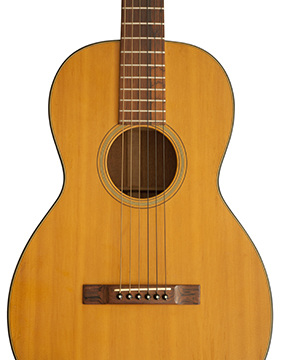
Martin 0-16NY and Martin
00-21NY
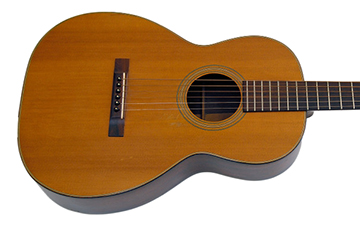
Chapter 56.
The 12 Fret Dreadnaught Returns
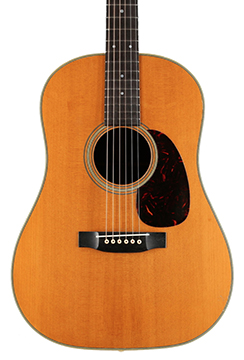
Martin Special Wurlitzer D-28SW
Chapter 57.
The Introduction of the 3 Piece Rosewood Back
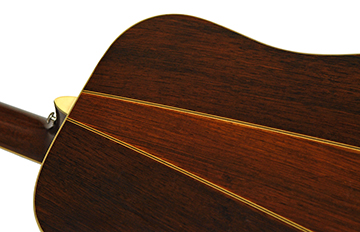
Martin D-35
' ' '
' ' ' ' ' ' ' '
' ' ' ' '
PART
3
FIRST
FEATURES
The Introduction of Features
of the Contemporary Steel String Acoustic Guitar
Chapter 58.
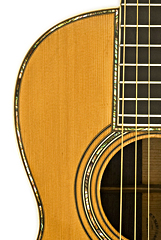
Border
Patrol
Chapter 59.
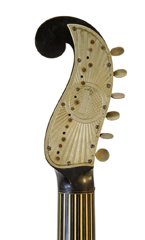
The Head of the Class
Chapter 60.
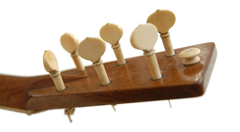
Tuner Sandwich
Chapter 61.
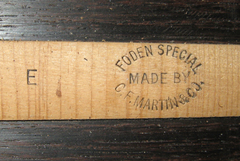
A
Stamp of Approval
Chapter 62.
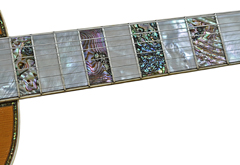
Pearl Jam
Chapter 63.
Arrowheads
and Other Hidden Treasures
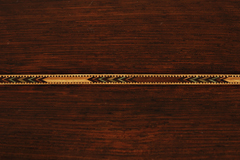
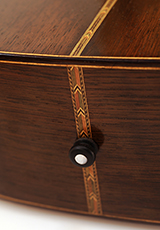
Chapter 64.
The End
Is Near
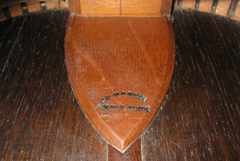
Chapter 65.
The
Spanish Foot
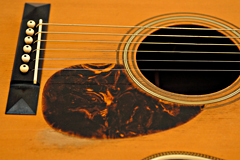
Chapter 66.
On
Guard!
Chapter 67.
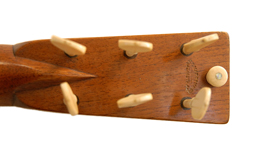
Speaking Volutes
Chapter 68.
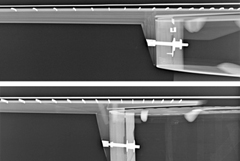
Feel Like a Heel
Chapter 69.
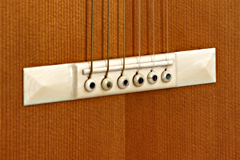
A Bridge to Somewhere
Chapter 70.
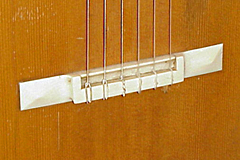
All Tied Up
Chapter 71.
Back in
the Saddle
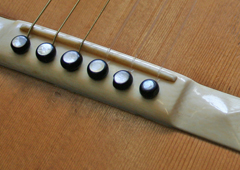
Chapter 72.
Hear a Pin
Drop
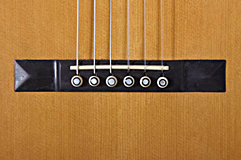
Chapter 73.
Nuts!!!
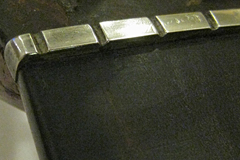
Chapter 74.
Something to Fret
About
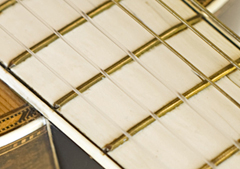
Chapter 75.
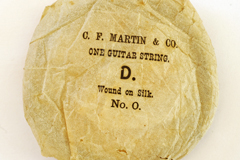
Strung
Out
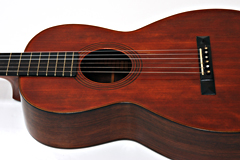
Chapter 76.
Photo Finish
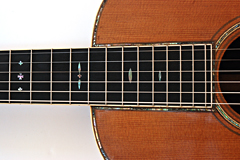
Chapter 77.
Knock on Wood
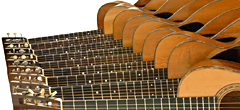
Chapter 78.
Does Size Matter?
Chapter 79.
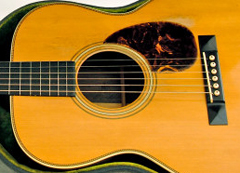
The Shape of Things to Come
Chapter 80.
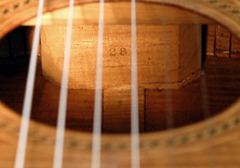
We've Got Your Number
Chapter 81.
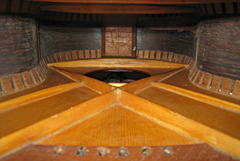
X Marks the Spot
Chapter 82.
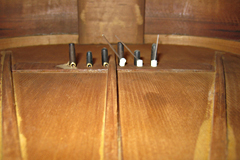
Your Biggest
Fan
Chapter 83.
Safe at
Home Plate
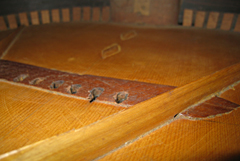
Chapter 84.
Case Closed
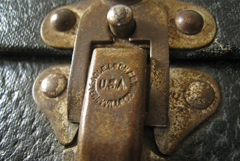
Chapter 85.
A
Final Nail in the Coffin
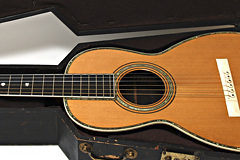
PART 4
LATER DEVELOPMENTS
Chapter 86.
Tune Up
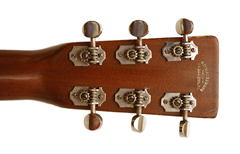
Chapter 87.
Hawaiian Punch
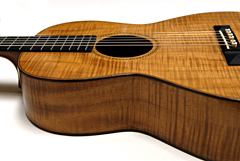
Chapter 88.
The Tenor of the Times
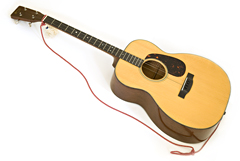
Chapter 89.
The Orchestra Model
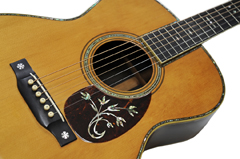
Chapter 90.
The Dreadnaught
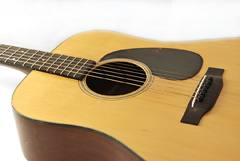
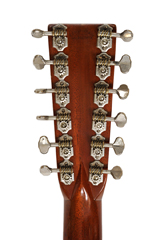
Chapter 91.
Double Your Fun
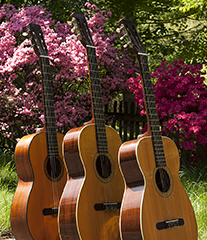
Chapter 92.
Classical Gas
' ' '
' ' ' ' ' ' ' '
' ' ' ' '
PART 5
MARTIN STYLES
As They've Been Defined Since the 1850's
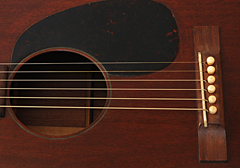
Chapter 93.
Styles 15, 17 & 18
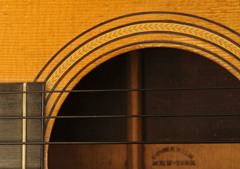
Chapter 94.
Styles 20, 21 & 22
Chapter 95.
Styles 23 & 24
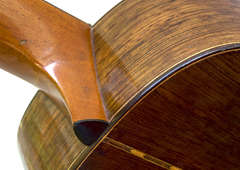
Chapter 96.
Styles 26 & 28
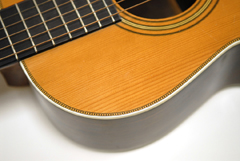
Chapter 97.
Styles 27, 30 & 34
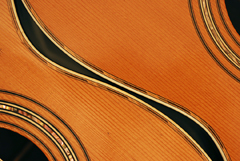
Chapter 98.
Style
35
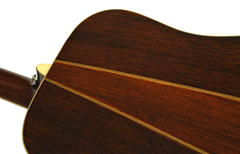
Chapter 99.
Styles 40 & 42
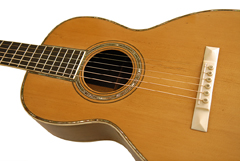
Chapter 100.
Style 45
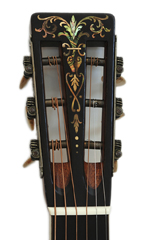
Chapter 101.
Style 45 DeLuxe
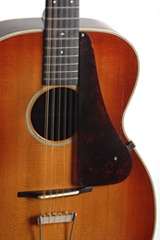
Chapter 102.
Martin Archtop Guitars
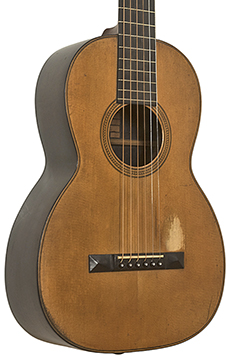
Chapter 103.
Martin Terz Guitars
Chapter 104.
Martin Mandolins
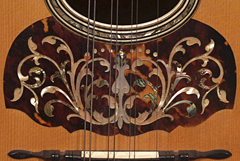
Chapter 105.
Tiples
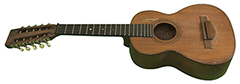
Chapter 106.
Tarropatch
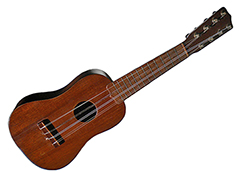
Chapter 107.
Harp Guitars
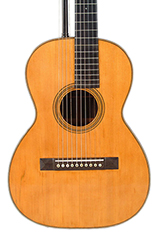
Chapter 108.
Martin Tenor Banjos
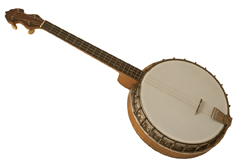
Chapter 109.
7 String Hawaiians
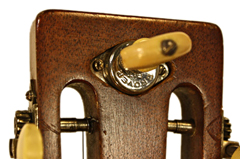
' ' '
' ' ' ' ' ' ' '
' ' ' ' '
PART 6
MARTIN
GUITARS MADE FOR OTHER FIRMS
Chapter 110.
Bacon
Banjo Company 0-21
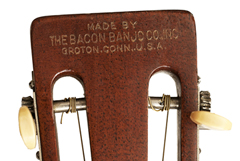
Chapter 111.
Buegeleisen & Jacobson S.S. Stewart 2-17 Special
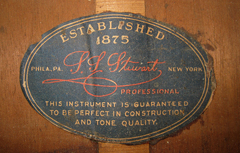
Chapter 112.
Oliver Ditson Company's "Own"
Style Guitars
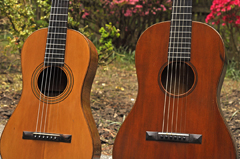
Chapter 113.
Carl Fischer Model Special
Tenor
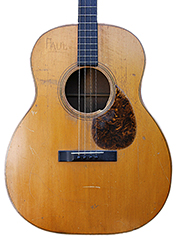
Chapter 114.
William Foden "Foden Special" Models
C, D, and E
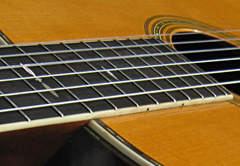
Chapter 115.
C.H.
Gaskin's Harp Mandolin
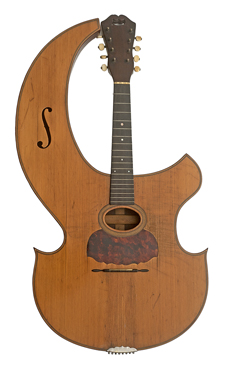
Chapter 116.
Grinnell
Brothers "Wolverine" 2-17 and 0-18
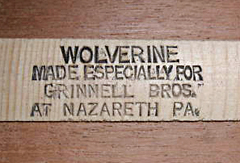
Chapter 117.
Wm. L. Lange Paramount
Style L Six String and Tenor Resonator Guitars
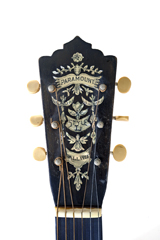
Chapter 118.
Montgomery Wards 0-17S
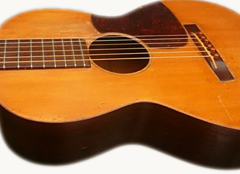
Chapter 119.
Vadah
Olcott-Bickford Style 44 "Soloist" and 1-44 "Artist" Guitars
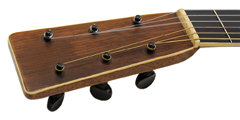
Chapter 120
Perlburg
& Halpin "Beltone" 2-17
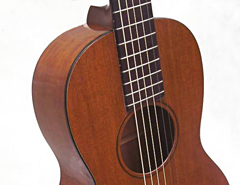
Chapter 121.
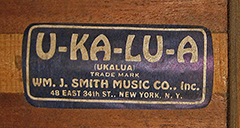
Chapter
122.
Southern
California Music Company "Nunes"
and "Rolando" Samples and
Style 1350
& 1400 1500 Guitars
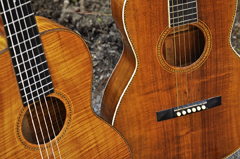
Chapter 123.
Rudolph Wurlitzer Styles
2087, 2088, and 2092
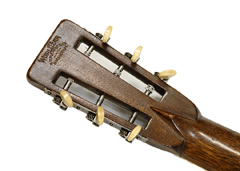
Chapter 124.
E.U Wurlitzer D-28SW
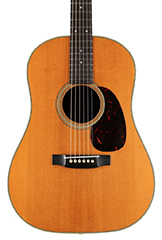
Chapter 125.
Bitting Special Mandolin
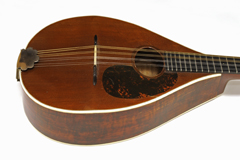
Chapter 126.
Briggs Special Mandolin
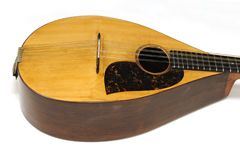
Chapter 127.
Ditson Company Mandolins
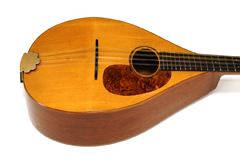
Chapter 128.
Ditson Standard
and Dreadnaught Style Ukuleles
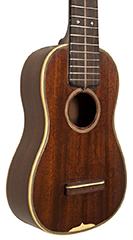
Chapter 129.
Martin
Zither for P. H. Louis Brachet
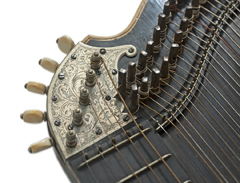
' ' '
' ' ' ' ' ' ' '
' ' ' ' '
PART 7
CHECKING OUT THE COMPETITION
Chapter 130.
James Ashborn Styles 1, 2, and 6
for William Hall & Son and Firth, Pond & Co.
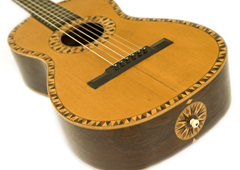
Chapter 131.
Joseph
Bohmann Early Presentation and Harp Guitars, and Guitar and
Mandolin with Interior Drone Strings
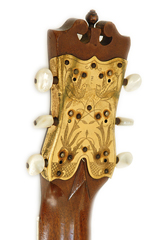
Chapter 132.
Dyer
Harp Guitars
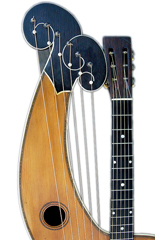
Chapter 133.
Orville Gibson
Guitars and Mandolins
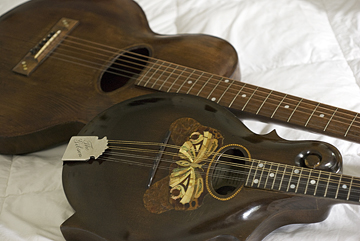
Chapter 134.
The Gibson Company
Instruments
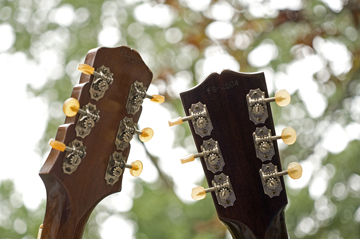
Chapter 135.
The Larson Brothers
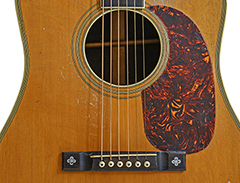
Chapter 136.
Louis
Panormo
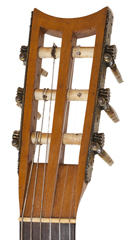
Chapter 137.
Jose
Recio, Cadiz
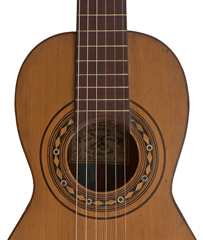
Chapter 138.
Rickenbacher,
Gibson, and Other Early Electrics
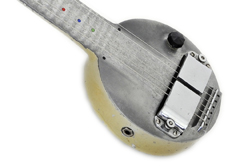
Chapter139.
Schmidt
& Maul Guitars with fan and Experimental X Bracing
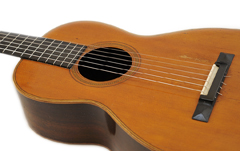
Chapter140.
Albert Shutt Style Introduces F holes to Guitars
and Mandolins
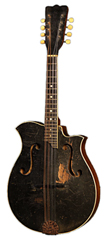
Chapter141.
Johann Stauffer of Vienna
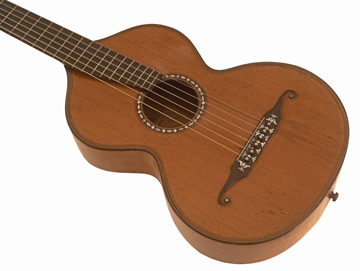
Chapter 142.
Tilton's Improvement
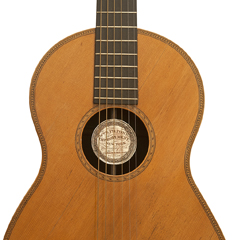
PART 8
CLEANING
HOUSE
If you would like to buy a
nice Martin or Gibson Guitar...
I love these, but I really need to make room for new ones.
Acoustic
Instruments for Sale
Electric
Instruments for Sale
I am not in the business of
buying and selling guitars, but am interested in purchasing
specific unique instruments to round out my collection to
present you with a web site with as complete a picture as
possible to help you learn. I am interested in
substantially original examples made from the 1800's to
1960's by Stauffer, Schmidt & Maul, C. F. Martin,
Martin & Coupa, Martin & Schatz, Martin & Bruno,
Martin & Zoebisch, John Coupa, Oliver Ditson, Southern
California Music, John Wanamaker, Wm. J. Smith, Wurlitzer, S.S.
Stewart, Orville Gibson, the Gibson Company, and the Larson
brothers. I am not hunting for bargains, but seeking
quality intstruments at a price that is fair to the buyer and
seller alike.
To see Robert's web site illustrating the development of the
Orville Gibson and Gibson Company Guitars:
oldgibson.com
To See Robert Corwin's Classic Photography of Folk and
Roots Musicians, visit:
robertcorwin.com
For
Information on Photography for
Exhibition,
Publication, CD's, Promotion, Web Pages, Tour Books,
to
Purchase Photographic Prints,
or
to Contact Robert With Questions:
e-mail:
Robert Corwin
* * *
"perfecting the art of 'guitar porn' ...
This site is an amazing labor-of-love, quite possibly the
most in-depth, photo-intensive look ever at old, pre-war
(and in many cases antique) Martin guitars … All online and
for free."
--Jason Verlinde
The Fretboard
Journal
"The internet is another good source of reference. One
website with good close up photos of vintage instruments...
that I particularly like is vintagemartin.com. It is
possible to extrapolate measurements from some of these
photos if you already know the dimensions of other details
in the photo. That type of thing can be very
useful..."
Guild of American Luthiers, 2011 Convention Keynote Lecture
by Joe Konkoly, Head of repair at Elderly Instruments.
I'm more than happy to
answer questions from luthiers restoring vintage Martins or
building new instruments to the best of my ability.
"Without any hesitation I can say that in my opinion, the
website that Robert has created is the most valuable source
of information on Early Martin Guitars in existence today,
in or out of print."
Bill Cappell, Early Martin Researcher
Robert's photographs can also be seen in the books "Martin
Guitars, a History" and "Martin Guitars, a Technical
Reference" by Johnston, Boak & Longworth
` ` ` ` ` ` `
` ` ` ` `
~
Click on the headstock image below and download a hi-res
file to create a high quality 11" x 14" photographic
print, suitable for framing, free for your personal use as
my gift to you! ~
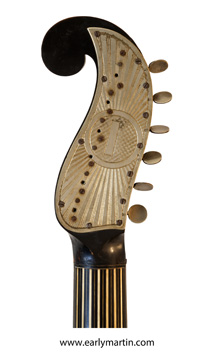
` ` ` ` ` ` `
` ` ` ` `
The Vintage Martin web page was first created in September,
2009.
Photographs and written material on this
site may not be reproduced without permission.
©1998-2026/Robert Corwin/Photo-Arts.
All rights reserved.